
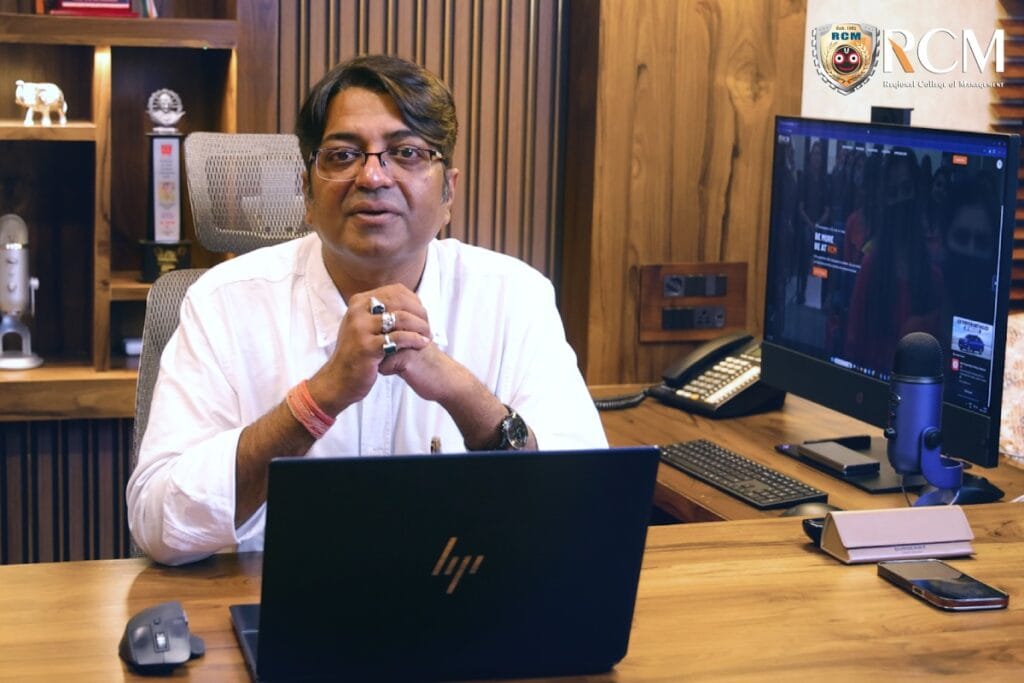
In the evolving narrative of Odisha’s educational landscape, few institutions have demonstrated the ability to balance legacy with innovation as effectively as the Regional College of Management (RCM), Bhubaneswar. And at the center of this transformation stands a leader whose vision is both contemporary and courageous—Dr. Pritam Pal.
A Legacy Rooted in Firsts
Established in 1982, RCM was not merely another academic institution—it was a pioneering force. As Odisha’s first dedicated management college, it laid the foundation for professional education in Eastern India at a time when such structured learning ecosystems were still nascent. Over the past four decades, RCM has quietly but consistently built a reputation that blends academic rigor with industry relevance.
Recognized under UGC Sections 2(f) and 12(B), approved by AICTE, and accredited by NBA, the institution carries the weight of credibility. Its affiliation with Biju Patnaik University of Technology (BPUT) further anchors it within a robust academic framework. Yet, what truly defines RCM is not just recognition—it is continuity. With over 10,000 alumni spread across industries and geographies, the institution represents a living legacy of leadership, adaptability, and growth.
Its guiding philosophy—“Passion for Innovative Education”—is not a slogan etched on walls but a principle embedded in practice. From its early years to its present stature, RCM has evolved into a dynamic hub where management, technology, and life skills converge seamlessly.
Leadership in a Time of Disruption
When Dr. Pritam Pal took charge as Director in 2020, the world was grappling with an unprecedented crisis. The COVID-19 pandemic had disrupted traditional education systems, forcing institutions into reactive modes. But where many saw uncertainty, Pal saw opportunity.
A serial entrepreneur, enterprise consultant, and Product R&D specialist, Dr. Pal brought with him a mindset shaped outside conventional academia. His leadership philosophy is simple yet profound: education must evolve, or it risks irrelevance.
Under his stewardship, RCM did not merely adapt—it reinvented itself.
Programs in Fintech, Data Science, Artificial Intelligence, and Cybersecurity were not just introduced but strategically embedded into the curriculum. This was not an exercise in trend-following; it was a deliberate move to align education with the emerging contours of global industry.
As Group Director of RCM Group of Institutions and CEO of SWASH Group of Companies, Pal operates at the intersection of academia and enterprise. This dual perspective has enabled him to bridge a gap that has long plagued Indian education—the disconnect between classroom learning and real-world application.
Redefining Academic Excellence
The results of this transformation are both visible and measurable. In the 2025 GHRDC B-School Survey, RCM secured the 15th position among India’s leading B-schools and ranked 2nd among private institutions in Odisha. These rankings are not accidental—they are outcomes of a deliberate strategy focused on relevance, rigor, and results.
RCM’s flagship PGDM+ and MBA programs reflect this shift. By integrating AI labs, corporate mentorship, and live industry projects, the institution ensures that learning extends beyond textbooks. Students are not just taught concepts—they are trained to apply them.
The emphasis on skill-based learning over mere credential acquisition is particularly noteworthy. In a country where degrees often overshadow capabilities, RCM’s approach marks a critical departure. Acceptance of exams like XAT 2026 further underscores its commitment to identifying potential rather than just performance.
Placement, often the ultimate benchmark for management institutions, has also seen significant strengthening. With structured industry tie-ups and 100% placement assistance, RCM is not just preparing students for jobs—it is preparing them for careers.
The “PLUS” Philosophy: Beyond Conventional Education
What truly differentiates RCM in a crowded educational marketplace is its “PLUS” model—an integrated approach that combines degrees with skills, exposure, and experience.
While many institutions remain anchored in traditional pedagogies, RCM has moved decisively toward experiential learning. AI-driven labs, edtech collaborations, and real-time project engagements ensure that students are constantly interacting with evolving technologies and business models.
But the transformation is not limited to academics alone.
RCM places equal emphasis on communication, leadership, and personality development. Through vibrant campus life, entrepreneurship cells, and collaborative platforms, students are encouraged to think, create, and lead. The outcome is a graduate who is not just employable but adaptable—an increasingly critical trait in today’s volatile business environment.
A Leader Shaping an Institution—and a Region
Dr. Pritam Pal’s impact on RCM can best be described as transformational rather than incremental. Since 2020, the institution has undergone what can only be termed a “sea change.” Curricula have been reimagined, industry linkages strengthened, and a culture of innovation institutionalized.
His presence at forums such as the 2025 ArdorComm Education Leadership Summit is a testament to his growing influence in the education sector. More importantly, it reflects the rising stature of Odisha as a serious contributor to India’s knowledge economy.
Rooted in Bhubaneswar, Pal brings a unique blend of local understanding and global perspective. Much like the ancient seat of learning at Puspagiri once symbolized intellectual excellence in the region, RCM under his leadership is emerging as a modern-day beacon of progressive education.
The Road Ahead
As India navigates the implementation of the National Education Policy (NEP) and transitions toward a more flexible, multidisciplinary learning ecosystem, institutions like RCM are poised to lead rather than follow.
The roadmap under Dr. Pal’s leadership is clear—deeper integration of artificial intelligence, expansion of digital infrastructure, and a sustained focus on 21st-century skills. Equally important is the emphasis on lifelong learning, ensuring that education does not end with a degree but continues as a continuous journey.
The ambition is not merely to remain relevant but to set benchmarks—to consistently feature among India’s top 15 B-schools and to emerge as a model for future-ready education in Eastern India.
A Concluding Reflection
In a time when higher education institutions often struggle to keep pace with change, RCM stands out as a case study in purposeful evolution. Its journey from Odisha’s first management college to a nationally recognized B-school is a story of vision, resilience, and reinvention.
And at its helm, Dr. Pritam Pal exemplifies a new breed of academic leadership—one that is not confined to administration but extends into innovation, entrepreneurship, and societal impact.
For Odisha, and indeed for India, such leadership is not just desirable—it is essential.
Because the future of education will not be defined by those who preserve the past, but by those who have the courage to redesign it.
