
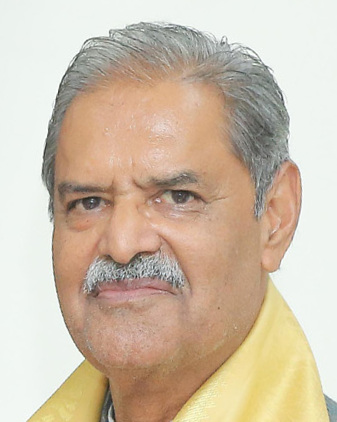
 FEATURE: In the evolving political landscape of Odisha, one name stands out, blending royal lineage with modern political acumen: Kanak Vardhan Singh Deo. Scion of the erstwhile Patnagarh princely state, Singh Deo represents a fascinating convergence of aristocratic heritage and political resilience. His ascension to the position of Deputy Chief Minister in June 2024 marks a significant shift in Odisha’s political narrative, marking the end of the long-standing dominance of the Biju Janata Dal (BJD) and ushering in a new era under the Bharatiya Janata Party (BJP).
Born on June 14, 1956, in Bolangir, Odisha, Singh Deo’s political journey is deeply intertwined with the changing political dynamics of the state. A direct descendant of the influential Singh Deo family, his lineage has played a vital role in shaping his worldview. His father, Raj Raj Singh Deo, served as the Member of Parliament for Bolangir, and his grandfather, Rajendra Narayan Singh Deo, was a former Chief Minister of Odisha. The legacy of these influential figures has provided Singh Deo with a solid foundation in governance and public service, as well as a perspective on the delicate balance between traditional power and modern democratic politics.
Despite his royal background, Singh Deo’s early education was marked by modesty and a desire to connect with the broader Indian experience. He completed his Bachelor’s degree in Arts from Delhi University, an educational path that speaks to his inclination to bridge the gap between aristocracy and the common man. While his academic journey was not marked by extraordinary achievements, it did reflect his aspiration to engage with the socio-political realities of India beyond the confines of his privileged upbringing.
Singh Deo’s political career began in 1995 when he first contested and won a seat in the Odisha Legislative Assembly from the Patnagarh constituency. His initial foray into politics was not just a nod to his family legacy but a statement of his own political acumen and determination. Representing the Patnagarh constituency, he was able to forge a strong connection with his constituents, a relationship that would prove essential throughout his career. Over the next two decades, Singh Deo secured five consecutive victories from the same constituency, which speaks volumes about his political resilience and his ability to remain connected to the people, despite the shifting political dynamics.
His political career was further cemented when he took on various ministerial portfolios in the Naveen Patnaik-led government. From 2000 to 2004, he served as the Cabinet Minister for Industry and Public Enterprise, and from 2004 to 2009, he held the Urban Development and Public Enterprise portfolios. These roles equipped Singh Deo with valuable experience in governance, economic planning, and policy-making. They also placed him at the center of some of Odisha’s key infrastructural and developmental projects, enabling him to navigate the intricacies of governance while balancing regional concerns with state-level aspirations. His tenure during this period was marked by pragmatism and a keen understanding of the state’s political landscape, which would later prove valuable in his political comeback.
One of the most intriguing chapters in Singh Deo’s career was his involvement in the BJD-BJP coalition government in Odisha, which lasted until 2009. This partnership, while productive for a time, eventually crumbled, leading to a significant shift in Odisha’s political alignment. The breakdown of the BJD-BJP alliance in 2009 marked a turning point for Singh Deo. It was not just the end of a political partnership; it also set the stage for a series of personal and political challenges that would test his resilience and adaptability.
In the 2019 elections, Singh Deo faced a major setback when he lost his seat to the BJD’s Saroj Kumar Meher by a margin of over 11,000 votes. This defeat, after five consecutive terms, could have spelled the end of his political career. However, Singh Deo viewed it as an opportunity for reinvention rather than a career-ending blow. The loss sparked a period of introspection, during which he recalibrated his political strategies and built new alliances, preparing for his eventual return to power.
That return came in 2024, albeit by a narrow margin. Singh Deo’s victory in the Patnagarh constituency in the 2024 elections was a dramatic comeback, with the BJP’s rise in Odisha playing a key role in reshaping the political landscape. His win, with a slim margin of just 1,357 votes, was not just a personal victory but a symbolic one, representing the changing political winds in the state. The BJP’s success in Odisha, where it had long been an outsider, marked a decisive shift in power dynamics, and Singh Deo’s return was seen as the party’s way of consolidating its base in the region.
In June 2024, the BJP formed its government in Odisha, and Singh Deo was appointed as one of the two Deputy Chief Ministers, a role that would see him take on significant responsibilities in key sectors such as agriculture, farmer’s empowerment, and energy. His appointment alongside Pravati Parida under Chief Minister Mohan Charan Majhi was part of the BJP’s strategy to balance regional representation and caste dynamics, which were crucial for consolidating its influence across the state.
As Deputy Chief Minister, Singh Deo’s focus has been on revitalizing Odisha’s agricultural sector, a task that is both complex and urgent. With the growing disinterest among younger generations in agriculture, Singh Deo is looking to make farming more remunerative and attractive, not just through policy changes but by integrating technology into farming practices. His push for schemes like the Samruddha Krushak Yojana and digital crop surveys shows his commitment to modernizing agriculture and making it a key pillar of Odisha’s future.
In addition to agriculture, Singh Deo is tasked with overseeing the energy sector, an area crucial to the state’s economic growth. Ensuring a reliable and affordable power supply is critical for both industrial growth and rural development, and Singh Deo’s performance in this area will be a defining aspect of his tenure. His leadership here could have far-reaching implications for Odisha’s economic trajectory, particularly as the state seeks to attract more industrial investment while ensuring that energy access reaches every corner of the state.
Singh Deo’s growing national profile is underscored by his appointment to the GST Council as Odisha’s representative. This national role places him at the heart of discussions about fiscal policies, which will undoubtedly benefit Odisha as the state looks to enhance its financial standing in the country.
In his personal life, Singh Deo is married to Sangeeta Kumari Singh Deo, a former Member of Parliament, and their daughter, Nivritti Kumari, is married into the royal family of Mewar, further strengthening their ties to India’s aristocracy.
As Deputy Chief Minister, he is positioned to influence the state’s future trajectory, particularly in agriculture and energy, both of which are pivotal for Odisha’s growth. His ability to navigate the complex socio-political landscape of Odisha while balancing his aristocratic legacy with the demands of contemporary governance will be key to his success. With the weight of history behind him and the hopes of the state resting on his shoulders, Singh Deo’s journey is one to watch closely as Odisha enters a new political chapter under BJP leadership.
