
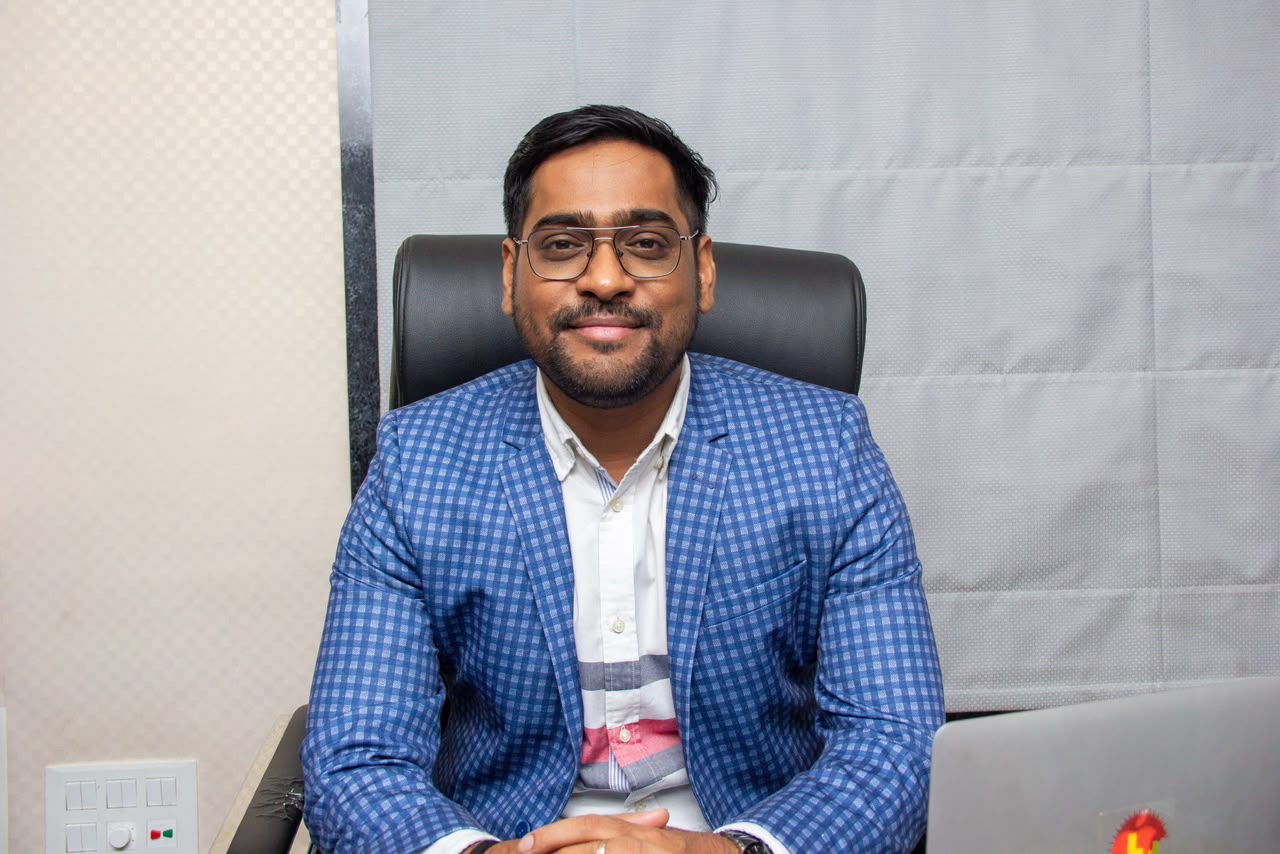
From the world of Information Technology to the dynamic landscape of real estate, Satyajit Biswal represents a new generation of entrepreneurs who believe that the real foundation of a business is not concrete and steel, but credibility, commitment and customer confidence.
A home is more than a property. It is an aspiration, an emotional investment and, for many families, the biggest financial decision of their lives. In an industry where promises are often made and expectations run high, building trust becomes the ultimate differentiator.
For Satyajit Biswal of Mason Estate, this belief is not merely a business philosophy; it is the principle guiding his entrepreneurial journey.
Managing one of Bhubaneswar’s established real estate firms, Biswal brings a distinctive combination of technological understanding, professional discipline and family-business values to an industry undergoing rapid transformation.
A LEGACY THAT BECAME A PURPOSE
Every entrepreneurial journey has a defining moment. For Satyajit Biswal, it was the decision to embrace the business built by his father.
His father moved from a Central Government job into the real estate sector, gradually establishing a business founded on commitment, customer relationships and timely delivery. Biswal, meanwhile, had pursued a different professional path.
An engineering graduate in Computer Science from KIIT University, he entered the IT and services industry, where he developed considerable technical expertise.
He had even imagined establishing his own IT venture. However, his interactions with customers and his growing understanding of his father’s business gradually changed his perspective.
What impressed him was not simply the scale of the business, but the credibility his father had earned over the years. Customers trusted him because commitments mattered and relationships extended beyond transactions.
Biswal realised that he was not merely inheriting a business. He was accepting the responsibility of carrying forward a legacy while preparing it for a new generation.
THE IT MINDSET MEETS REAL ESTATE
Before entering real estate, Biswal had built his professional credentials in the technology sector. An experienced Information Technology Analyst, he worked across multiple technologies, including Android, Java, PHP, Python, Ionic and Cordova, along with database systems.
He was also instrumental in the development and management of the TCS HackQuest programme.
This exposure to technology, structured processes and problem-solving shaped his approach to business.
When he entered real estate, he noticed an important gap in the industry: the need for greater transparency, systematic documentation and clearer communication with customers.
He wanted Mason Estate to become a more transparent and professionally organised player.
His approach was straightforward: maintain clear records, document commitments, communicate openly and ensure that customers understand what they are investing in.
«”What we commit, we aim to deliver—especially when it comes to timelines and transparency.”»
It is a simple statement, but one that captures the philosophy he wants Mason Estate to represent.
WHY MASON? A NAME WITH A MEANING
Even the name Mason Estate carries an interesting story.
Influenced partly by his father’s interest in numerology, the company adopted a name beginning with the letter ‘M’. But the word Mason also represents something fundamental to construction.
A mason is the person who lays the foundation, brick by brick, with patience and precision.
For Biswal, that symbolism resonates with the company’s identity. Just as a mason builds a structure through skill and dedication, a real estate enterprise must build its reputation through consistency and trust.
GROWTH WITH A VISION
Mason Estate’s journey has evolved beyond its initial focus on group housing, duplexes and low-rise developments.
The company has gradually expanded into commercial development and hotel infrastructure while exploring opportunities in high-rise projects.
Among the developments Biswal discusses are Urban Suites at Akpatia and a commercial building leased to a bank, whose infrastructure and facilities have received positive feedback.
The company’s future possibilities include group housing, plotted developments, apartments and a resort-style hotel project, for which land acquisition is underway.
However, Biswal believes in measured expansion rather than aggressive growth.
For him, the objective is not simply to increase the project portfolio, but to create developments that respond to genuine market requirements.
THE CUSTOMER IS NOT JUST A BUYER
Perhaps the most defining aspect of Biswal’s business philosophy is his understanding of the customer relationship.
In real estate, the relationship should not end when a booking is completed. It should continue through construction, possession and beyond.
Mason Estate attempts to accommodate reasonable layout modifications, subject to feasibility, and encourages customers to remain engaged throughout the process.
Biswal is particularly conscious of the financial pressures faced by homebuyers, many of whom manage house rent alongside home-loan EMIs.
His approach is therefore to understand a family’s budget before recommending a property. If a customer is stretching financially to purchase a larger apartment, he may suggest a more affordable option, leaving room for an upgrade in the future.
He also encourages buyers to compare properties, examine documentation and understand the market before making a decision.
For him, a satisfied customer is more valuable than a hurried transaction.
TRANSPARENCY BEFORE TRANSACTION
One of the most significant challenges in real estate is the gap between what is promised and what is eventually delivered.
Biswal believes that this gap can be reduced through transparent processes.
Customers can examine ownership documents, approvals and payment schedules at the company’s office. The agreed price is reflected in the agreement, without hidden costs.
He also emphasises accessibility. He does not believe in avoiding difficult conversations or customer complaints.
Employees are encouraged to listen, explain the situation and resolve issues as quickly as possible. Even when disputes become complicated, the objective is to find a solution that works for both parties.
This emphasis on accountability reflects his desire to make the homebuying experience more structured and dependable.
A LEADER WHO BELIEVES IN THE GROUND REALITY
Biswal’s leadership philosophy is deeply influenced by his father.
His day generally begins at project sites, with office work and meetings following in the second half.
One lesson from his father continues to guide him: an impressive office may create an image, but the real work happens on the ground.
He also recognises that an organisation’s strength lies in its people.
Some employees have been associated with the business for more than two decades. Their experience and institutional knowledge are invaluable, while younger colleagues bring familiarity with automation, AI and digital tools.
Rather than viewing these generations as competitors, Biswal believes their strengths complement each other.
It is a leadership approach that respects experience while remaining open to innovation.
THE NEW HOME, THE NEW BUYER
The pandemic changed how people perceive their homes.
A home is no longer just a place to return to after work. It has increasingly become an office, a study space and an environment for multiple dimensions of family life.
Biswal has observed growing interest in 2BHK-plus-study and 3BHK-plus-study configurations.
At the same time, rising land prices and construction costs have made affordability an important consideration.
He believes developers must strike a balance between quality, functionality and pricing.
Looking beyond Bhubaneswar, he is optimistic about the growth potential of Puri and Cuttack as well. Infrastructure development, including ring roads, canal-side development and road overbridges, will be important in shaping the region’s real estate landscape.
He also sees considerable potential in technology-enabled governance. Faster approvals and NOCs through digital processes, while retaining essential scrutiny, could make the sector more efficient.
THE NEXT GENERATION OF REAL ESTATE
Biswal believes the real estate industry is opening its doors to a much wider range of professionals.
The sector is no longer limited to conventional sales and construction. Opportunities now extend to construction technology, new building techniques, legal services, advocacy, artificial intelligence and information technology.
Younger professionals are already contributing to CRM and pre-sales operations. Gen Z employees are comfortable with digital platforms and AI-assisted tools, while experienced professionals bring practical knowledge and industry understanding.
He believes the future belongs to organisations that can combine both.
His message to corporate professionals considering a transition into real estate is simple: identify your area of interest, develop the required skills and approach the sector with genuine commitment.
THE PROJECT THAT MADE IT PERSONAL
For every entrepreneur, there is often one project that remains especially close to the heart.
For Biswal, that project is Mason Luxuria.
It was the first project he managed after joining the family business. His father entrusted him with the responsibility, and the experience became a defining test of his ability to take ownership.
Many of the buyers were older than him, making the responsibility even more significant.
The project eventually received its Occupancy Certificates, customers expressed satisfaction and the team earned positive reviews.
More than a completed development, Mason Luxuria became a milestone in his transition from the corporate world into the family enterprise.
It gave him something that no professional designation could offer: the confidence of having delivered a project and earned the trust of its customers.
