
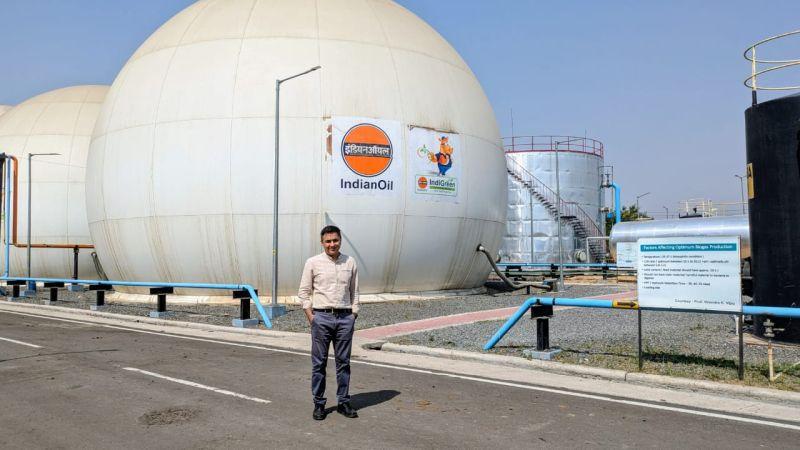
With a proposed combined capacity of 39,600 tonnes per annum and employment potential of 760, IndianOil’s multi-district CBG investment puts biofuel at the centre of Odisha’s latest industrial expansion.
Bhubaneswar: Odisha’s transition towards a more diversified and sustainability-oriented industrial economy has received a significant boost, with Indian Oil Corporation Limited (IndianOil/IOCL) proposing an investment of ₹960 crore to establish compressed biogas (CBG) manufacturing facilities across eight districts of the state. Business Standard
The proposed facilities will have a combined annual capacity of 39,600 tonnes and are expected to generate around 760 employment opportunities. The investment is among the largest individual proposals cleared at the 150th meeting of Odisha’s State Level Single Window Clearance Authority (SLSWCA), chaired by Chief Secretary Anu Garg. Business Standard
Eight Odisha Districts in IndianOil’s Green-Energy Map
Unlike a conventional industrial investment concentrated at a single location, IndianOil’s proposed CBG network will extend across Balasore, Balangir, Bargarh, Ganjam, Kalahandi, Keonjhar, Mayurbhanj and Sonepur/Subarnapur. The New Indian Express
That geographical spread is one of the most significant aspects of the proposal. It takes green-energy investment beyond Odisha’s established industrial centres and distributes proposed capacity across western, southern and northern parts of the state.
IndianOil Odisha CBG Project — At a Glance
Investment: ₹960 crore
Combined capacity: 39,600 tonnes per annum
Districts covered: 8
Employment potential: 760
Sector: Compressed Biogas / Biofuel
Company: Indian Oil Corporation Limited Business Standard
Why Compressed Biogas Matters
Compressed biogas is produced by processing biodegradable feedstocks such as agricultural residue, animal waste and other organic material. After purification and compression, the resulting gas can be used as a fuel.
For an agriculture-rich state such as Odisha, expansion of CBG infrastructure has the potential to create economic activity extending beyond the plant itself. Feedstock aggregation, transportation, storage and associated services can contribute to local supply chains if the projects move from approval into implementation.
This is what makes the IndianOil proposal particularly noteworthy: it sits at the intersection of energy, agriculture, waste utilisation, rural supply chains and industrial investment.
Biofuel Emerges as a Major Part of Odisha’s Latest Investment Round
IndianOil is not the only company investing in the segment.
The SLSWCA has also cleared a proposal from Kineta Global Limited to establish an 8,250-tonne-per-annum compressed-biogas facility in Ganjam, involving an investment of ₹170 crore and potential employment for around 170 people. Business Standard
Together, the IndianOil and Kineta Global proposals represent approximately ₹1,130 crore of proposed investment in compressed biogas, underlining the prominence of biofuel within this round of approvals. Business Standard
For Odisha, traditionally associated with mineral resources, metals and heavy industry, such investments also illustrate the widening composition of the state’s industrial pipeline.
Part of a ₹3,280-Crore Investment Push
IndianOil’s ₹960-crore proposal forms part of a much broader set of investments approved by the Odisha government.
At its 150th meeting, the SLSWCA cleared 19 investment proposals collectively valued at ₹3,280.58 crore, with the potential to create 10,661 jobs. Business Standard
The projects span a notably diverse group of sectors, including biofuels, technical textiles, textiles and apparel, food processing, downstream steel, chemicals, plastics, circular economy, tourism, information technology and Global Capability Centres. Business Standard
Among the other major proposals is a ₹401.63-crore project by Shri Dakshineshwari Maa Polyfabs Limited in Khordha, while Dollar Industries has proposed a ₹125-crore integrated hosiery manufacturing facility. Tata Power has also received clearance for a proposed Global Capability Centre in Khordha involving an investment of ₹54.31 crore. Business Standard
The scale and diversity of these proposals point towards a broader effort to expand Odisha’s investment story beyond its traditional strengths.
From Mineral Economy to a More Diversified Industrial Base
Odisha remains one of India’s most important mineral and metals hubs, with major investments in steel, aluminium, mining and associated industries.
The latest approvals, however, demonstrate an expanding industrial mix.
Biofuels are being accompanied by investments in technical textiles, hospitality, food processing, knowledge-based services, downstream manufacturing and circular-economy projects. The IndianOil proposal is particularly significant within that transition because it combines the scale of a major central PSU with a decentralised, multi-district green-energy model.
Chief Secretary Anu Garg said the state is encouraging investments that add value to local resources, strengthen supply chains and create sustainable economic opportunities. She also emphasised continued facilitation and coordinated clearances to help investors progress from proposals towards implementation. Business Standard
The Rural-Economy Dimension
The proposed geographical footprint also gives the IndianOil project a potentially important rural dimension.
Districts such as Balangir, Bargarh, Kalahandi, Keonjhar, Mayurbhanj and Subarnapur contain substantial agricultural and rural economies. A functioning CBG ecosystem can require organised networks for sourcing and transporting suitable organic feedstock.
That creates scope for economic activity beyond direct plant employment.
However, the extent of these wider benefits will depend on factors including the eventual feedstock model, plant locations, procurement arrangements and execution of the approved proposal. Those details have not all been publicly specified in the investment announcement.
IndianOil Adds Corporate Weight to Odisha’s Green Transition
IndianOil’s participation also gives the development considerable corporate significance.
As one of India’s largest state-owned energy companies, the company has a nationwide presence across refining, pipelines, petroleum marketing and a growing portfolio of emerging and lower-carbon energy businesses.
Its proposed ₹960-crore commitment therefore provides Odisha’s developing biofuel ecosystem with a major PSU anchor.
For the state, the significance lies not simply in attracting another industrial project, but in drawing investment into an area that could connect cleaner fuel production with regional economic activity and resource utilisation.
From Approval to Execution Will Be the Critical Next Step
The ₹960-crore figure is substantial, but it is important to distinguish an approved investment proposal from a completed investment.
The projects have received SLSWCA clearance; their eventual economic impact will depend on subsequent implementation, commissioning and operational scale.
That makes execution the next important milestone to watch.
If the proposed network progresses as planned, the eight-district model could become an important test of how large-scale biofuel investment can be distributed across Odisha rather than concentrated exclusively around established industrial clusters.
A New Chapter in Odisha’s Green Industrial Story
IndianOil’s proposed ₹960-crore investment, 39,600-TPA capacity, eight-district footprint and 760-job potential give the project both scale and visibility. The New Indian Express
More importantly, it reflects a changing dimension of Odisha’s industrial ambitions.
The state’s minerals and manufacturing strengths remain central to its economy, but investments in biofuels, circular economy, technology, tourism and value-added manufacturing are increasingly broadening the narrative.
For Odisha, IndianOil’s CBG proposal therefore represents more than another number in an investment approval list. If successfully implemented, it could become part of a wider transition in which green energy, regional supply chains and industrial diversification increasingly complement the state’s traditional economic strengths.
