
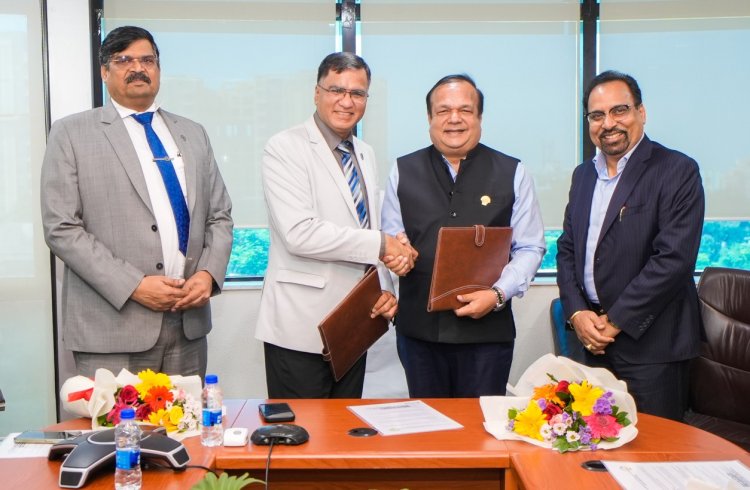
Non-binding MoU brings together coal gasification and fertiliser manufacturing as the two public-sector enterprises begin evaluating the technical and commercial viability of a new urea-production pathway in Jharkhand
By Snigdha Mishra | The Interview Times
India’s push to derive greater value from its domestic coal resources while strengthening fertiliser self-reliance has received a fresh corporate impetus, with Coal India Limited (CIL) and Hindustan Urvarak & Rasayan Limited (HURL) joining hands to explore coal-gasification-based urea production at Sindri in Jharkhand.
The two companies executed a non-binding Memorandum of Understanding (MoU) on September 29, 2026, opening the door to an assessment of whether coal gasification can support a commercially and technically viable urea-production project at the historic fertiliser hub of Sindri. Business Standard
The development is significant because it brings together two strategically important sectors—coal and fertilisers—at a time when India is seeking to utilise domestic resources more efficiently and reduce dependence on imported feedstocks.
From Coal to Fertiliser: What the MoU Proposes
Under the agreement, Coal India and HURL will initially examine the technical, commercial and implementation modalities of the proposed project. The companies will also facilitate preparation of a Preliminary Feasibility Report (PFR) to evaluate its viability. Business Standard
This distinction is important. The September 29 agreement does not yet represent a final investment decision or an approved new plant. Rather, it establishes a framework through which the two organisations can determine whether the proposed coal-to-urea route at Sindri is feasible and suitable for further development.
If the assessment supports the project and subsequent approvals and investment decisions follow, the initiative could add another dimension to Sindri’s role in India’s fertiliser ecosystem.
Why Coal Gasification Matters
Coal gasification differs fundamentally from conventional direct combustion of coal. The process converts coal into synthesis gas, or syngas, which can subsequently serve as a feedstock for several industrial products.
Syngas can be used for products including synthetic natural gas, methanol, ethanol and ammonia—the latter being a critical intermediate in fertiliser production. This makes coal gasification potentially relevant to India’s effort to convert domestic coal into higher-value chemical and industrial products rather than relying solely on its conventional use as a fuel. Business Standard
The Coal India–HURL proposal therefore sits at the intersection of resource utilisation, fertiliser manufacturing, industrial technology and import substitution.
Sindri Returns to the Industrial Spotlight
The location gives the proposed initiative additional significance.
Sindri has a long association with India’s fertiliser industry, and HURL’s existing Sindri unit represents the revival of that industrial legacy with modern manufacturing infrastructure.
According to HURL, its Sindri unit was commissioned on November 5, 2022, achieved commercial operation on April 15, 2023, and was dedicated to the nation on March 1, 2024. The existing facility has an ammonia capacity of 2,200 tonnes per day and urea capacity of 3,850 tonnes per day, corresponding to annual urea-production capacity of approximately 12.7 lakh tonnes. HURL
The new MoU should therefore be understood as an exploration of an additional coal-gasification-based production pathway at Sindri, rather than the announcement of HURL’s existing Sindri fertiliser plant.
HURL’s Expanding Fertiliser Footprint
HURL itself represents an important collaboration among some of India’s largest public-sector enterprises.
The company was incorporated in 2016 as a joint venture involving Coal India Limited, NTPC Limited and Indian Oil Corporation Limited as lead promoters, alongside Fertilizer Corporation of India Limited (FCIL) and Hindustan Fertilizer Corporation Limited (HFCL). HURL
Its three revived fertiliser facilities are located at Gorakhpur, Barauni and Sindri.
HURL currently reports combined production capacity of 38.1 lakh metric tonnes per year across its operations and says it achieved its highest-ever annual urea production of 38.9 lakh metric tonnes in FY2025-26. HURL
Those numbers underline why the latest partnership is strategically noteworthy: HURL brings large-scale fertiliser-production expertise, while Coal India brings India’s dominant domestic coal-production platform.
A Bigger National Coal-Gasification Push
The development also comes against the backdrop of a much larger policy push toward coal gasification.
India’s National Coal Gasification Mission has targeted 100 million tonnes of coal-gasification capacity by 2030. Business Standard
Earlier this year, the Union Cabinet also approved a ₹37,500-crore scheme for promotion of surface coal and lignite gasification projects. The programme is designed to encourage domestic coal conversion into products including syngas, methanol, ammonia and urea. Ministry of Coal
That policy context makes the CIL–HURL collaboration more than an isolated corporate agreement. It reflects the broader effort to establish alternative industrial uses for India’s coal resources while developing domestic supply chains for chemicals and fertilisers.
The Fertiliser-Security Dimension
For India, urea is not simply another industrial commodity. Its availability directly affects agricultural productivity and therefore carries implications for farmers, food production and rural economic activity.
The proposed pathway could become strategically relevant if domestic coal can be converted into syngas and subsequently used in fertiliser production at competitive economics and acceptable environmental performance.
Business Standard reported that the initiative comes amid efforts to reduce dependence on imported natural gas and other feedstocks used in fertiliser manufacturing. Business Standard
However, whether the proposed Sindri project ultimately delivers those advantages will depend on the findings of the feasibility exercise, project economics, technology selection, environmental considerations and subsequent approvals.
From MoU to Execution: The Crucial Next Stage
The immediate story, therefore, is not about the size of an announced investment or the capacity of a confirmed new plant. Neither has been formally established in the disclosed MoU.
The critical next milestone will be the Preliminary Feasibility Report.
That assessment is expected to examine whether the project makes technical and commercial sense and how it could potentially be implemented. Only after that evaluation and subsequent corporate and regulatory decisions would a clearer picture emerge regarding capacity, investment, timelines and execution.
This makes restraint particularly important when assessing the development: Coal India and HURL are exploring the opportunity; they have not yet committed to building the project. Business Standard
Coal, Chemicals and Agriculture Converge
Even at this preliminary stage, the partnership illustrates an interesting transformation in India’s industrial landscape.
Coal India is traditionally associated with supplying fuel to the country’s power and core industrial sectors. HURL is associated with rebuilding domestic fertiliser capacity and supplying farmers. Coal gasification creates a potential technological bridge between these two worlds.
If the Sindri proposal advances beyond feasibility, it could demonstrate how India’s coal resources can be integrated into a broader manufacturing value chain—from coal to syngas, from syngas to ammonia and ultimately to fertiliser.
For now, the September 29 MoU marks the beginning of that evaluation.
But with Coal India and HURL behind the initiative, Sindri once again finds itself at the centre of an important conversation about India’s industrial self-reliance, fertiliser security and the future role of coal beyond conventional combustion.
