
Rajnath Singh announces ₹553 crore in engine-capacity expansion at Sunabeda as HAL Koraput strengthens its role in India’s aerospace propulsion ecosystem
By – Snigdha Mishra
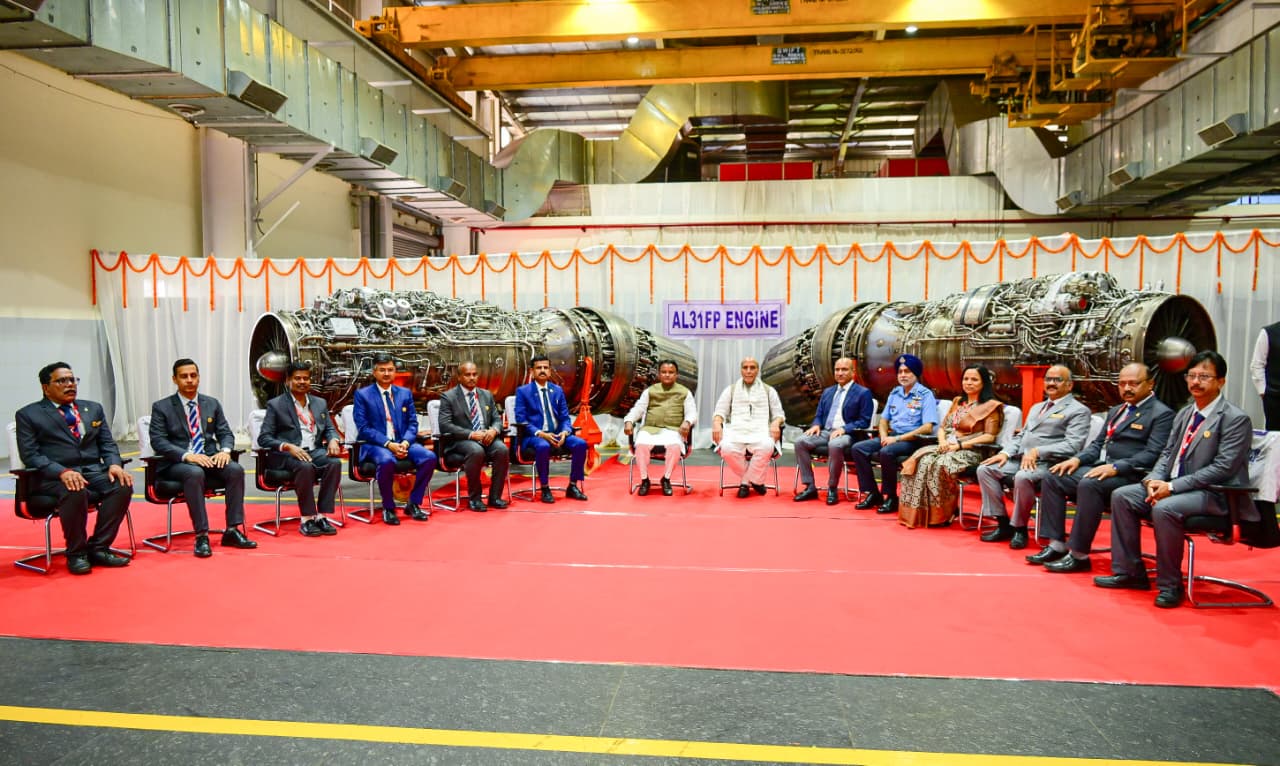
SUNABEDA, KORAPUT: Odisha marked a major milestone in India’s defence manufacturing journey on Monday as Hindustan Aeronautics Limited’s Koraput Division delivered its 2,000th aero-engine, completing nearly six decades of contribution to the country’s military aviation and aerospace propulsion capabilities.
Defence Minister Rajnath Singh witnessed the milestone at HAL Koraput on October 6 and announced a major expansion of the facility’s engine-manufacturing capabilities. The plans include ₹335 crore to increase AL-31FP engine production capacity and ₹218 crore for a second Shakti engine production line. Press Information Bureau
Together, the two projects represent ₹553 crore of announced capacity investment, strengthening Sunabeda’s position within India’s growing defence and aerospace manufacturing ecosystem.
2,000 Engines: Six Decades of Engineering Excellence
The delivery of the 2,000th aero-engine represents far more than a production number.
HAL’s Koraput Division was established in 1964, giving the facility more than six decades of engineering and technological experience. Over the years, engines associated with some of India’s frontline military aircraft—including the MiG-21, MiG-27, MiG-29 and Su-30MKI—have been supported through Koraput’s manufacturing and overhaul capabilities. Press Information Bureau
The scale of its maintenance contribution is equally striking.
According to the Ministry of Defence, HAL Koraput has overhauled more than 9,000 engines so far, contributing to aircraft availability, operational readiness and extension of the service life of critical defence assets. Press Information Bureau
For Odisha, the milestone demonstrates that one of India’s long-standing centres of advanced aerospace engineering operates from the hills of Koraput.
₹335 Crore Push for Su-30MKI Engine Capacity
One of the biggest announcements from the event concerns the AL-31FP, the engine that powers the Indian Air Force’s Su-30MKI fighter aircraft.
HAL will invest ₹335 crore to increase annual AL-31FP production capacity at Koraput from 30 engines to 50 engines. Press Information Bureau
The expansion is closely connected to the Government’s massive Su-30MKI engine procurement programme.
In 2024, the Ministry of Defence signed a contract with HAL for 240 AL-31FP aero-engines worth more than ₹26,000 crore. The engines are to be manufactured by HAL’s Koraput Division, making Odisha central to sustaining one of the Indian Air Force’s most strategically important fighter fleets. Press Information Bureau
There is already evidence of progress.
Despite global supply-chain and raw-material challenges, HAL delivered its first engine ahead of schedule. By the end of the second year, it had supplied 63 engines against a target of 60, according to the Defence Minister. Press Information Bureau
That puts HAL ahead of its targeted delivery trajectory.
₹218 Crore Second Shakti Engine Line
The second major announcement places Koraput deeper into India’s indigenous helicopter ecosystem.
A second production line for Shakti engines will be established with an investment of ₹218 crore. Once fully established, the new line will have the capacity to manufacture up to 100 engines annually. It is scheduled to become fully operational by 2028-29. Press Information Bureau
The engines will cater to indigenous helicopter platforms including the Dhruv Advanced Light Helicopter (ALH) and the Prachand Light Combat Helicopter (LCH).
That gives the Sunabeda facility a strategically important role across both fixed-wing combat aircraft and indigenous helicopter programmes.
From Su-30MKI to Prachand: Why Koraput Matters
An aero-engine is among the most technologically complex and strategically sensitive components of an aircraft.
Advanced airframes, radars, avionics and weapon systems cannot deliver their full capability without reliable propulsion. Rajnath Singh described the aero-engine as the “heart” of an aircraft and stressed the need for India to strengthen indigenous capabilities across engine design, development, testing, manufacturing and maintenance. Press Information Bureau
Koraput therefore represents much more than another HAL production location.
Its manufacturing and overhaul capabilities directly support India’s military aviation readiness.
On one side is the AL-31FP programme for the Su-30MKI. On the other is expanding Shakti-engine capacity for indigenous helicopters such as Dhruv and Prachand.
Together, these programmes place Odisha inside one of the most strategically significant areas of defence manufacturing—aircraft propulsion.
₹26,000 Crore Su-30MKI Programme Adds Scale
The numbers surrounding the Su-30MKI engine programme demonstrate the scale of opportunity ahead.
The Government-approved procurement covers 240 AL-31FP engines at a cost exceeding ₹26,000 crore. When the contract was signed, HAL was scheduled to supply 30 engines annually and complete the order over eight years. Press Information Bureau
The programme also carries a significant indigenisation component.
Average indigenous content is targeted at more than 54%, with HAL aiming to increase it to as much as 63% by the end of the delivery programme. Indian MSMEs, public-sector organisations and private companies are expected to participate in the broader manufacturing ecosystem. Press Information Bureau
Increasing Koraput’s annual capacity from 30 to 50 engines could further strengthen the facility’s ability to support future requirements.
A Bigger Vision: Turn Koraput Into a Propulsion Ecosystem
Perhaps the most important message from the event was that Koraput’s future should extend beyond being an engine production centre.
Rajnath Singh called upon HAL to develop the region into a broader aerospace propulsion ecosystem by nurturing suppliers, mentoring MSMEs, supporting start-ups and young engineers, collaborating with universities and research institutions, and developing indigenous capability for critical engine components. Press Information Bureau
This opens an important development angle for Odisha.
A large aerospace manufacturing ecosystem can create opportunities beyond a single PSU facility—from specialised suppliers and precision engineering companies to research institutions, skilled employment, technology start-ups and MSMEs.
For Koraput and southern Odisha, the potential economic impact could therefore extend beyond HAL’s factory gates.
Odisha’s Defence Manufacturing Ambitions Grow
The Defence Minister also highlighted Odisha’s broader potential in aerospace and defence manufacturing, pointing to its strategic location, coastline, ports, mineral resources, industrial infrastructure and skilled manpower.
He also referred to DRDO’s Integrated Test Range at Chandipur and the Odisha Government’s approval of an Aerospace and Defence Equipment Manufacturing Complex at Gajamara in Dhenkanal as foundations for a larger defence ecosystem in the state. Press Information Bureau
This presents an increasingly compelling industrial narrative.
Odisha has traditionally built its industrial identity around mining, steel, aluminium, power and ports. Aerospace, defence and advanced engineering now provide an opportunity to broaden that identity into higher-value manufacturing.
And Koraput already gives the state a six-decade head start.
The Numbers Behind the Milestone
For an infographic, these are the numbers I would highlight:
2,000 — Aero-engines delivered by HAL Koraput
9,000+ — Engines overhauled
₹335 crore — AL-31FP capacity expansion
30 → 50 — Planned annual AL-31FP production capacity
₹218 crore — Second Shakti engine production line
Up to 100/year — New Shakti-line capacity
240 engines — Su-30MKI AL-31FP procurement programme
₹26,000+ crore — Value of the Su-30MKI engine contract
63 vs 60 — Engines delivered against the second-year target Press Information Bureau
Sunabeda: Odisha’s Engine Room for India’s Defence Skies
The 2,000th aero-engine milestone is both a celebration of what HAL Koraput has achieved and an indication of what comes next.
Six decades of experience have established the foundation. The ₹335-crore AL-31FP expansion will strengthen fighter-engine manufacturing capacity. The ₹218-crore second Shakti line will deepen Koraput’s contribution to India’s indigenous helicopter programmes. And the ₹26,000-crore Su-30MKI engine order provides a substantial manufacturing pipeline. Press Information Bureau
The next opportunity is even bigger: transforming Koraput from an engine-manufacturing location into an integrated aerospace propulsion ecosystem involving HAL, MSMEs, start-ups, research institutions, suppliers and skilled local youth.
From the MiG era to the Su-30MKI, and from Dhruv to Prachand, Sunabeda has quietly helped power India’s military aviation story.
Today, the 2,000th engine makes that contribution impossible to overlook.
