
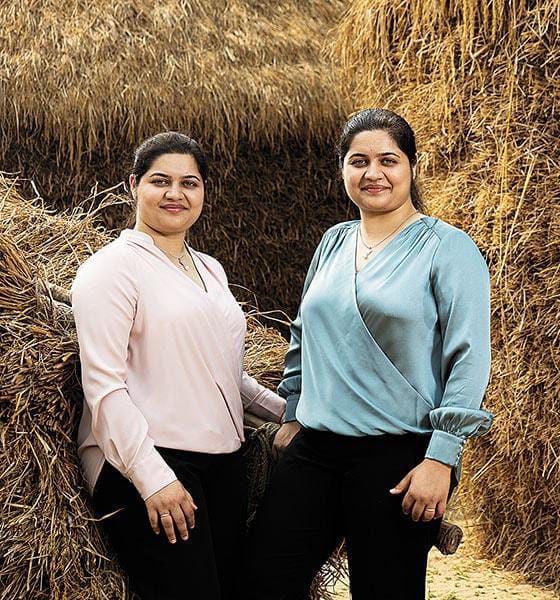
Two sisters, one remarkable vision: How Bhubaneswar-based Nexus Power is reimagining agricultural waste as a resource for India’s sustainable energy future.

By – Snigdha Mishra | The Interview Times
Bhubaneswar, October 22, 2026
In an era when the world is searching for cleaner energy solutions, two sisters from Odisha are challenging conventional thinking about waste, sustainability and innovation. For Nishita Baliarsingh and Nikita Baliarsingh, the co-founders of Bhubaneswar-based Nexus Power, agricultural waste represents more than an environmental challenge. It is a potential resource for developing the next generation of sustainable battery materials.
Their entrepreneurial journey reflects an increasingly important shift in India’s innovation landscape: the emergence of homegrown enterprises seeking to address global challenges through locally developed technologies.
At the intersection of clean energy, agricultural sustainability and advanced materials, Nexus Power represents a compelling example of how Odisha’s startup ecosystem can contribute to India’s ambitions in green mobility and technological self-reliance.
An Idea Rooted in Sustainability
Across India, agricultural residues present a persistent environmental and economic challenge. Depending on the crop, location and available infrastructure, such residues may be burned, discarded or put to other uses.
But what if some of this material could become an input for advanced energy-storage technology?
This possibility lies at the heart of Nexus Power’s approach.
The company is working on battery-related materials derived from agricultural and biomass waste, bringing together materials innovation and the principles of a circular economy.
Instead of viewing agricultural residue solely as a disposal problem, Nexus Power seeks to explore its potential as a productive industrial resource.
The idea carries significance beyond technology. It reflects a broader opportunity to connect India’s agricultural economy with emerging clean-energy industries.
Meet the Baliarsingh Sisters: The Women Behind Nexus Power
Nishita Baliarsingh, Co-founder and CEO, and Nikita Baliarsingh, Co-founder and CIO, are part of a new generation of entrepreneurs seeking to build technology-driven businesses from Odisha.
Their work is especially notable in the context of India’s growing emphasis on women-led entrepreneurship and deep-tech innovation.
Building an enterprise around advanced battery materials requires more than an appealing sustainability concept. It demands research, technical development, collaboration and the ability to translate scientific ideas into commercially relevant solutions.
For the Baliarsingh sisters, Nexus Power is an opportunity to pursue these challenges while maintaining a strong connection to Odisha.
Their journey offers an important message to aspiring entrepreneurs: meaningful innovation need not begin in an established metropolitan technology hub. Ambitious ideas can emerge from Bhubaneswar and seek relevance far beyond regional boundaries.
Transforming Agricultural Waste into Battery Innovation
The transition towards electric mobility and renewable energy has intensified interest in batteries, energy-storage systems and the materials required to manufacture them.
However, the sustainability of a battery depends not only on how it is used but also on the resources, processes and supply chains involved in its production.
This is where materials innovation becomes particularly important.
Nexus Power’s agricultural-waste-focused approach seeks to investigate alternative material pathways that could contribute to the development of more sustainable energy-storage technologies.
The broader concept is straightforward but ambitious: identify value in underutilised biomass, apply scientific and engineering expertise, and develop materials suited to modern energy applications.
Such an approach connects several major priorities:
- Resource efficiency: Exploring productive uses for agricultural residues.
- Circular economy: Seeking to transform waste streams into valuable industrial inputs.
- Clean-energy innovation: Supporting research into battery-related materials.
- Indian technological capability: Encouraging the development of homegrown solutions for emerging industries.
The eventual environmental and commercial benefits of such technologies depend on successful testing, manufacturing performance, costs and scalability. Nevertheless, the direction of innovation is relevant to India’s long-term energy transition.
Why Nexus Power’s Work Matters to India
India’s clean-energy transformation requires progress across multiple sectors, including renewable power, electric mobility, advanced manufacturing and energy storage.
While electric vehicles attract considerable public attention, the technologies and materials supporting their batteries are equally important.
Domestic innovation in this field can contribute to the country’s wider efforts to strengthen industrial capabilities and develop more resilient supply chains.
Nexus Power’s work also highlights the potential for innovation at the intersection of two very different sectors: agriculture and advanced energy technology.
If such approaches become technically and commercially viable at scale, they could open additional avenues for resource utilisation and value creation.
The larger opportunity is not simply to develop another battery material. It is to rethink how industries source resources and how technologies can be designed with sustainability in mind.
From Bhubaneswar to a Wider Innovation Landscape
Odisha is increasingly recognised for its efforts to encourage entrepreneurship, industrial investment and technology-led development.
Bhubaneswar, in particular, has developed an ecosystem of educational institutions, research organisations, incubators and emerging enterprises.
Against this backdrop, Nexus Power’s journey illustrates the possibilities available to entrepreneurs willing to pursue specialised, research-intensive ideas.
The company’s connection to Odisha is especially significant because it challenges the assumption that ambitious clean-technology ventures must originate in India’s largest startup centres.
For young innovators in the state, the Baliarsingh sisters’ journey offers an example of entrepreneurship built around identifying a meaningful problem and pursuing a technology-based solution.
Their story also reinforces the importance of supporting women founders in sectors traditionally associated with engineering, industrial research and manufacturing.
Women-Led Innovation and the Next Generation of Entrepreneurship
India’s entrepreneurial landscape is evolving as more women establish businesses in fields ranging from consumer technology to manufacturing and scientific research.
Yet building a deep-tech enterprise can involve distinct challenges, including access to specialised talent, research facilities, funding, industrial partnerships and patient capital.
Women entrepreneurs working in such sectors therefore contribute not only through their businesses but also by broadening the visibility of female leadership in technology-intensive industries.
Nishita and Nikita Baliarsingh represent this emerging generation.
Their work offers a powerful reminder that entrepreneurship is not limited to conventional business models. It can also involve tackling complex scientific and environmental questions whose solutions may take years to develop.
The Road Ahead: Research, Scale and Sustainable Impact
For innovative battery-material technologies, moving from an idea to widespread adoption requires rigorous technical validation and sustained commercial development.
Performance, durability, safety, cost competitiveness, environmental impact and manufacturing scalability are all essential considerations.
For Nexus Power, progress in these areas will be central to translating its sustainability vision into lasting industrial value.
The opportunity is considerable. As demand for energy-storage technologies grows, innovations that can demonstrate practical performance alongside credible sustainability benefits may become increasingly relevant.
Equally important will be the partnerships and investment needed to move promising research towards commercial applications.
A Bigger Message for Odisha and India
The story of Nexus Power is about more than agricultural waste or battery materials.
It is about the ambition to see opportunity where others see limitations.
It is about women entrepreneurs entering technically demanding industries with ideas rooted in sustainability.
And it is about Odisha’s potential to nurture enterprises whose ambitions extend well beyond the state’s borders.
For Nishita and Nikita Baliarsingh, the journey of Nexus Power is still unfolding. Its long-term success will depend on technological progress, market adoption and the ability to scale.
But the larger message is already clear: India’s sustainable future will be shaped not only by major industrial corporations but also by innovators willing to question existing approaches and explore new possibilities.
From the agricultural fields of India to the laboratories of tomorrow, Nexus Power’s vision points towards a future where waste can become opportunity, innovation can drive sustainability, and ideas emerging from Odisha can contribute to a cleaner, brighter India.
The Interview Times celebrates entrepreneurial journeys that connect innovation, sustainability and nation-building.
