
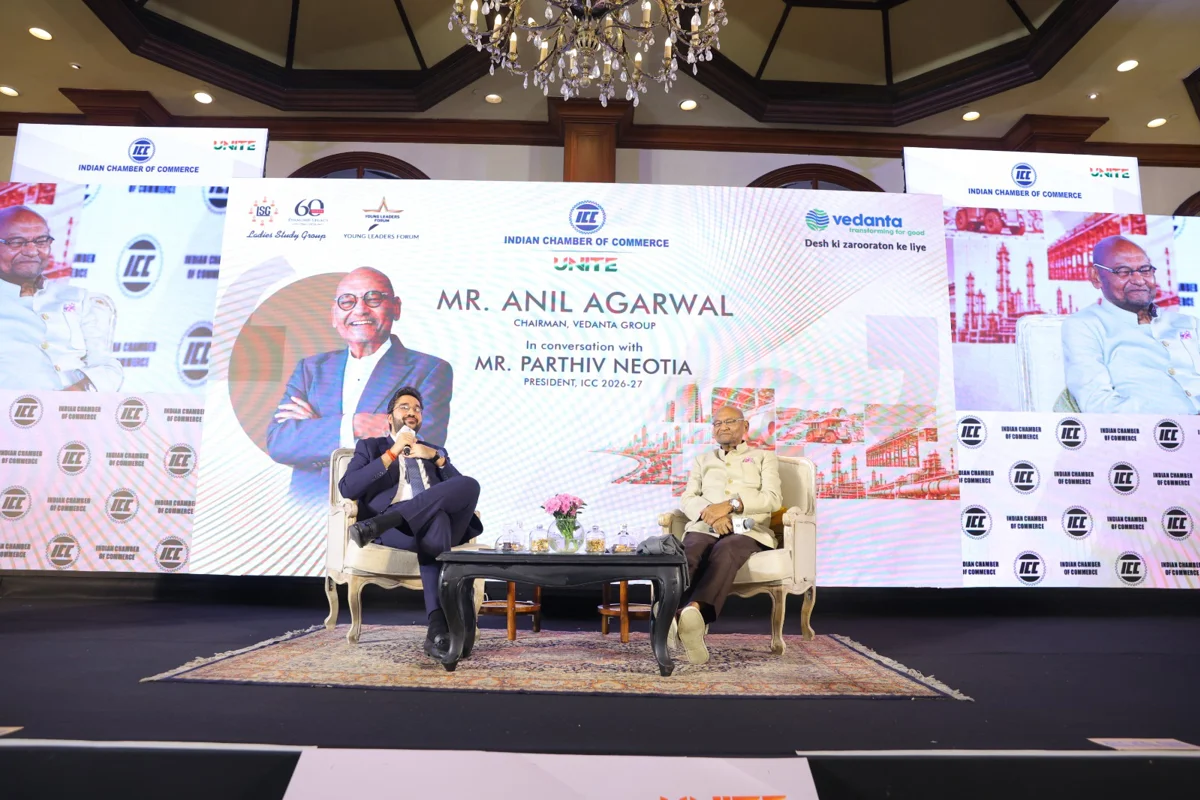
As Vedanta explores a major investment opportunity in West Bengal, its founder calls for faster mineral exploration, stronger domestic manufacturing and a new generation of entrepreneurs capable of transforming India’s natural resources into economic opportunity.
By – Snigdha Mishra
Kolkata, October 29, 2026 | The Interview Times
India has never lacked natural resources. What it continues to confront is a more difficult question: how much of the economic value generated from those resources should remain within the country?
For Anil Agarwal, Founder and Chairman of Vedanta Group, the answer lies in building a stronger domestic manufacturing ecosystem, accelerating mineral exploration and encouraging entrepreneurs to enter industries that have traditionally demanded substantial capital, patience and technical expertise.
Speaking at an interaction organised by the Indian Chamber of Commerce (ICC) in Kolkata on October 28, Agarwal made a compelling case for reducing India’s dependence on imported products that could potentially be manufactured domestically.
His remarks arrived alongside reports that Vedanta is exploring investment opportunities worth approximately ₹70,000–80,000 crore in West Bengal, particularly in power generation and aluminium-related industries.
Although these proposals have not been finalised, their scale has brought renewed attention to the industrial potential of eastern India.
Beyond the investment figures, Agarwal’s central argument raises a question of national significance: Can India convert its mineral wealth into a larger, more competitive manufacturing economy?
A Call to Manufacture What India Has the Resources to Produce
At the ICC interaction, Agarwal questioned the continued reliance on imports in sectors where India possesses the resources and industrial potential to develop domestic manufacturing capabilities.
“India cannot continue to depend on imports when we have the resources to manufacture these products at home.”
The statement captures a challenge that extends across India’s mining, metals, energy and manufacturing sectors.
Natural resources alone do not guarantee industrial competitiveness. Their economic potential depends on exploration, processing technology, reliable energy, infrastructure, investment and the ability to develop industries that convert raw materials into marketable products.
Agarwal argued that mineral exploration must move faster and that more entrepreneurs should be encouraged to participate in the sector.
His emphasis was not confined to large mining operations. He also highlighted the importance of downstream industries, which transform raw materials into higher-value products used across manufacturing supply chains.
For India, expanding these capabilities could help strengthen domestic supply networks, create employment and reduce dependence on imported finished goods.
Why Downstream Manufacturing Matters
Mining and mineral development are inherently long-term activities.
Exploration, regulatory approvals, environmental clearances, financing and project construction can take several years before a large mining operation becomes commercially productive.
Agarwal drew attention to an alternative opportunity: expanding industries that process available raw materials into finished or intermediate products.
Such businesses can create economic value through activities including metal fabrication, component manufacturing, industrial processing and specialised engineering.
The distinction is important.
A region that exports raw materials may capture only a portion of their potential economic value. A region that also develops processing facilities, manufacturing units and supporting enterprises can create additional layers of employment, technology development and commercial activity.
For eastern India, where mineral resources and industrial clusters already form an important part of the regional economy, the argument has particular relevance.
The challenge is not simply to extract more resources, but to build stronger industrial ecosystems around them.
Vedanta’s ₹80,000-Crore Investment Possibility in West Bengal
The Kolkata engagement also coincided with reports of Vedanta examining substantial investment opportunities in West Bengal.
According to media reports published on October 28, the group is exploring investments estimated at ₹70,000–80,000 crore, with potential projects involving power generation and aluminium smelting.
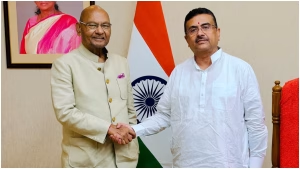
Agarwal also engaged with the state leadership regarding industrial opportunities.
The proposed investment would be significant for West Bengal if it progresses through feasibility assessment, approvals and implementation.
However, the reported amount should not be interpreted as expenditure already committed or projects already sanctioned.
Major industrial proposals depend on several factors, including access to land, energy, raw materials, infrastructure, regulatory clearances and commercial viability.
The broader significance of Vedanta’s interest lies in the possibility of creating an integrated industrial ecosystem in which energy generation and metal processing support one another.
Such developments can have implications beyond the primary investment, potentially creating demand for equipment suppliers, engineering firms, logistics providers and local service enterprises.
Whether these possibilities translate into measurable economic outcomes will depend on the final scope and execution of any projects undertaken.
Anil Agarwal: The Entrepreneur Who Built Beyond Conventional Boundaries
Agarwal’s observations on industrial self-reliance draw additional significance from his own entrepreneurial journey.
From modest beginnings to establishing a multinational natural resources business, his career has been shaped by acquisitions, industrial restructuring and expansion into capital-intensive sectors.
During the ICC programme, Dr. Rajeev Singh, Director General of the Indian Chamber of Commerce, reflected on Agarwal’s journey, including his arrival in Mumbai at the age of 19.
The discussion also recalled the transformation of businesses such as BALCO and Hindustan Zinc, both of which became important chapters in Vedanta’s development.
Agarwal’s experience illustrates the scale of commitment required to build businesses in industries where investments are substantial and results often take years to materialise.
Yet his message to aspiring entrepreneurs was broader than the mining sector.
“Entrepreneurship is about persistence, innovation and creating opportunities for others.”
He also emphasised the importance of shareholder value, transparency and sound corporate governance.
These principles are particularly relevant for businesses operating in resource-intensive industries, where long-term success depends not only on financial performance but also on regulatory compliance, responsible operations and public trust.
The Indian Chamber of Commerce Brings Industry and Emerging Leadership Together
The interaction was held as the Indian Chamber of Commerce marked its 101st year, bringing together established industry leaders, business representatives and emerging entrepreneurs.
Parthiv Neotia, President of ICC for 2026–27, engaged Agarwal in the discussion.
Keshav Bhajanka, Senior Vice President of ICC, opened the session and reflected on the industrial transformations associated with Vedanta’s journey.
Dr. Rajeev Singh, Director General of ICC, provided context on Agarwal’s entrepreneurial development and philanthropic commitments.
The discussion also highlighted Agarwal’s stated pledge to direct a substantial portion of his wealth towards social causes, alongside the work of Nand Ghar, a Vedanta-supported initiative associated with the modernisation of Anganwadi services.
Gyanesh Chaudhary, Vice President of ICC, delivered the vote of thanks.
The gathering demonstrated the value of bringing experienced industrialists into direct conversation with the next generation of business leaders.
For young entrepreneurs, such exchanges offer an opportunity to understand not only how large businesses are built, but also the institutional, financial and operational challenges involved in sustaining them.
Eastern India and the Opportunity for Industrial Value Addition
The conversation in Kolkata has particular relevance for the wider eastern Indian economy.
States such as Odisha, Jharkhand and West Bengal possess important industrial capabilities and natural resource advantages, although their economic structures and development priorities differ.
The opportunity lies in developing stronger connections between resource availability, manufacturing capacity, technological innovation and market demand.
In Odisha, for example, mining, steel, aluminium, ferroalloys and related industrial activities already contribute significantly to the state’s economic identity.
Expanding downstream industries could create opportunities for smaller manufacturers, component suppliers, engineering businesses and specialised service providers.
But successful industrial development requires more than investment announcements.
Reliable infrastructure, competitive energy costs, skilled workers, transparent regulation and responsible environmental management are essential to attracting and retaining manufacturing businesses.
Agarwal’s call for faster exploration must therefore be considered alongside the need for environmental safeguards, community engagement and sustainable resource use.
Industrial self-reliance becomes meaningful when economic growth is accompanied by responsible development and opportunities that extend beyond the largest corporations.
The Next Generation of Entrepreneurs Has a Role to Play
One of the most notable elements of Agarwal’s message was his emphasis on bringing more entrepreneurs into the minerals and manufacturing ecosystem.
India’s industrial future cannot depend exclusively on a limited number of large conglomerates.
Smaller and medium-sized enterprises can contribute through fabrication, processing, machinery manufacturing, maintenance, logistics, technology and specialised industrial services.
These businesses may not command the same public attention as large mining or smelting projects, but they form an essential part of competitive manufacturing supply chains.
Encouraging their growth requires access to finance, technical capabilities, markets and predictable business conditions.
For young entrepreneurs, the opportunity may lie not in replicating the scale of a company such as Vedanta, but in identifying the industrial gaps that larger investments create.
As manufacturing systems become more sophisticated, opportunities may emerge for businesses capable of providing innovative, efficient and specialised solutions.
From Resource Wealth to Industrial Strength
India’s ambition to strengthen domestic manufacturing will ultimately be judged by its ability to translate resources, capital and entrepreneurial energy into productive economic activity.
The conversation initiated by Anil Agarwal at the Indian Chamber of Commerce brings this challenge into sharper focus.
His call for accelerated exploration and deeper downstream manufacturing presents a vision in which India captures more value from the resources it possesses.
Vedanta’s reported investment exploration in West Bengal adds a substantial commercial dimension to that discussion, although the proposals remain at an exploratory stage.
For policymakers, the challenge is to create an environment that supports investment while protecting environmental and community interests.
For established companies, it is to combine industrial scale with transparency, governance and operational responsibility.
And for the next generation of entrepreneurs, it is to recognise that some of India’s most consequential business opportunities may emerge not from entirely new industries, but from transforming the way existing industries create value.
India’s next industrial breakthrough may depend not simply on what it extracts from the earth, but on what its entrepreneurs and manufacturers are capable of building from it.
The Interview Times | Business • Leadership • Nation Building
