
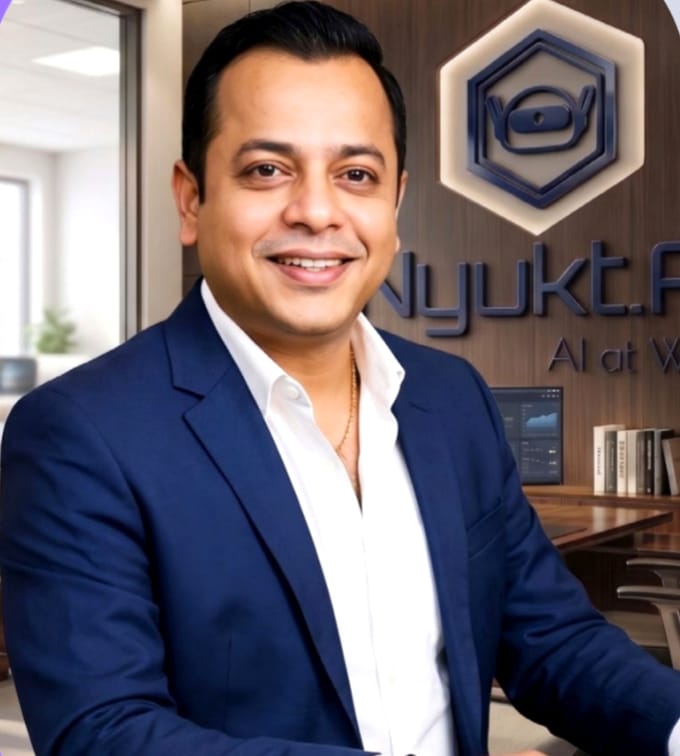
Some stories are defined by achievements. Others are defined by the vision that drives them. The journey of Sujit Routray belongs to the latter.
When Sujit Routray stepped onto the stage at the Economic Times Indo Global Leaders Summit 2025 in Dubai to receive the award for Excellence in Deep Tech Innovation and Applied Research, it marked far more than a personal milestone. It was the culmination of years spent pursuing a belief that world-class innovation can emerge from places far beyond the traditional centres of technology and power.
Born and educated in Odisha, Routray’s path reflects a rare blend of technical depth, entrepreneurial courage, and an unwavering commitment to his roots. A graduate in Electronics and Telecommunication Engineering from ITER, SOA University, and later an MBA from XIMB, he entered the professional world with a curiosity that extended beyond building businesses. He wanted to understand how technology could fundamentally reshape the way people work, govern, and create value.
His early years with global consulting firms such as Accenture and Infosys provided exposure to large-scale digital transformation projects across industries and geographies. Yet the entrepreneurial instinct remained impossible to ignore. Over the next decade, he would build and scale ventures spanning media, healthcare, fintech, and emerging technologies, gaining a reputation for identifying opportunities long before they became mainstream.
Today, as the Founder and CEO of Nyukt.AI, Routray stands at the forefront of one of the most consequential technological shifts of our time: the rise of Agentic AI. And nowhere is the impact of that shift more urgent than in healthcare.
The Problem He Refused to Accept
Walk into a hospital or clinic anywhere in India or the GCC, and a version of the same scene plays out millions of times a day. A doctor spends twenty to thirty minutes collecting a patient’s history through conversation, paper forms, and verbal questioning before a single clinical decision is made. Eighty percent of primary consultations are non-critical, yet they consume nearly half of every physician’s day. For patients who do not speak the dominant language, the challenge is compounded further: symptoms get lost in translation, history goes unrecorded, and care deteriorates.
This is the problem Routray chose to solve with Nyukt.AI’s flagship clinical intelligence platform, ChikitAI and he chose to solve it not with a digital form or a symptom checker, but with something far more ambitious: an inhouse-built, clinical-grade Large Language Model designed from the ground up for regulated medical environments.
ChikitAI accepts patient input via voice or text in native languages, translates symptoms into structured medical terminology, performs probabilistic differential diagnosis using AI reasoning, escalates red-flag symptoms automatically, and delivers a structured, clinician-ready summary to the doctor before the patient even enters the room. The result is a documented reduction of over fifty percent in intake time, a seventy percent reduction in discharge documentation burden, and a consultation experience that is faster, more accurate, and meaningfully less frustrating for patients and physicians alike.
“We are not building a chatbot with a medical dictionary,” Routray has said. “We are building the intelligence layer that sits between patients and clinicians, one that genuinely understands context, history, and clinical risk.”
Proprietary Technology at the Core
What makes Nyukt.AI’s approach distinctive and difficult to replicate is that the intelligence powering ChikitAI is not licensed from a third party or built on a general-purpose foundation model. It is proprietary, built inhouse, and purpose-designed for clinical deployment.
The company has developed its own Clinical Grade LLMs, trained on real-world healthcare interactions at scale. These models are multilingual, context-aware, and aligned to clinical guidelines capable of probabilistic inference, differential diagnosis support, and risk scoring in ways that generic language models are not designed to handle. In a domain where an incorrect inference can carry serious consequences, that distinction is not a marketing point. It is a patient safety imperative.
Alongside this, Nyukt.AI has developed Quantora, a proprietary Quantum-Aware Machine Learning Simulator that represents one of the company’s most significant research achievements. Operating at ninety-six percent accuracy and approximately seventy-five percent more cost-efficiently than classical large language models, Quantora™ is designed to bring quantum-computing principles to bear on the kind of complex, high-dimensional inference problems that clinical AI demands. In an era where the cost of running frontier AI models remains a genuine barrier to healthcare adoption at scale, Quantora™ represents a potential answer and a durable competitive moat.
Together, these two inhouse intellectual properties sit at the heart of Nyukt.AI’s Agentic AI Operating System: a multi-agent platform with persistent patient memory, federated learning capabilities, enterprise-grade clinical governance, and the orchestration architecture to coordinate multiple specialised AI agents within a single clinical workflow.
Building Deep Tech With Purpose
While much of the world remains focused on artificial intelligence as a tool for generating content or automating tasks, Routray’s vision goes further. Through Nyukt.AI, he is developing intelligent systems capable of reasoning, adapting, learning from context, and executing complex clinical workflows with minimal human intervention technology that behaves less like software and more like a collaborative partner to the clinician.
The company’s roadmap reflects the full scope of that ambition. ChikitAI is live today for General Practice. Emergency Medicine is actively in development. Radiology, Oncology, Pathology, and Cardiology follow on a structured timeline through 2027, each a purpose-built specialty LLM trained on domain-specific clinical data. By 2029, the platform is designed to evolve into a self-learning care network, a federated, population-scale intelligence system that improves continuously without sensitive patient data ever leaving the institution.
The market has responded to this momentum in the most unambiguous terms possible. In the space of a single year, Nyukt.AI has grown from a founder-funded seed stage venture into a company valued at thirty million dollars, a trajectory that places it among the fastest-scaling deep-tech startups in the MENA region. It is a number that reflects not hype, but the compounding weight of proprietary IP, demonstrated clinical outcomes, and a go-to-market engine that is only beginning to find its full velocity. By the close of 2026, Routray is targeting a valuation of one hundred million dollars a milestone that would represent a more than three-fold growth within a single calendar year, and would cement Nyukt.AI’s position as one of the defining healthcare AI ventures to emerge from the Gulf.
Under Routray’s leadership, Nyukt.AI has rapidly emerged as a recognised name in the global deep-tech ecosystem. The company has earned accolades including the Startup of the Month recognition from the Dubai AI Campus and DIFC Innovation Hub, won the EurekaGCC 5th Edition against over five hundred startups from fifty-seven countries, forged advanced research collaborations with NVIDIA, and established a growing international presence across the Middle East and Asia.
The Human Behind the Mission
Yet what makes Routray’s story particularly compelling is that, despite operating on a global stage, he continues to look homeward. At a time when talent often migrates away from smaller innovation ecosystems, he is actively investing in Odisha’s future. With research initiatives, talent development efforts, and plans for large-scale AI infrastructure, he envisions Bhubaneswar evolving into a significant centre for deep-tech research and artificial intelligence innovation.
His commitment extends beyond enterprise applications. Nyukt.AI has worked with public institutions to explore how AI can improve governance, modernise administrative systems, and deliver greater efficiency in public services. For Routray, the clinical-grade LLMs and quantum-aware models his team builds are not merely commercial assets, they are instruments of societal impact. Technology built to serve the patient who cannot easily explain their symptoms. The doctor who has twenty more patients to see. The hospital system has more demand than it can absorb.
What emerges from every conversation with him is a refreshing sense of perspective. Despite international recognition and rapid business growth, he frequently credits his achievements to the sacrifices of his parents, the guidance of his teachers, and the values instilled during his upbringing in Odisha.
In an era captivated by headlines about artificial intelligence, Sujit Routray represents something equally important: the human ambition behind innovation. His story is not simply about algorithms, funding rounds, or technological breakthroughs. It is about the conviction that excellence can be built anywhere that a clinical-grade LLM can be conceived in Bhubaneswar, refined in Dubai, and deployed in hospitals across the world. That global aspirations need not come at the cost of local identity. And that the future of technology should remain deeply connected to the people it seeks to serve.
From the streets of Cuttack to boardrooms in Dubai, Sujit Routray’s journey is ultimately a reminder that while innovation may be global, the purpose is often profoundly personal. And it is that sense of purpose not the patents, not the platform, not the awards that continues to shape both his work and his vision for what AI can become.
