
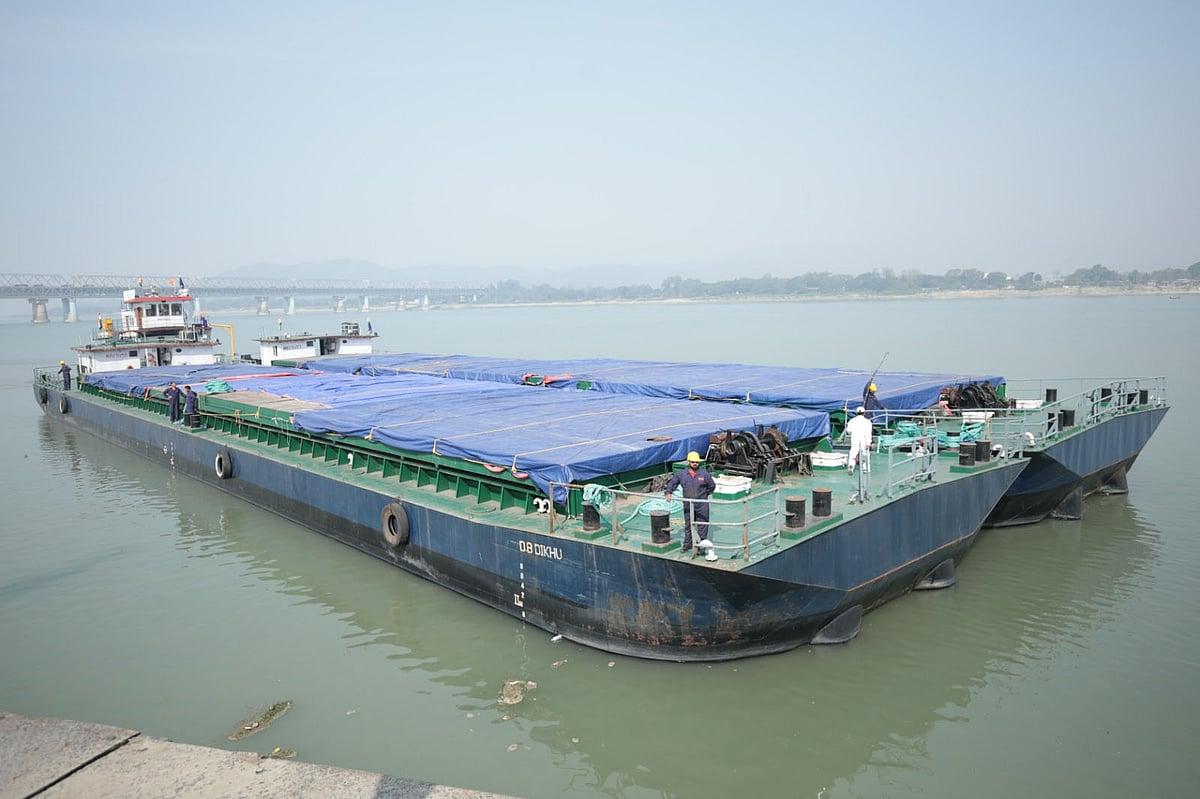
A major development in India’s Northeast has taken place with the departure of the first international cargo shipment from Dibrugarh in Assam to a foreign port since Independence.
A barge carrying 540 metric tonnes of methanol has departed from the Bogibeel Terminal in Dibrugarh for Bangladesh, marking the revival of an international river-trade route that had remained largely dormant for nearly seven decades.
The shipment was flagged off by Union Minister for Ports, Shipping and Waterways Sarbananda Sonowal. The cargo, produced by state-owned Assam Petro-Chemicals Ltd at Namrup, is headed towards Bangladesh.
The vessel will travel approximately 768 kilometres through National Waterway-2 along the Brahmaputra before connecting with the Indo-Bangladesh Protocol Route. The total journey from Bogibeel to the Dhaka region will cover roughly 1,300 kilometres.
The development has historical significance for Dibrugarh. The town was once an important river-trade centre, with steamers carrying tea, timber, passengers and other goods along the Brahmaputra. Partition in 1947 disrupted traditional trade routes and fundamentally changed the movement of goods from Assam.
The reopening of the route could now give Assam and the wider Northeast an alternative pathway to international markets.
Government officials say inland waterways can reduce transportation costs compared with road-based logistics while improving connectivity with neighbouring countries.
The move is particularly important because India’s Northeast shares international boundaries with Bangladesh, Bhutan, Myanmar and China, making connectivity a major economic and strategic priority.
The revival of the Brahmaputra as a commercial waterway could potentially benefit industries including petrochemicals, fertilisers, agriculture and other manufacturing sectors.
The shipment also comes as India seeks to deepen economic connectivity between its northeastern states and neighbouring countries under broader regional connectivity initiatives.
The significance extends beyond Assam. If regular commercial cargo movement becomes viable, the Brahmaputra could increasingly function as an international logistics corridor linking the Northeast with Bangladesh and ports beyond.
For Dibrugarh, the voyage represents the return of a form of commerce that once played an important role in the city’s economic history.
Why it matters: This is more than a single cargo shipment. It could mark the beginning of a new chapter in Northeast India’s international trade and logistics network.
