
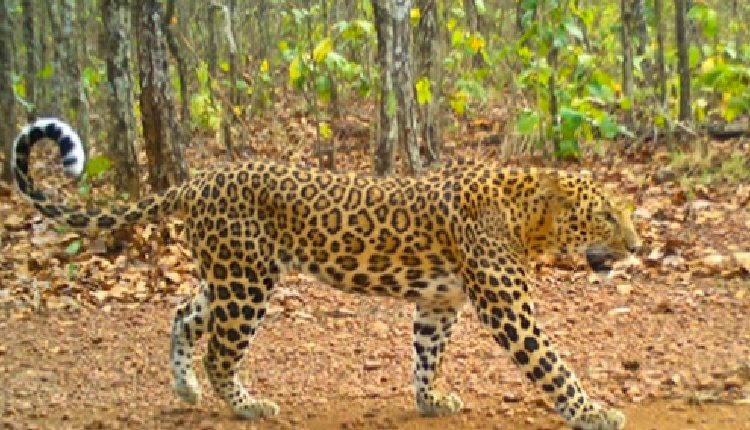
India’s overall large-carnivore population has increased, but the east-central region does not appear to have kept pace. A recent Wildlife Institute of India (WII) study found that leopards continue to face threats such as habitat destruction, poaching and human-wildlife conflict. Sponsored by the Odisha Forest Department, the study showed a declining trend in leopard and prey populations in the state and highlighted the need for systematic monitoring.
As part of a long-term monitoring project, researchers assessed leopard and prey populations at key sites in the Similipal-Satkosia landscape, a fragmented forest complex with protected and non-protected areas, to develop conservation strategies. Systematic camera-trap surveys were conducted in Kuldiha Wildlife Sanctuary, Hadagarh Wildlife Sanctuary, Rebana Reserve Forest, and the Satkosia and Mahanadi wildlife divisions of Satkosia Tiger Reserve (STR).
Leopards were identified by their rosette markings. Density estimates used maximum-likelihood spatially explicit capture-recapture (SECR) models; prey relative abundance indices (RAI) were based on detections per 100 trap-nights, and leopard diet in STR was analysed through trichotaxonomic examination of medullary guard hairs from field-collected scat samples, the report said.
“Leopard density and prey abundance varied across the landscape,” the report stated, adding that the highest leopard densities were in Satkosia and Mahanadi, at 17.9 ± 1.75 and 11.9 ± 1.66 leopards per 100 km², respectively. These figures matched higher levels of medium- and large-sized prey, which formed a major part of the leopard diet.
The report noted that medium- to large-sized ungulates, excluding wild boar, were either absent or recorded at low densities in Kuldiha, Hadagarh and Rebana. The study found that leopards were functionally extinct in Kuldiha and Hadagarh and remained at low densities in Rebana, with 2.2 ± 0.70 leopards per 100 km². Small-bodied prey were more common across all study sites.
