Dikhyaa Mohanty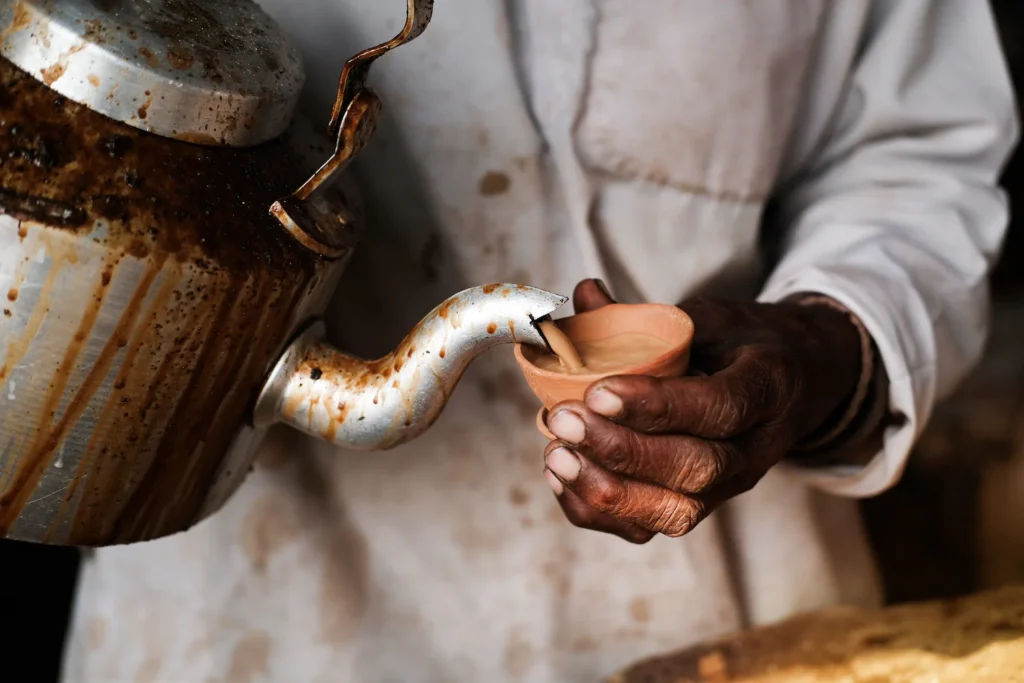
India’s national beverage is unquestionably tea. A normal day for many Indians starts with a cup of masala chai at home, with more cups being obtained from the various tea vendors and canteens throughout the day. India’s masala chai is one of the most well-known brews in the world. It is typically made by boiling tea leaves with milk, sugar, ginger root, and warm spices like cardamom and clove. In many countries, the word “chai,” which means “tea” in Hindi, refers to the Indian brewing method.
However, tea’s popularity in India is a relatively new phenomenon. Many Indians had never tasted tea, much less masala chai, sixty or seventy years ago. The global slump, the fight for independence, technical advancement, and a string of aggressive marketing initiatives all contributed to its evolution from the beverage of the British colonists on the subcontinent to a uniquely Indian beverage that is known across the world.

Tea Drinking Before Colonization
Even though it has only just gained popularity, tea drinking has ancient roots in India. Tea grew naturally in the state of Assam in the northeast. The Singpho people and several other indigenous cultures drank this wild tea regularly as early as the 12th century for its health advantages and, most likely, its caffeine content.

They frequently processed it by packing toasted, dried tea leaves inside the bamboo cane, which was then smoked. The Singpho still drink tea in this manner, cutting off a piece of smoked, tea-filled cane as needed. Later accounts of tea consumption in Indian cities close to trade routes with China, the Middle East, and Europe exist.
Growth in Tea Production in India
India started producing tea industrially as a result of the British-Chinese struggle. Britain was consuming an astounding 40 million pounds annually by the 1830s. The British searched for other sources after China unexpectedly stopped trading tea with them and their relationship descended into war. The British extended their colonial authority into Assam to clear the forest for tea plantations after realizing that the Assamese grew their native type of tea.

Conflict and quick expansion characterized the early years of the Indian tea business. Industrialists from Europe, Assam, and India began establishing tea plantations in the 1830s. A planting frenzy sprang out as the need for tea for export increased. But getting people to labour on those plantations was another story. Because they mistrusted the tea business, many Assamese people refused to work in the tea fields or clear the forest for planting. The Assamese rebelled against the planters and attacked the plantation owners and their families in an attempt to preserve their autonomy.
The Independence Movement and Tea
The advent of the Indian independence movement affected the public perception of tea. The Indian populace became more and more disenchanted with British rule in the 1930s and 1940s. Mahatma Gandhi publicly criticized the poor wages and reliance on enslaved labour of the tea plantation system, calling for Indians to boycott British imperial commodities, especially tea, as part of the Swadeshi Movement. As a result, many tea workers went on strike or quit their jobs entirely.

Advertisers used tea to support the nationalist movement for Indian independence despite these objections. They commissioned Indian artists to create striking, graphic images of tea drinkers dressed in regional attire with text in regional languages, replacing colonial messages with depictions of tea as a Swadeshi beverage that was associated with the national identity. These ads emphasized national unity while simultaneously highlighting regional distinctions, and the message seemed to strike a chord with a populace that desired independence from British authority.
As processing technology advanced in the years after independence, tea drinking became more accessible and inexpensive. The “crush-tear-curl” (CTC) method, which shreds tea leaves and turns them into homogeneous granules, was crucial to this. CTC tea boils more quickly and yields much more cups of tea per weight than non-CTC-processed tea because to its larger surface area. Although CTC processing has existed since the 1930s, a Bengali engineer improved its industrial scalability in the late 1950s.

As Indian emigrants and tourists introduced non-Indians to several varieties of masala chai, decades later, India’s tea-brewing customs expanded around the world. In the 1990s, Starbucks and several other businesses latte-ified masala chai, giving it a household term. International variations drastically alter the proportions of milk, sugar, and spices, add espresso shots, and take various liberties with masala chai. In India, tea is still a reasonably priced, daily beverage that supports many facets of life, even if masala chai has emerged as a popular substitute for cappuccino.