

From improved connectivity to a growing renewable-energy pipeline, the proposed wind project at Papadahandi brings Nabarangpur into Odisha’s changing energy map as NLC India expands its green footprint across the state.
A New Energy Story Is Emerging in Southern Odisha
Odisha’s industrial and energy story has traditionally been associated with coal, thermal power, steel, aluminium and mineral-rich industrial corridors.
But in Papadahandi, Nabarangpur district, a different energy story is taking shape.
NLC India Renewables Limited, the renewable-energy arm of NLC India, is pursuing a 49.5 MW wind-power project at Papadahandi. The project had earlier received approval from Odisha’s Energy Department, while NLC subsequently floated an open tender in April 2026 for its establishment, including supply, erection, commissioning and operation and maintenance for 10 years.
At 49.5 MW, the project may appear modest when compared with the multi-gigawatt thermal and renewable projects reshaping India’s energy landscape.
Its significance, however, lies partly in where it is being developed.
Why Papadahandi Matters
Nabarangpur is far removed from Odisha’s traditional industrial concentrations around Angul, Jharsuguda, Kalinganagar and Paradip.
That makes the emergence of a utility-scale wind project in Papadahandi noteworthy.
When Odisha approved the Papadahandi proposal along with three other renewable-energy projects in 2025, the state said such projects were expected not only to help meet renewable-purchase obligations and climate objectives, but also to contribute to local employment and infrastructure development in their respective districts.
For districts such as Nabarangpur, therefore, renewable energy presents a development question that extends beyond electricity generation.
Can clean-energy investment help take new infrastructure, contracting opportunities, technical activity and associated economic development into regions that have historically received fewer large industrial projects?
Papadahandi could become an important case to watch.
49.5 MW — The Number Behind the Project
NLC India’s tender describes the project as the “Setting Up of 49.5 MW Wind Power Project at Papadahandi, Odisha with O&M for 10 Years.”
The tender was published on 2 April 2026, with the scope covering supply, erection and commissioning.
PAPADAHANDI PROJECT AT A GLANCE
49.5 MW — Proposed wind capacity
Papadahandi — Project location
Nabarangpur — District
NLC India Renewables Ltd — Developer
10 Years — O&M component under the tender
These numbers provide the immediate project picture.
The larger story, however, becomes visible when Papadahandi is placed within NLC India’s rapidly expanding renewable-energy strategy.
NLC Is Thinking Much Bigger in Odisha
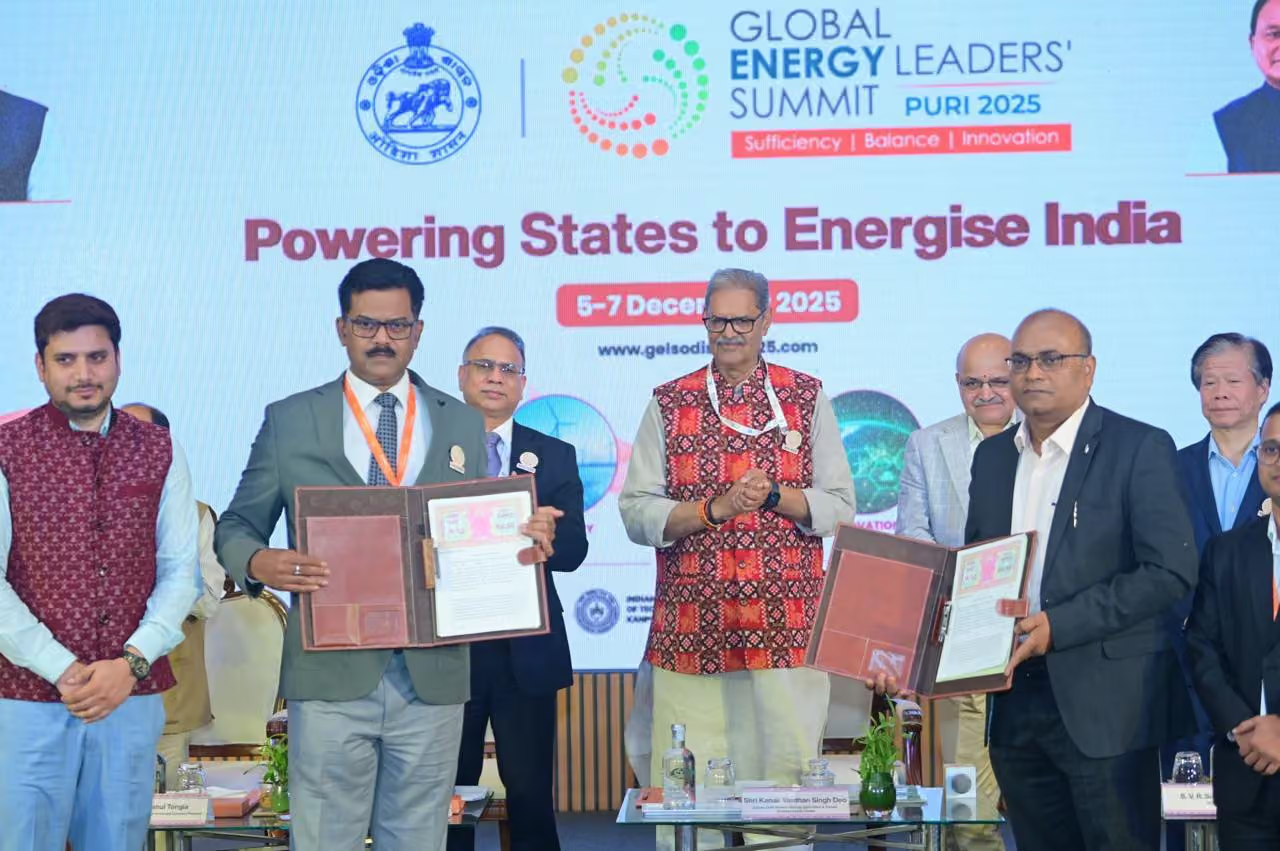
In June 2026, NLC India Renewables Limited (NIRL) and the Odisha Renewable Energy Development Agency (OREDA) signed a joint-venture agreement for the development of 1,000 MW of green-energy projects in Odisha in the first phase.
Under the announced structure, NIRL will hold 51% of the joint venture and OREDA 49%.
The planned portfolio includes:
250 MW of wind power
225 MW of floating solar capacity
Other renewable and clean-energy projects across Odisha
The agreement therefore places Papadahandi against a much larger backdrop.
Rather than being viewed simply as an isolated 49.5 MW wind farm, it can be seen as part of an expanding renewable-energy footprint involving NLC India and Odisha.
From Coal Company to Integrated Energy Player
NLC India’s own transformation makes the development particularly interesting.
Historically associated with lignite mining and thermal generation, the public-sector enterprise is now pursuing a substantial expansion of its renewable portfolio.
The Union Ministry of Coal said in September 2026 that NLC India currently has 8,405 MW of power-generation capacity and 59.10 MTPA of mining capacity, while positioning itself as an increasingly diversified energy enterprise.
Under its longer-term strategy, NLC India has targeted a major increase in renewable-energy capacity. Its Corporate Plan 2030 envisages increasing the renewable portfolio from 1.43 GW to 10.11 GW, supported by approximately ₹50,000 crore of renewable investment.
Papadahandi therefore represents a small but locally significant piece of a much larger corporate transition.
The Infrastructure Question
One of the most interesting dimensions of the Papadahandi story is logistics.
Wind-power projects are unlike conventional industrial projects in one important respect: some of their largest components are extraordinarily difficult to transport.
Wind-turbine blades, tower sections and associated heavy equipment require suitable highways, turning radii, bridges and last-mile road connectivity.
An industry observer familiar with the development has pointed to improved road connectivity in southern Odisha as an important factor in making transportation of large wind-energy components increasingly feasible in areas such as Nabarangpur.
This is an important observation because it demonstrates how infrastructure can change the investment potential of a region.
However, the precise relationship between specific Bharatmala road development and NLC’s decision to locate the project at Papadahandi has not yet been established through the public documents reviewed by The Interview Times. It should therefore be treated as an industry perspective rather than an official explanation for the investment decision.
When Roads Unlock Energy Investment
The broader argument remains significant.
Renewable-energy potential alone does not guarantee investment.
A commercially viable wind project requires much more:
Road connectivity.
Transmission infrastructure.
Suitable land.
Grid evacuation capacity.
Heavy-equipment logistics.
Contractor access.
Regulatory approvals.
When those elements begin coming together, regions previously regarded as difficult investment destinations can become commercially accessible.
That is why the Papadahandi project deserves attention beyond its 49.5 MW capacity.
Nabarangpur Enters Odisha’s Wind-Energy Map
Odisha’s wind potential has been discussed for decades, although wind development has historically progressed more slowly than several other renewable technologies in the state.
Today, however, approved wind projects are beginning to appear across Odisha’s renewable-energy pipeline, including projects connected with Nabarangpur, Koraput and other districts. Regulatory documents list multiple approved wind projects at different stages of development.
The geographical pattern matters.
Renewable-energy investment does not necessarily have to follow the same industrial geography as coal, steel or aluminium.
Wind resources, solar irradiation, land availability and grid connectivity can create entirely different investment maps.
That potentially gives districts outside Odisha’s traditional industrial belt an opportunity to participate in the state’s next energy transition.
A 1,000 MW Partnership Changes the Scale
The NLC India Renewables–OREDA agreement significantly raises the stakes.
The proposed 1,000 MW first-phase green-energy portfolio means that Odisha could become an increasingly important geography in NLC India’s national renewable strategy.
Of that planned portfolio, 250 MW has been identified for wind power, while 225 MW is intended for floating solar, alongside other clean-energy initiatives.
This creates an interesting possibility.
Papadahandi may not simply be a standalone wind project.
It could become one of several building blocks in a much broader NLC renewable-energy presence across Odisha.
The Development Question for Nabarangpur
Large infrastructure investments are often evaluated through megawatts, capital expenditure and commissioning dates.
For Nabarangpur, another measurement may matter just as much:
What economic activity develops around the project?
Construction creates demand for logistics, civil works, equipment movement and local services. Operations require maintenance and technical support. Supporting infrastructure can potentially improve the attractiveness of surrounding areas for subsequent investment.
The extent of those benefits will depend on the project’s eventual implementation, procurement model and local economic linkages.
A 49.5 MW project alone cannot transform an entire district.
But it can contribute to an ecosystem.
From the Periphery to the Renewable-Energy Map
That may ultimately be the most interesting part of the Papadahandi story.
For decades, industrial development in Odisha has naturally gravitated towards locations with minerals, ports, established infrastructure and large manufacturing clusters.
The clean-energy transition can alter that geography.
Wind and solar projects follow different economic and geographical considerations. As road and transmission infrastructure improve, locations that once appeared peripheral can become increasingly relevant to investors.
For a district such as Nabarangpur, that creates a different development proposition.
Not a coalfield.
Not a steel hub.
Not a major port.
But potentially part of Odisha’s emerging green-energy frontier.
The Bigger NLC–Odisha Story
NLC India’s expanding relationship with Odisha also illustrates a broader transformation occurring across India’s public-sector energy companies.
The challenge is no longer simply to produce more electricity.
It is to simultaneously provide reliable baseload power while building increasingly large renewable portfolios.
NLC India’s strategy reflects precisely that transition—from its traditional mining and thermal-power foundations towards a more diversified energy business encompassing solar, wind and other clean-energy technologies.
Odisha now appears positioned to participate in both sides of that transition.
The Real Milestone Will Be on the Ground
As with any proposed infrastructure project, announcements and approvals are only the beginning.
Tendering must translate into contracting.
Contracting must translate into construction.
Construction must translate into commissioning.
And commissioning must ultimately translate into reliable generation and tangible economic benefits.
That distinction is particularly important for the Papadahandi project.
The 49.5 MW proposal is real and the tender is documented, but some additional claims currently circulating regarding the precise status of bidding and the timing of further government or NLC announcements are not yet sufficiently supported by the public sources reviewed for this feature.
The Interview Times will therefore treat those aspects as developments to watch rather than completed milestones.
When the Wind Turns Towards Nabarangpur
Papadahandi may be only one location on India’s enormous renewable-energy map.
But sometimes the geography of an investment tells a bigger story than its capacity.
A wind-power project reaching Nabarangpur suggests that Odisha’s energy transition could increasingly extend beyond its traditional industrial centres.
And with NLC India Renewables and OREDA planning 1,000 MW of green-energy development across the state, the 49.5 MW project could be an early marker of something considerably larger.
The question is no longer simply how much renewable energy Odisha can produce.
It is how widely the economic opportunities created by that transition can travel.