

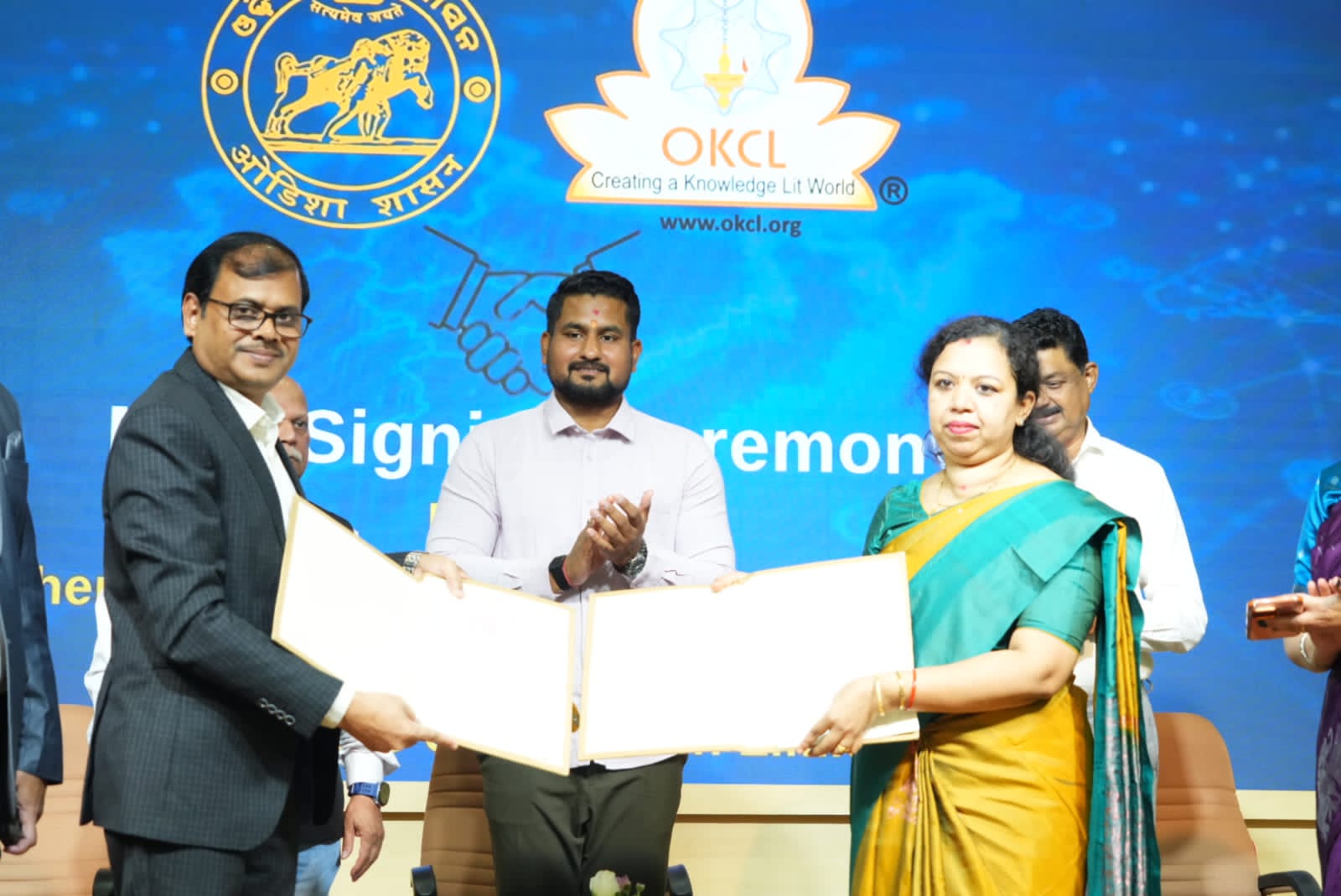
Bhubaneswar, September 5, 2026: In a move aimed at strengthening and future-proofing Odisha’s higher education ecosystem through technology, innovation, and skill development, the Department of Higher Education, Government of Odisha, signed a Memorandum of Understanding (MoU) with the Odisha Knowledge Corporation Limited (OKCL) today. The collaboration is expected to open new avenues for making the state’s higher education institutions more efficient, innovation-driven, and digitally empowered.
Speaking on the occasion, Shri Suryabanshi Suraj, Hon’ble Minister of State (Independent Charge) for Higher Education and Sports & Youth Services, Government of Odisha, welcomed the partnership and expressed hope that it would create fresh opportunities for the state’s students, faculty, and higher education institutions. Highlighting the demands of a rapidly changing world, he emphasized the need to prepare the younger generation in areas such as digital skills, artificial intelligence, emerging technologies, employability, and entrepreneurship. The vision and strategic guidance of Shri Arabinda Agrawal, IAS, Commissioner-cum-Secretary of the Higher Education Department, were noted as instrumental in shaping the direction of this collaboration, with his emphasis on linking technology, innovation, and capacity-building with higher education giving the partnership a structured direction in line with the goals of the National Education Policy (NEP) 2020.
Dr. Manoranjan Puthal, Managing Director of OKCL, described the MoU as a significant milestone in expanding OKCL’s contribution to knowledge, skilling, and digital transformation in Odisha, adding that the collaboration would create opportunities to develop comprehensive, technology-driven, and outcome-oriented solutions for students, teachers, and institutions alike.
Under the MoU, students stand to benefit from programmes in communication skills, digital literacy, career guidance, AI, and other emerging areas, along with opportunities in digital employability, academic credit learning, entrepreneurship, internships, apprenticeships, and work-based learning. Faculty members will have access to capacity-building opportunities through AI orientation, digital skills training, and Faculty Development Programmes, while institutions will find a wide scope for collaboration on quality standards, accreditation, NEP 2020 implementation, digital governance, innovation, research, entrepreneurship, and industry partnerships.
The collaboration will also encourage capacity-building in future-focused fields such as Artificial Intelligence, Data Science, Cyber Security, IoT, and Industry 4.0, alongside initiatives like hackathons, ideathons, internships, apprenticeships, work-integrated learning, and employability enhancement programmes. There is also room for new steps toward inclusive, multilingual, and technology-based education. The MoU is being viewed as a dynamic and evolving framework of collaboration, one that can accommodate new areas and initiatives over time as per the future needs of the state’s higher education sector.