
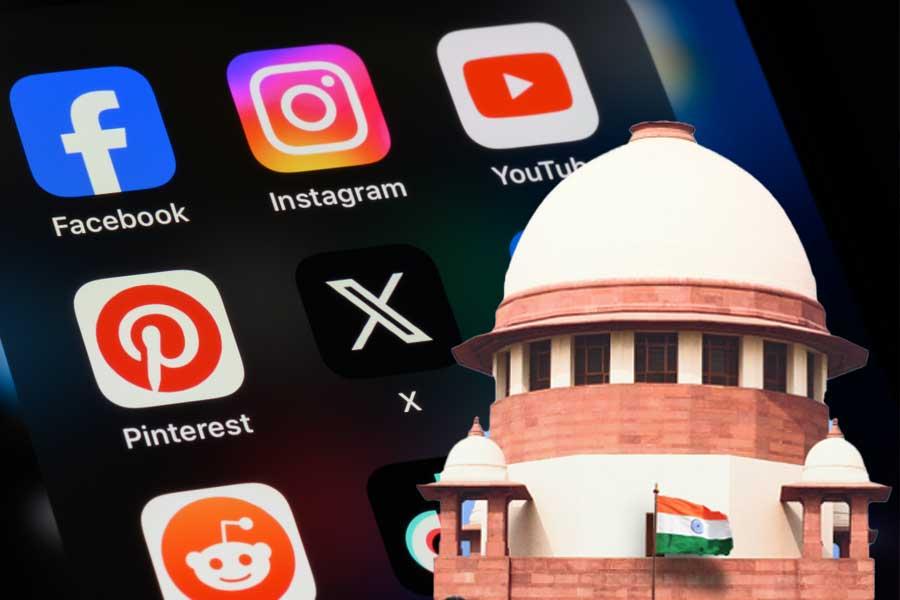
India is moving toward tighter regulation of children’s access to social-media platforms, with the government planning changes that could prevent people below the age of 18 from independently creating accounts.
The development follows growing scrutiny of children’s exposure to online risks and comes shortly after the Supreme Court asked the Centre to consider safeguards governing minors’ access to social-media platforms.
According to a report published Tuesday, the government intends to amend the Information Technology Intermediary Rules to prevent under-18 users from creating social-media accounts. The proposed framework would also require platforms to implement stronger age-verification mechanisms.
The issue has gained considerable attention because social-media platforms are widely used by teenagers in India, while existing systems generally rely heavily on users declaring their own age.
The Supreme Court’s intervention has accelerated the debate.
On September 28, the court considered a petition concerning safeguards for minors using social-media and other digital platforms. The bench indicated that the government needed to address the issue and discussed whether parental consent should be required for minors to maintain accounts.
The court’s observations do not themselves amount to a nationwide ban on children using social media. Instead, they form part of an ongoing legal and regulatory process concerning how minors should be protected online.
The government has now indicated that it intends to strengthen the existing regulatory framework.
One of the central questions is how platforms can actually determine a user’s age.
At present, many online services allow users to enter a date of birth when registering. Such systems can be difficult to verify because a person can potentially enter an incorrect age.
A stricter framework would therefore require platforms to introduce some form of age-assurance or age-verification technology.
Exactly how that verification will work remains an important unresolved issue.
Possible systems could involve verification through existing digital identity or authentication mechanisms, parental consent systems, third-party age-assurance technology or other technical approaches. Each method creates its own questions involving privacy, data protection, accessibility and implementation costs.
The government therefore faces a balancing exercise: protecting children from online risks while avoiding unnecessary collection of sensitive personal information.
The Supreme Court proceedings were triggered by a petition from the Just Rights for Children Alliance, which argued that existing arrangements do not adequately protect minors from risks including online grooming, sexual exploitation, cyberbullying, exposure to inappropriate material and misuse of personal data.
The petition also raised a legal question concerning minors and contracts.
Social-media accounts generally operate under terms of service that users agree to when creating accounts. The petition argues that Indian law recognises 18 as the age of majority and restricts the contractual capacity of minors.
The government has been examining whether existing laws can address the issue or whether additional regulatory provisions are required.
During the September 28 hearing, Solicitor General Tushar Mehta indicated that the government would examine whether the Digital Personal Data Protection framework already provides an appropriate legal basis. The court is expected to consider the matter again after further examination.
The debate is also taking place against a wider international background.
Governments around the world are increasingly examining age restrictions on social media. Australia has already introduced restrictions affecting users under 16, while European countries and other jurisdictions are considering different approaches to children’s access to online platforms.
India’s proposed approach is therefore part of a broader international discussion about the responsibilities of technology companies toward younger users.
For social-media companies, stronger age verification could mean substantial changes to the way accounts are created and maintained.
Platforms would potentially need to detect underage users more effectively, prevent the creation of accounts that do not meet age requirements and establish mechanisms for handling disputes when an account is incorrectly restricted.
For parents, the changes could mean greater involvement in their children’s online accounts.
For teenagers, however, the rules could significantly change how they use platforms such as Instagram, Facebook, YouTube and X, depending on the final regulations.
The government has yet to provide all operational details of the proposed system, so it would be premature to assume exactly what the final rules will look like.
The most significant development today is that the issue appears to be moving from discussion toward formal regulatory action.
The coming weeks will be important as the Centre works on the proposed amendments and the Supreme Court continues to examine the broader legal questions surrounding minors and social-media platforms.
The debate ultimately extends beyond social media itself. It raises questions about children’s digital rights, privacy, parental responsibility, platform accountability and how governments should regulate rapidly changing online environments.
For millions of young Indians and their families, any eventual age-verification regime could become one of the most noticeable changes to everyday digital life in the coming period.
