
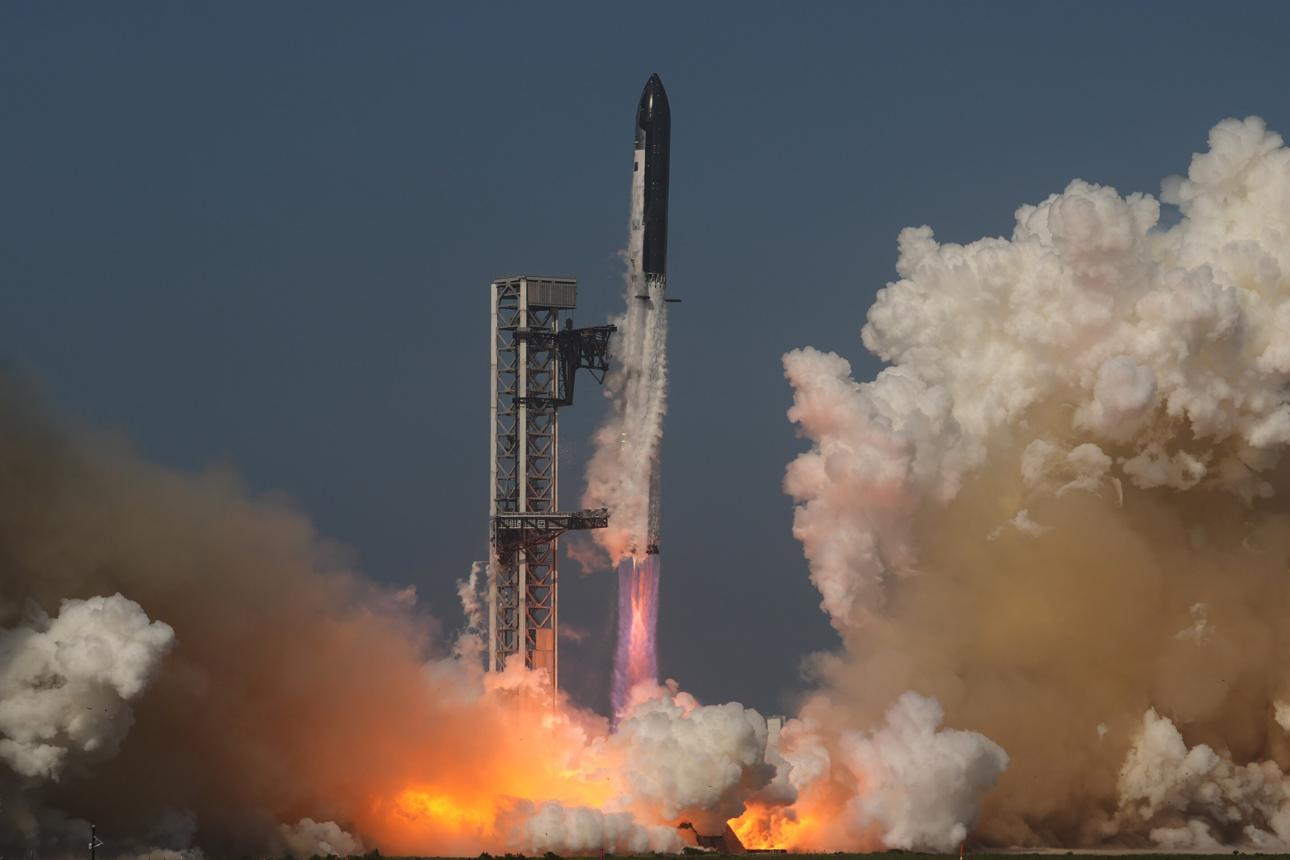
SpaceX’s giant Starship rocket has reached Earth orbit for the first time, marking a major milestone in the development of the company’s next-generation launch system. The achievement came during Starship’s 14th full-scale test flight on September 28, but the mission was shortened after one of the spacecraft’s engines shut down unexpectedly.
Despite the technical problem, flight controllers decided to continue with the mission after determining that the vehicle could still achieve its orbital objective. Starship subsequently reached orbit and successfully deployed 26 next-generation Starlink V3 satellites, making the mission the first Starship flight to carry and deploy an operational satellite payload.
The launch took place from SpaceX’s Starbase facility in South Texas. The vehicle, standing roughly 40 stories tall, consists of the Super Heavy booster and the Starship upper stage. The system is designed to be fully reusable and is being developed for everything from large-scale satellite deployment to future missions involving the Moon and, eventually, Mars.
The mission had originally been planned as a much longer demonstration. SpaceX intended Starship to spend almost 10 hours in space and complete six trips around Earth before returning to the Pacific. Instead, an engine problem prompted mission controllers to shorten the flight.
According to Reuters, one of Starship’s three main engines shut down prematurely after separation from the Super Heavy booster. Engineers initially considered whether the vehicle could continue toward orbit, but subsequently determined that the remaining systems could perform the required manoeuvre. Starship then successfully entered orbit.
The successful orbital insertion was particularly significant because previous Starship test flights had not achieved a complete orbital mission. The latest flight therefore crossed an important technical threshold: the vehicle demonstrated that it could accelerate to orbital velocity and operate in an orbital environment rather than merely reaching space on a suborbital trajectory.
The satellite deployment was another major part of the mission.
Starship released 26 Starlink V3 satellites, which Reuters reported were deployed at an altitude of roughly 269 kilometres. The satellites are designed to provide substantially greater data capacity than earlier generations of Starlink spacecraft. SpaceX intends to use Starship’s enormous payload capacity to deploy much larger groups of Starlink satellites in future missions.
The flight also demonstrated why Starship is important to SpaceX’s broader business strategy. The company’s Falcon 9 rocket currently handles most of its satellite launches, but Starship is designed to carry much larger payloads and potentially launch much more frequently.
The successful orbital flight could therefore eventually change the economics and scale of satellite deployment. Rather than sending relatively small batches of satellites into orbit on separate launches, Starship is being developed to transport much larger numbers in a single mission.
However, Monday’s flight was not completely successful in every respect.
After completing its orbital objectives, Starship returned toward Earth earlier than originally planned. The spacecraft performed a controlled descent into the Pacific Ocean near Hawaii. The vehicle ultimately tipped over and was engulfed in flames after reaching the ocean. The spacecraft was not intended to be recovered from the water during this particular test.
The engine shutdown also remains an important engineering issue. Engine reliability will become increasingly important as SpaceX moves toward missions involving human spaceflight, lunar landings and more complex orbital operations.
Starship is particularly important to NASA’s Artemis programme. NASA plans to use a Starship-based lunar lander for future Artemis missions, meaning the vehicle will eventually need to demonstrate far more than simply reaching orbit. Future requirements include reliable repeated launches, orbital refuelling, lunar operations and safe transportation of astronauts and cargo.
The successful orbital test therefore represents progress rather than completion of the Starship development programme.
The latest mission was also significant because it carried an actual commercial payload. Reuters described the flight as Starship’s first revenue-generating mission, rather than being solely a technology demonstration.
For SpaceX, the achievement comes at a critical stage in its plans to increase Starlink capacity and eventually transition more launch activity to Starship. For NASA and the wider space industry, the flight provides another demonstration of the potential of extremely large, reusable launch vehicles.
The next challenge will be turning a successful orbital demonstration into a repeatable and reliable launch system.
The September 28 flight showed that Starship can reach orbit even after encountering an engine problem. The coming test flights will determine whether SpaceX can improve engine reliability, demonstrate controlled recovery and move closer to routine operations.
For now, the headline achievement is clear: after years of development and 13 earlier test flights that stopped short of a complete orbital mission, Starship has finally reached orbit and deployed satellites from space.
