
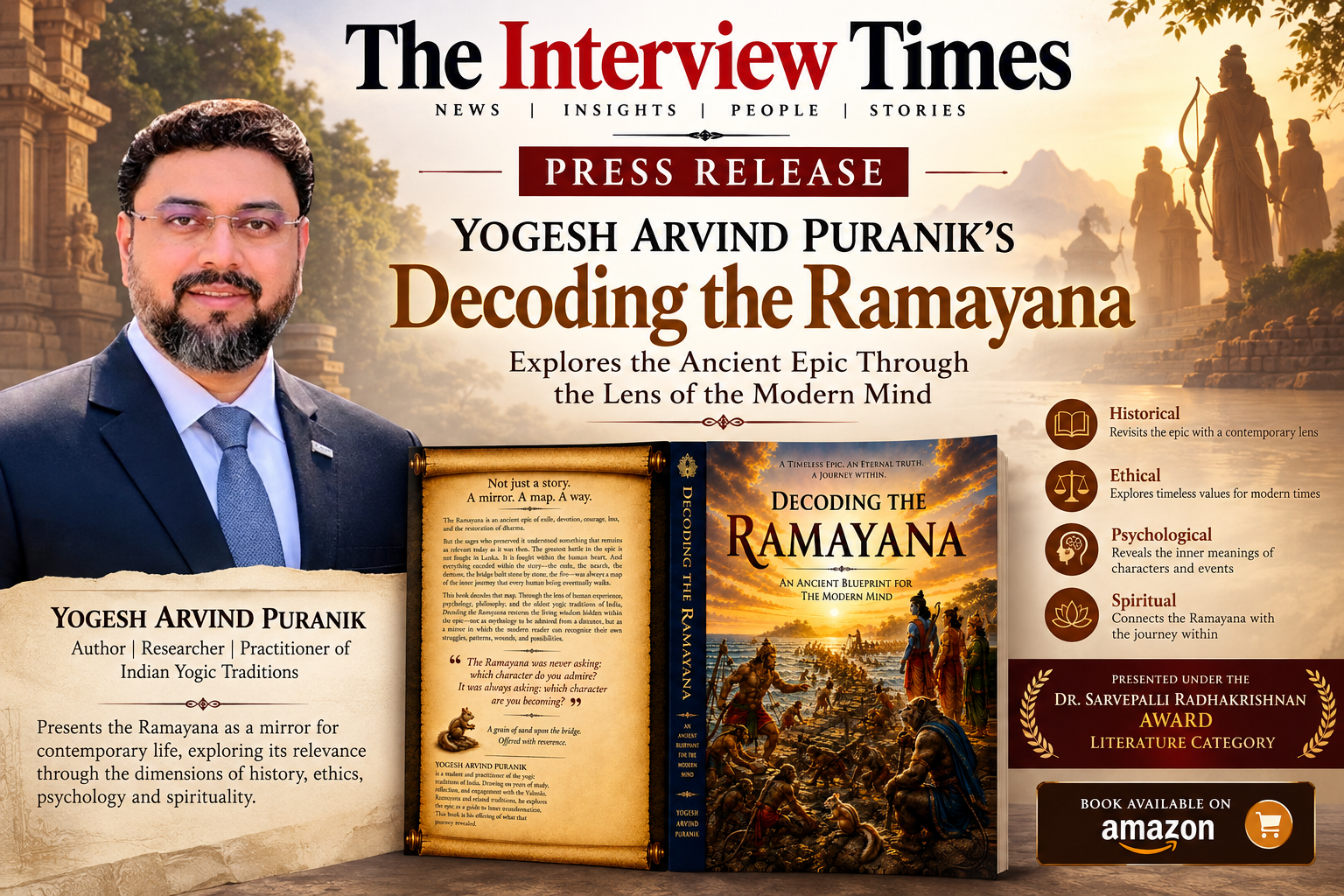
Author brings together history, ethics, psychology and spirituality in a contemporary exploration of the Ramayana
Kolkata, October 8, 2026: Author and practitioner of Indian yogic traditions Yogesh Arvind Puranik is drawing attention in the literary space with his book Decoding the Ramayana: An Ancient Blueprint for the Modern Mind, a contemporary exploration of one of India’s most enduring epics.
The book has been presented under the Literature category for the Dr. Sarvepalli Radhakrishnan Award, recognising literary contributions that engage meaningfully with knowledge, culture and ideas.
Rather than simply retelling the Ramayana or offering another devotional interpretation, Decoding the Ramayana approaches the epic through four interconnected dimensions — Historical, Ethical, Psychological and Spiritual. The book seeks to examine the deeper meanings represented by its characters, relationships and events while connecting them with questions faced by the modern human mind.
At the heart of Puranik’s approach is the idea that the characters of the Ramayana can also be understood as representations of different dimensions of human consciousness. Rama is presented as Pure Consciousness, Sita as the living force of Pure Energy, Hanuman as awakened Prana, and Lakshmana as focused attention. Lanka becomes a representation of the fortified ego, while Ravana is explored as the wounded brilliance of the human ego.
Through this framework, the ancient narrative becomes a study of attention, energy, identity, desire, consciousness and destiny.
One of the distinctive aspects of the book is its treatment of the women of the Ramayana. Puranik explores figures including Kaushalya, Sumitra, Mandodari, Trijata, Tara, Shabari, Urmila and Kaikeyi, presenting each as revealing a different dimension of inner wisdom, sacrifice, devotion, clarity or human complexity.
The book also gives particular significance to Shabari, returning to her presence immediately before the final battle. Her position in the narrative is used as a spiritual key to understanding the deeper significance of the confrontation that follows.
Another notable element is the exploration of Ravana’s final teaching to Lakshmana, where the defeated antagonist becomes, paradoxically, a source of wisdom. Through such moments, the book encourages readers to look beyond conventional ideas of hero and villain and examine what each character may represent within the individual.
Puranik’s motivation for writing the book emerged from a sustained engagement with the Ramayana and a desire to understand what its ancient narrative could reveal about contemporary psychological and spiritual challenges.
“I wanted to explore what lies beneath the familiar narrative and ask what the epic can reveal about consciousness, attention, energy, ego, desire, identity and human destiny,” the author explains.
Importantly, Decoding the Ramayana does not seek to replace traditional interpretations of the epic. Instead, it attempts to create a bridge between the ancient text and the inner questions of contemporary life.
The central question of the book shifts the reader’s attention from “What happened in the Ramayana?” to “What is happening within me?”
In doing so, Puranik presents the Ramayana not merely as an ancient story to be remembered, but as a mirror through which readers can examine their own struggles, patterns, identities and possibilities.
The book is particularly positioned for readers interested in Indian philosophy, mythology, psychology, spirituality and the continuing relevance of ancient wisdom in modern life.
Decoding the Ramayana: An Ancient Blueprint for the Modern Mind is available on Amazon.
Book: Decoding the Ramayana: An Ancient Blueprint for the Modern Mind
Author: Yogesh Arvind Puranik
Category: Literature – Dr. Sarvepalli Radhakrishnan Award
