
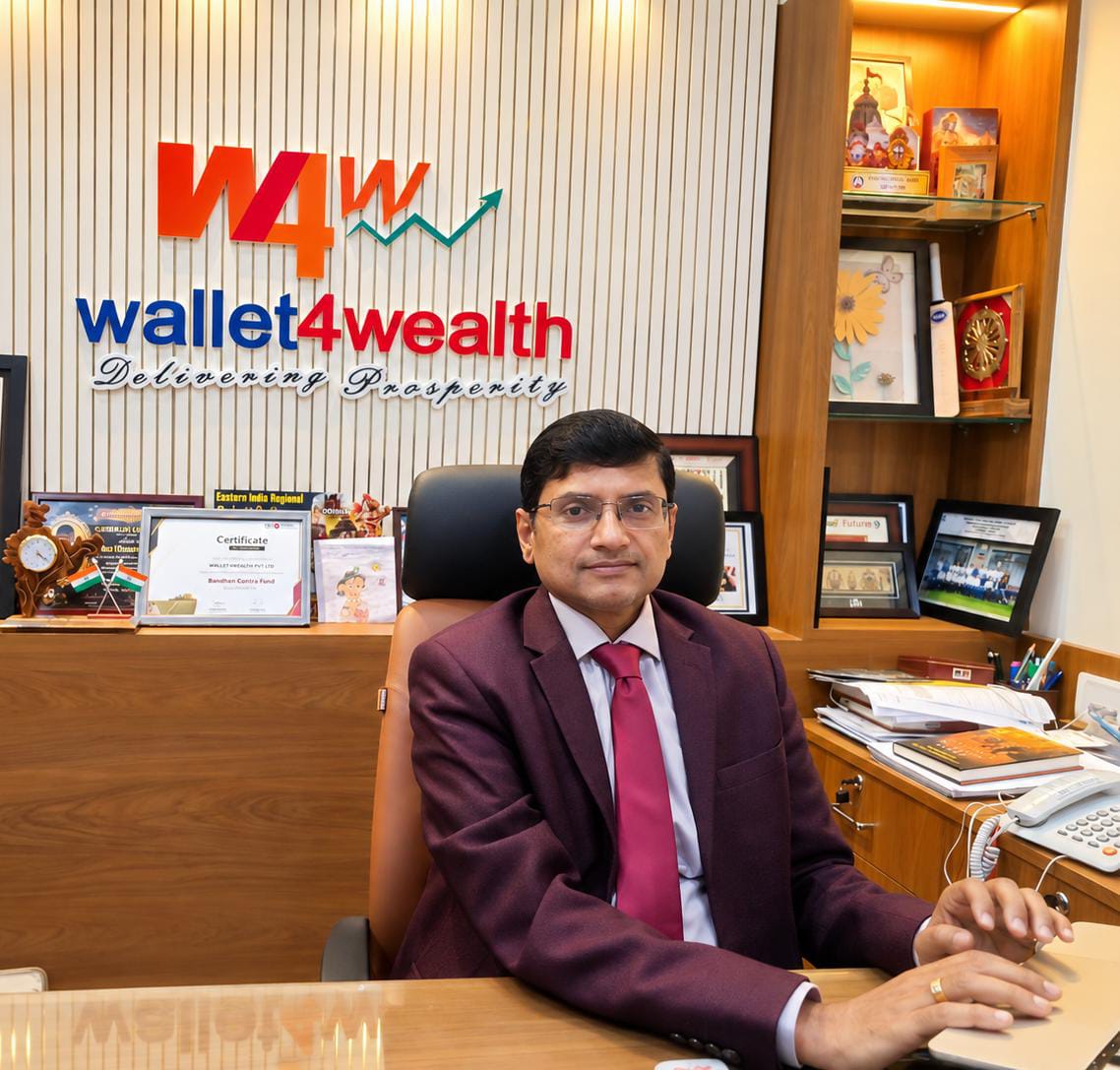
Wallet4Wealth’s founder-MD says trust, education and purpose, not products, are what make financial services last
Leaving the Corner Office for a Calling
Trinath Lenka started his career at Karvy Stock Broking in 2000 and later became Deputy Vice President and Regional Head at Edelweiss. Along the way he came to believe that wealth management should go beyond selling products. In 2016 he left the corporate track and founded Wallet4Wealth from Odisha, with a team of three, limited resources and a clear vision. The first year, he says, taught him that entrepreneurship is not about the best office or the biggest team. It is about credibility, consistency and the willingness to keep going when results do not come immediately. “If you build a business around trust, knowledge and service, growth becomes a consequence of your purpose rather than the only objective,” he says.
Advice That Starts with the Client, Not the Product
Mutual fund distribution earns commissions, and Lenka addresses this directly. He argues that a distributor’s duty is to act ethically, disclose relevant information and recommend only what suits the investor. At Wallet4Wealth that means looking at income, assets, liabilities, goals, time horizon, liquidity needs and risk capacity before any product is chosen. He insists that a product’s popularity must never be confused with its suitability, and that equities must never be sold as guaranteed returns. Trust is tested most when markets fall, he adds, because an adviser has to be there for anxious clients as well as for new investments. “A satisfied client may bring one more client, but a genuinely trusted institution can build relationships across generations,” he says.
The SIP Boom: Encouraging, but Not a Shortcut
Lenka calls the surge in mutual funds and systematic investment plans one of the most encouraging developments in India’s financial journey. He says SIPs build discipline, widen access and help young earners form a long-term habit. What worries him is the belief that an SIP guarantees wealth. It is only a method of investing, he stresses, and the outcome still depends on the underlying investment, the time horizon, costs and market conditions. He wants investors to understand the difference between saving, investing and speculation, and to keep emergency money out of equity volatility. Wallet4Wealth ties every investment to a goal, whether that is a child’s education, a home, retirement or financial independence. “Wealth creation is a marathon, not a sprint,” he says.
Warning Young Investors About Quick-Money Trading
Easy trading apps have made derivatives look simple, and Lenka cautions that they are not. Futures and options can be useful for hedging, but they can also cause heavy losses. Young people see screenshots of profits on social media, he notes, but rarely the losses, transaction costs, taxes and failed trades behind them. His advice is to first build emergency savings, buy appropriate insurance, understand asset allocation and learn the basics of long-term investing. He also puts responsibility on intermediaries and platforms. Risk disclosures must be meaningful, onboarding should promote informed participation, and financial education must be more than a disclaimer users click through. “India needs young people to become investors and wealth creators, not to feel compelled to gamble their savings,” he says.
The Mistakes Even Successful Professionals Make
Lenka has trained employees of NTPC, NALCO, HAL, BEML, ONGC, GAIL, HPCL and other PSUs, as well as retirees. He says even financially successful professionals make avoidable errors. They postpone planning, concentrate wealth in one asset class such as real estate, fixed deposits or equities, and buy products without understanding costs, liquidity or suitability. Many also fail to plan for retirement. A large corpus, he points out, is not the same as knowing how to manage it for 20 or 30 years against inflation, healthcare costs and longevity. The one habit he would have everyone adopt is an annual review of personal finances against clearly defined life goals. Every working professional, he says, should know their net worth, monthly savings, insurance cover, liabilities and retirement needs.
Bridging Odisha’s Financial Literacy Gap
Odisha has enormous potential, Lenka says, but financial inclusion and financial literacy have to advance together. Bank accounts and digital payments matter, but people also need to understand savings, inflation, insurance, taxation, fraud prevention and retirement planning. In smaller towns, families still lean on traditional savings and physical assets. The problem, he says, is not a lack of ambition but a lack of trustworthy guidance, practical education and professional services in their own towns and languages. He wants literacy programmes in schools, colleges, workplaces and community groups, delivered in local languages with familiar examples, and with banks, fund houses, distributors, regulators and government all taking part. His dream is that a young person in a small Odisha town gets the same quality of guidance as someone in Mumbai, Bengaluru or Delhi.
Technology Can Consolidate, but Only People Can Counsel
Wallet4Wealth’s app brings mutual funds, equities, bonds, fixed deposits and insurance into a single view. Lenka says such consolidation helps families see their full financial position, spot concentration and track progress towards goals. Technology also improves documentation, reporting and service across cities. But he is clear that an app cannot replace the planner who understands the family behind the numbers, including its responsibilities, fears and changing circumstances. Two investors of the same age putting in the same amount may need very different strategies. “The future of wealth management will belong to organisations that use technology to strengthen trust, not to replace it,” he says.
An Outlook for Middle-Class Households
On the Budget and the economy, Lenka says households must pay closer attention to the real purchasing power of their savings, the quality of their investments and the tax efficiency of their decisions. Inflation quietly erodes money parked in low-yielding instruments, while equities offer higher potential returns with higher volatility, so families need a balance of protection, liquidity, growth and income. He says changes to capital gains tax or the Securities Transaction Tax should be judged on their overall effect on long-term investment, liquidity, revenue and investor confidence. For middle-class families he recommends an emergency reserve, a review of health and life cover, regular goal-based investing instead of following market rumours, diversification by horizon and risk, and an annual review of tax planning, nominations, estate arrangements and retirement needs. Budget announcements and short-term market swings, he says, should not drive investment decisions.
Giving Back: Rotary, Parents and a Wider Purpose
Lenka measures success not only by business growth but by how many lives have improved. He served as President of the Rotary Club of Bhubaneswar Toshali for 2025–26 and dedicated his safe drinking water and alma mater initiatives to his parents, whom he calls a source of inspiration. During his tenure the club ran a mega health camp at Pailo village in Kendrapara, where more than 500 patients received treatment, along with other service projects. He believes supporting the next generation matters just as much, because education can transform an entire family. “My aspiration is to create wealth with purpose and to ensure that business success translates into social value,” he says.
Proving That Scale Can Start in Odisha
Between 2016 and 2026, Wallet4Wealth has grown from three people to more than 100 direct employees across 25 cities and 14 states. Lenka says many people once assumed a nationally ambitious financial firm had to come from a metro. He disagreed, believing geography should not decide the scale of one’s ambition. Growth meant building teams and processes, deepening client relationships and keeping service standards consistent across locations, and it was not without setbacks. It also required patience, financial discipline and the courage to keep investing in a long-term vision. He calls the milestone a beginning rather than a destination. “The biggest achievement is proving that an entrepreneur from Odisha can build a nationally relevant financial-services organisation from the state itself,” he says.
Serving Every Stage of Life
Lenka says financial needs do not end with buying a product, because they change across a lifetime. Young professionals need help with savings, insurance and wealth creation. Families need support on education, retirement and tax. Retirees need help with pensions, regular income and managing accumulated wealth. Beyond mutual funds and financial planning, Wallet4Wealth offers assistance on NPS, PPF, the Senior Citizens’ Savings Scheme, RBI bonds, tax matters, leave encashment, VRS and EPS-95 pension issues. Senior citizens, he notes, often also need help with documentation, procedures and increasingly digital systems. When a client brings a problem, he says, the aim is a practical solution, even when that solution is not another investment product.
Education, Healthcare and Opportunity for Girls
Lenka says a company’s responsibility extends beyond commerce, and that talent exists everywhere while opportunity does not. He calls support for girls’ education especially meaningful because a girl who completes her studies lifts an entire family and, often, later generations. Healthcare assistance, he adds, helps families who would otherwise delay treatment for financial or practical reasons. Wallet4Wealth has been associated with medical assistance and health camps, including Rotary-led initiatives, which he says depend on volunteers, doctors and community groups and cannot be achieved by one person alone. He did not give figures for girls supported or patients treated, saying these should be taken from documented programme records. “A business becomes more meaningful when its growth enables it to contribute to education, healthcare and the well-being of society,” he says.
One Philosophy Across 14 States and Beyond
Expanding nationally, Lenka says, takes more than opening offices. It takes an understanding of regional markets, the right people, common operating standards and responsiveness to local needs. Each Wallet4Wealth location follows shared standards on compliance, service and investor education while serving its own clients. He says smaller industrial towns and emerging business centres deserve the same professional guidance as the big cities. The firm’s network includes Bhubaneswar and Jharsuguda in Odisha, Mumbai (including its Dadar East corporate-office presence), Chennai (including Anna Salai) and Korba in central India. The Invest Odisha conclave in Tokyo, which Lenka helped arrange, was meant to connect the state’s strengths in industry, minerals, manufacturing and infrastructure with international business interest. “Our approach is to combine local roots with a national outlook and an openness to global opportunities,” he says.
A Lifelong Commitment to Financial Education
Lenka traces his commitment to financial education back to 2000, when he saw how a lack of understanding could turn market opportunities into poor decisions. That conviction took him into literacy programmes, corporate training, investor-awareness drives and sessions with employees, retirees and community groups. The lesson he took away is that people do not need complicated jargon. They need practical guidance tied to their salaries, family responsibilities, retirement and aspirations. He calls financial education a continuous responsibility rather than a campaign, because markets, products, regulations and people’s needs keep changing. Building Wallet4Wealth from Odisha was an extension of the same belief. He wants the firm to stand for financial knowledge, responsible wealth creation and service to society, and says that if it makes a real difference in those three areas, “I will consider our journey worthwhile.”
