
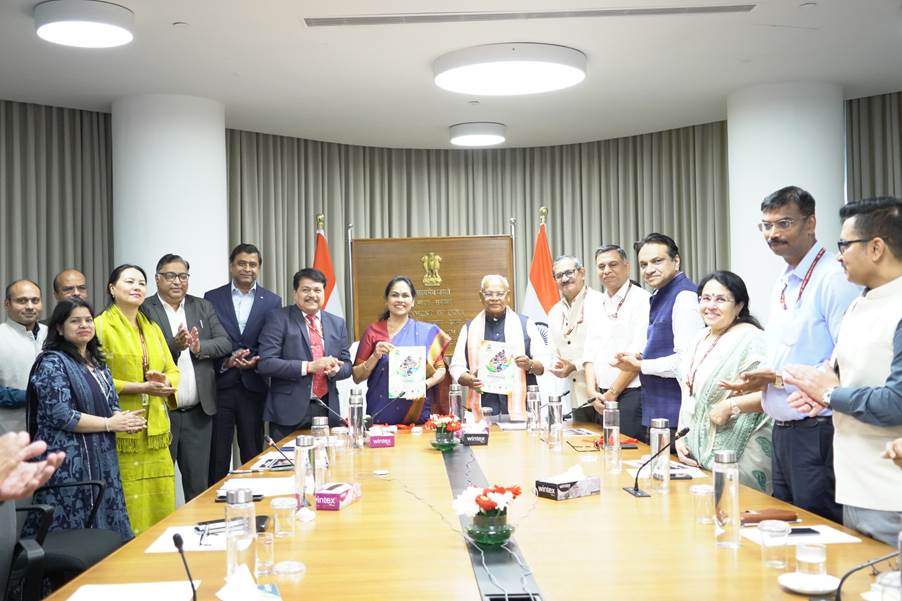
With ₹159 crore in profit after tax and a ₹47.76 crore dividend to the Government of India, the National Small Industries Corporation demonstrates how financial performance and enterprise development can strengthen India’s journey towards an Atmanirbhar Bharat.
By – Snigdha Mishra
New Delhi | October 30, 2026 | The Interview Times
India’s economic ambitions are often measured through major infrastructure projects, large corporate investments and expanding industrial corridors. Yet, beyond these headline-making developments lies another powerful engine of growth: the country’s micro, small and medium enterprises.
From manufacturing workshops and emerging technology ventures to traditional industries and service providers, MSMEs contribute to employment, entrepreneurship and industrial development across India.
At the centre of efforts to strengthen this ecosystem stands the National Small Industries Corporation Limited (NSIC), a Schedule ‘A’ Mini Ratna public sector enterprise under the Ministry of Micro, Small and Medium Enterprises.
Under the leadership of Dr. Subhransu Sekhar Acharya, Chairman-cum-Managing Director, NSIC has reported strong financial performance for FY 2025–26, reflecting the corporation’s institutional role in supporting smaller businesses.
On October 28, 2026, Dr. Acharya presented a ₹47.76 crore dividend to the Government of India, marking an important development in the corporation’s financial journey.
The announcement, issued by the Ministry of MSME on October 29, highlighted not only NSIC’s financial results but also its continuing commitment to strengthening entrepreneurship, enterprise creation and industrial competitiveness.
A Financial Performance That Reflects Institutional Strength
For FY 2025–26, NSIC reported revenue of ₹3,767 crore and profit after tax of ₹159 crore.
The figures represent growth over the preceding financial year, according to the Ministry’s official announcement.
The corporation also presented a dividend of ₹47.76 crore to the Government of India, reflecting its capacity to generate financial returns while continuing its public-sector responsibilities.
The dividend was presented by Dr. Acharya to Shri Jitan Ram Manjhi, Union Minister for Micro, Small and Medium Enterprises, and Sushri Shobha Karandlaje, Minister of State for MSME.
The presentation took place in the presence of Shri Bharat Khera, Secretary, Ministry of MSME, along with senior officials of the Ministry and NSIC.
The occasion brought attention to the importance of financially sustainable public enterprises that also serve wider economic and developmental objectives.
For NSIC, the challenge extends beyond achieving revenue and profitability. Its broader responsibility lies in making business support more accessible to enterprises that may lack the resources, networks or market reach available to larger corporations.
Dr. Subhransu Sekhar Acharya and the Leadership Behind NSIC’s Progress
Leadership in a public sector enterprise requires a balance between commercial discipline and developmental responsibility.
For Dr. Subhransu Sekhar Acharya, the latest financial results represent an opportunity to demonstrate how institutional performance can complement national priorities.
During the dividend presentation, Dr. Acharya highlighted NSIC’s financial achievements and the growth recorded during the financial year.
The Ministry’s statement associated the corporation’s performance with effective management, sustained financial progress and its commitment to improving MSME competitiveness.
This combination is particularly significant for an organisation whose responsibilities extend across enterprise support, market facilitation, skills and entrepreneurship development.
As India’s smaller businesses navigate changing technology, competition and customer expectations, the relevance of institutions such as NSIC increasingly depends on their ability to respond to practical business challenges.
The larger measure of success is therefore not only how strongly NSIC performs as an enterprise, but also how effectively its services support the businesses it was established to serve.
Why NSIC Matters to India’s Enterprise Economy
India’s MSME sector represents an extensive network of entrepreneurs, manufacturers, traders and service providers.
Many of these enterprises operate with limited capital, smaller teams and fewer opportunities to access large markets.
While entrepreneurial ambition is widespread, translating an idea into a sustainable business can involve significant obstacles.
Access to raw materials, technology, technical expertise, financing, marketing channels and institutional guidance can influence whether an enterprise survives its early years and achieves long-term growth.
NSIC plays an important role in addressing parts of this challenge through its business support and facilitation activities.
Its institutional framework includes assistance associated with marketing, technical services, skills development and other enterprise-support mechanisms.
Such services are important because the success of smaller businesses often depends on their ability to connect with larger supply chains and adapt to evolving industrial requirements.
When smaller enterprises become more competitive, their growth can support employment, local production and economic activity across different regions.
Beyond Profitability: Building an Ecosystem for Entrepreneurs
The Ministry’s announcement placed particular emphasis on NSIC’s contribution to entrepreneurship and enterprise development.
During the dividend presentation, Union MSME Minister Jitan Ram Manjhi appreciated the corporation’s role in supporting smaller businesses through integrated services and the implementation of government initiatives.
The Ministry also expressed confidence in NSIC’s continuing contribution to entrepreneurship, enterprise creation, skill development and the growth of micro and small enterprises.
These priorities reflect a broader economic challenge.
India requires not only successful large companies but also a strong network of smaller businesses capable of innovating, manufacturing, supplying services and creating employment.
An effective MSME ecosystem can help distribute economic opportunities beyond major industrial centres.
It can also encourage first-generation entrepreneurs to participate in sectors where entry barriers may otherwise appear difficult to overcome.
For young entrepreneurs, particularly those entering manufacturing and technology-driven industries, institutional support can provide a valuable connection between ambition and execution.
Technology, Skills and the Changing Needs of Small Businesses
The future competitiveness of India’s MSMEs will depend increasingly on technological readiness and workforce capabilities.
Manufacturing methods are evolving, digital platforms are changing how businesses reach customers, and new technologies are influencing production, quality control and operational efficiency.
For smaller enterprises, adapting to these changes can be expensive and technically demanding.
This makes access to training, modern equipment, technical facilities and market information particularly important.
NSIC’s wider institutional activities include technical and skill-development support intended to help enterprises improve their capabilities.
For example, the Ministry’s FY 2025–26 annual report records the establishment of a high-technology tool room at the NSIC Technical Services Centre in Chennai, supporting access to advanced manufacturing technologies and technical training.
Such initiatives illustrate the importance of connecting enterprise development with practical skills.
As India seeks to expand its manufacturing capabilities, the ability of smaller businesses to adopt modern technology will influence the strength of the country’s industrial supply chains.
A Stronger MSME Sector for an Atmanirbhar Bharat
The vision of an Atmanirbhar Bharat is closely connected with the ability of Indian enterprises to develop competitive products, strengthen domestic production and participate in wider markets.
For this ambition to become sustainable, smaller businesses must be able to grow alongside larger industries.
An industrial economy requires manufacturers, component suppliers, logistics providers, engineering firms, technology businesses and service enterprises working within interconnected supply chains.
MSMEs form an important part of these networks.
Their growth can strengthen local industrial ecosystems while creating opportunities for entrepreneurs and skilled workers.
In this context, NSIC’s financial performance carries a significance that extends beyond its balance sheet.
A financially capable institution is better positioned to sustain its operations and pursue its mandate, although the impact of its programmes must ultimately be assessed through outcomes for the enterprises receiving support.
The central question is how institutions can combine commercial efficiency with measurable improvements in business competitiveness and access to opportunity.
Odisha and the Opportunity for Regional Enterprise Development
The relevance of MSME development is especially visible in states such as Odisha, where industrial expansion is creating opportunities across manufacturing, mining-related services, food processing, engineering, logistics and other sectors.
Large industrial projects can generate demand for a broad network of smaller suppliers and service providers.
However, local businesses must possess the technical capabilities, quality standards, financing and market access required to participate in these opportunities.
This creates a strong case for enterprise-support institutions, industry bodies and training organisations to work together.
For Odisha’s emerging entrepreneurs, the opportunity lies not only in starting independent businesses but also in becoming reliable partners within larger industrial value chains.
Greater emphasis on technical skills, market readiness and enterprise development could help translate regional industrial growth into broader economic participation.
NSIC’s national mandate is relevant to this objective, even though the latest dividend announcement did not specify new investments or programme commitments for Odisha.
The Road Ahead: Financial Strength with Developmental Purpose
The latest dividend presentation marks another milestone in NSIC’s financial performance.
With ₹3,767 crore in revenue, ₹159 crore in profit after tax and a ₹47.76 crore dividend, the corporation has demonstrated its ability to generate financial returns while operating within a developmental mandate.
But the future significance of NSIC will be determined by more than financial indicators.
As Indian enterprises face new market pressures and technological changes, the corporation’s continuing relevance will depend on how effectively its services help smaller businesses become more resilient, productive and competitive.
For Dr. Subhransu Sekhar Acharya and the institution he leads, the opportunity is to build on financial progress while strengthening the practical support available to India’s entrepreneurs.
India’s economic transformation will require investments of every scale—from major industrial projects to small businesses that grow into successful employers and manufacturers.
The country’s journey towards an Atmanirbhar and Viksit Bharat will be shaped not only by the strength of its largest industries, but also by the opportunities created for its smallest enterprises.
And in that journey, institutions such as NSIC have an important role to play.
The Interview Times | Business Leadership • MSME Development • Nation Building
