
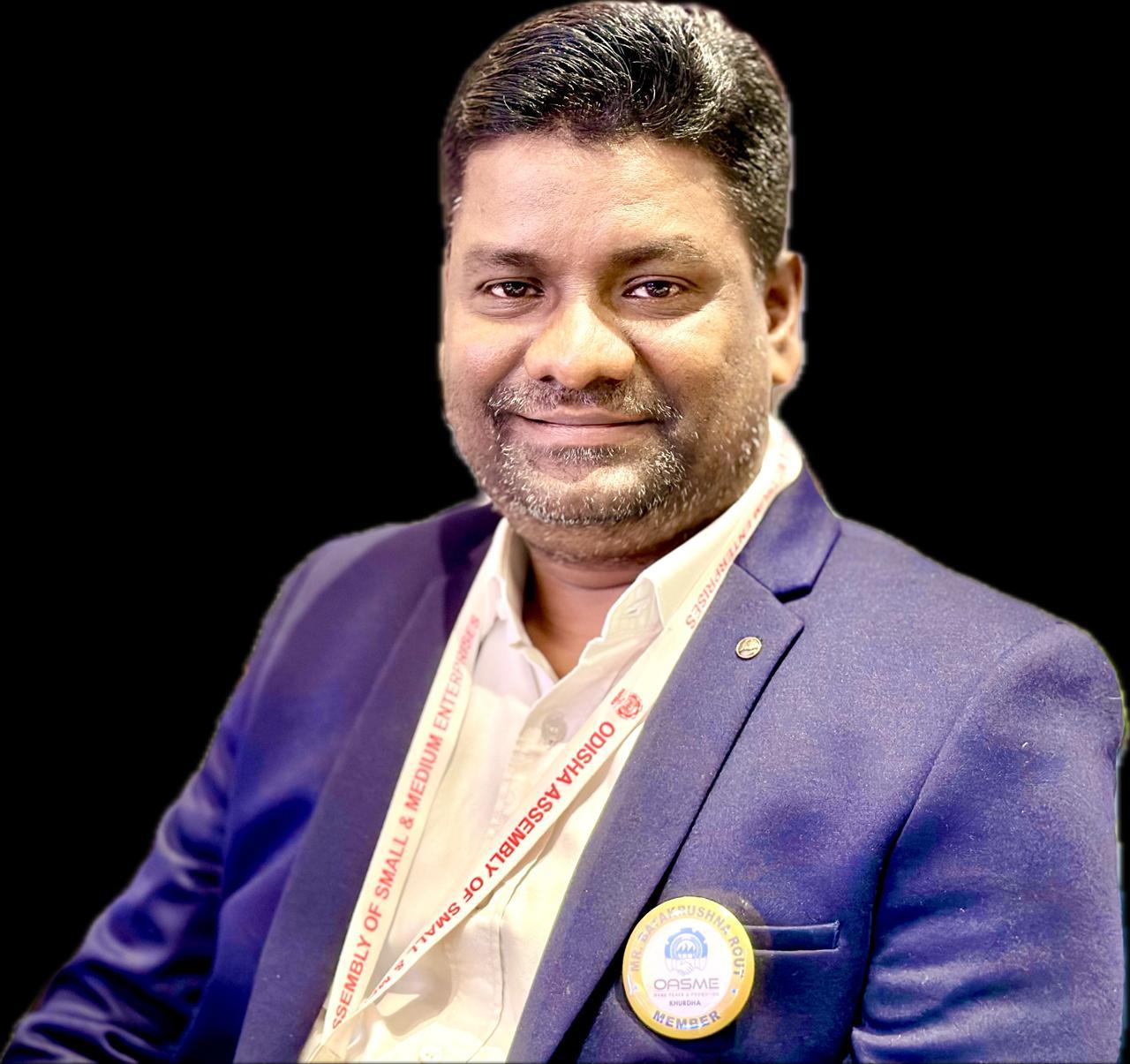
From a modest beginning in construction-material supply to manufacturing and plans for diversification, the entrepreneur is looking towards new opportunities in logistics, food processing and hospitality, with employment generation at the centre of his long-term vision.
Bhubaneswar, Odisha: Every entrepreneurial journey begins with an idea, but turning that idea into a sustainable business requires determination, adaptability and the willingness to learn from experience. For Batakrushna Rout, Managing Director of Shree Jayram Udyog Private Limited, the journey has been shaped by these principles. Beginning with sand and aggregate supply, he gradually expanded his business interests into transportation and construction-material manufacturing. Today, the company is looking towards a broader future, exploring opportunities in fly-ash-brick manufacturing, logistics, food processing and hospitality.
Based in Chandaka Industrial Estate, Patia, Bhubaneswar, Shree Jayram Udyog operates in the construction-material sector, with activities associated with sand, aggregates, crushed stone, fly-ash bricks and concrete blocks. Its future plans reflect an ambition to build on this foundation, strengthen existing capabilities and explore new business opportunities that could contribute to industrial development and employment in Odisha.
For Rout, growth is not simply about increasing the scale of a business. It is also about identifying opportunities, developing reliable business relationships, improving operational capacity and creating a stronger foundation for the years ahead.
The Beginning: A Decision to Build Something of His Own
Rout’s entrepreneurial journey was featured in Interview Times on 26 July 2022 under the headline “The Dripper of Construction.” The interview traced his decision to pursue entrepreneurship after completing his MBA in 2002, choosing to establish his own business rather than follow a conventional employment path.
His early business activities focused on supplying sand and aggregates, materials essential to construction and infrastructure development. One of the milestones highlighted in the interview was his initial delivery of ten truckloads of material to Infosys in Bhubaneswar, through a business relationship involving CCCL.
The beginning was modest. Instead of immediately investing in a large fleet, Rout hired vehicles belonging to people from his village to transport materials. This approach allowed him to begin operations while making use of the resources and relationships available to him.
As the business developed, he gradually expanded his transportation capacity and moved towards owning vehicles. The experience demonstrated how a small operation could become the foundation for a larger enterprise through persistence, planning and the ability to respond to business opportunities.
The early years also required him to manage practical challenges, from coordinating vehicles and drivers to ensuring timely deliveries and maintaining customer relationships. These responsibilities formed an important part of his experience as an entrepreneur in a sector where reliability and execution directly affect business performance.
Rather than remaining limited to material supply, Rout continued to explore new possibilities. This willingness to evolve eventually led towards manufacturing, opening another chapter in the development of his business.
From Material Supply to Manufacturing
The transition from supplying construction materials to manufacturing them represents an important stage in Rout’s business journey. According to his earlier Interview Times profile, he obtained an industrial site through IDCO in 2009 with the intention of establishing manufacturing operations. He subsequently installed machinery for producing hollow and solid blocks before exploring fly-ash-brick manufacturing.
This progression reflects a practical approach to business expansion: building on existing market knowledge while gradually entering activities that offer additional opportunities.
Construction-material supply requires an understanding of customer requirements, transportation, availability and delivery schedules. Manufacturing adds another layer of responsibility, including production planning, machinery, quality control, raw-material procurement and operational efficiency.
By developing interests across these connected activities, Rout sought to build a business with capabilities extending beyond trading and transportation.
Shree Jayram Udyog Private Limited was incorporated in September 2022, according to corporate-registration records. The company’s registered address is at Chandaka Industrial Estate, Patia, Bhubaneswar, and its directors include Batakrushna Rout and Truptimayee Rout.
The company’s development therefore brings together an entrepreneurial journey that began earlier and a formal corporate structure established in 2022.
Building Trust Through Quality and Customer Relationships
In the construction-material sector, customer confidence depends on more than the availability of products. Consistent quality, dependable delivery, responsive communication and the ability to address concerns are equally important.
Rout’s earlier interview highlighted the importance he placed on commitment, responsibility and hard work. It also described the company’s approach to addressing customer dissatisfaction, including a return policy for materials that did not meet expectations.
Such an approach reflects the value of accountability in a competitive market. Construction projects often operate within demanding schedules, and delays or material-related problems can affect multiple stages of work. Suppliers who understand these requirements can strengthen their relationships with contractors, developers and institutional buyers.
The company’s experience in transportation is also relevant to this business model. Coordinating vehicles, drivers and deliveries requires careful attention to timing, communication and operational management. As operations expand, these capabilities can support more organised supply arrangements and help the business respond to changing customer needs.
For a growing enterprise, the long-term objective is not merely to secure individual orders but to develop relationships that encourage repeat business and create opportunities for future collaboration.
A Growing Network Across Construction and Infrastructure
Over the course of his business journey, Rout has discussed relationships with organisations operating in construction, infrastructure and other sectors. His 2022 Interview Times profile referred to names including Infosys, Z1, DLF, Mindtree, TCS, LV Prasad Eye Hospital, Ahluwalia and SPCL.
Additional information supplied for this profile identifies possible or reported business relationships involving KIIT University, Wipro, Mayfair Patia and Seafood Park, alongside references to cement-sector companies such as UltraTech Cement, Shree Cement, Nuvoco and ACC Cement.
These names indicate the breadth of organisations and projects associated with the company’s business network. However, the precise nature of each relationship should be confirmed before publication, since an organisation may be a customer, supplier, contractor, project partner or a participant in the wider construction supply chain.
The reported connection with Mayfair Patia and the Seafood Park project is particularly worth exploring further. Confirming the exact project, the materials supplied and the nature of the company’s involvement would provide concrete examples of how its construction-material operations contribute to specific developments.
As the company continues to pursue new opportunities, strengthening its relationships with developers, contractors, institutions and suppliers could remain an important part of its growth strategy.
Strengthening Fly-Ash-Brick Manufacturing
Manufacturing remains central to the company’s future ambitions. The expansion information provided for this profile refers to two fly-ash-brick manufacturing units and a production figure of approximately 30,000–40,000 units. The applicable time period and whether the figure refers to each unit or their combined output remain to be confirmed.
Fly-ash bricks are used in building construction and incorporate fly ash, an industrial by-product, as a raw material. Their production offers manufacturers an opportunity to serve the construction market while making productive use of an industrial material.
For Shree Jayram Udyog, expanding manufacturing capacity could strengthen its existing position in construction materials and help it respond to changing market requirements. Additional capacity, if implemented, would also bring opportunities to develop production planning, workforce skills, procurement and distribution.
The next stage of expansion will depend on the current status of the units, investment, machinery, production capacity and the availability of suitable industrial infrastructure. Clarifying these details will help establish the scale and timeline of the company’s manufacturing plans.
A central consideration will be maintaining consistent product quality while ensuring that any increase in production is supported by adequate operational and distribution capacity.
The Larger Manufacturing Vision
Rout’s ambitions have previously extended beyond the company’s immediate operations. The 2022 Interview Times profile described his vision of developing a major manufacturing facility near Trisulia, intended to bring together quality construction-material manufacturing and create employment and learning opportunities for more than 500 people.
This earlier vision demonstrates the scale of his long-term aspirations. It also provides context for the newer expansion plans shared for this profile, although the current status of the Trisulia proposal and its relationship to the newer projects must be confirmed.
Large manufacturing ambitions require more than land and machinery. They depend on investment, reliable raw-material supply, skilled workers, transport infrastructure, regulatory compliance and access to sustainable markets. Turning a long-term vision into an operating facility involves translating these requirements into a workable development plan.
The company’s future progress will therefore depend on how effectively it combines its existing experience with the resources and capabilities required for larger projects.
Exploring Logistics and New Business Opportunities
Beyond construction materials, the information provided for this profile identifies logistics as another area of interest. This is a natural area to explore given Rout’s experience in transporting sand, aggregates and other construction materials.
Logistics involves coordination, movement of goods, delivery planning and the management of supply chains. Building on experience in these areas could provide opportunities to develop more organised transportation and distribution services, subject to the company’s specific plans and investment decisions.
The proposed diversification also includes masala repackaging, reprocessing and manufacturing. This would introduce the company to a different sector, with distinct requirements for sourcing, processing, packaging, quality assurance, food safety and distribution.
Entering food-related manufacturing would require careful planning and the appropriate registrations, licences and infrastructure. It would also call for a clear understanding of target markets and consumer demand.
Together, these proposed activities reflect an interest in broadening the company’s business base rather than relying exclusively on construction materials. The details of the projects, including their locations, ownership structures, implementation timelines and operational status, remain to be confirmed.
Government-Linked Industrial Development and Land
The expansion information shared for this profile also refers to government-related industrial initiatives and land obtained or proposed for two projects.
Industrial land and infrastructure can be important factors in establishing manufacturing facilities, particularly when businesses need room for machinery, storage, transport access and future expansion. Odisha’s industrial development framework provides a context in which enterprises can explore manufacturing opportunities.
However, the precise land allotments associated with Rout’s proposed projects have not been independently established through the information reviewed for this article. The relevant plots, allotment documents, project names and current development status should therefore be confirmed before specific claims are made about government support or project approvals.
If these projects progress, their development could mark another step in the company’s transition from an established construction-material business towards a more diversified enterprise.
Hospitality: An Additional Avenue for Growth
Hospitality is another sector identified in the company’s future plans. The information provided refers to a proposed four-star hotel, with an estimated employment requirement of approximately 60 people.
A hospitality venture would represent a significant move beyond the company’s established activities. Unlike manufacturing and material supply, the hotel business depends heavily on service quality, guest experience, staffing, operational management and sustained demand.
If developed, the project could create opportunities across hotel operations, administration, housekeeping, food services, maintenance and other related functions. It could also create indirect opportunities for local suppliers and service providers.
The proposed hotel’s location, investment, development stage, approvals and expected opening date remain to be confirmed. Until these details are established, it should be described as a future proposal rather than an operational business.
Nevertheless, its inclusion in the company’s expansion vision indicates an interest in exploring opportunities across more than one sector.
Employment Generation and Local Opportunity
Employment generation is an important part of the company’s stated ambitions. The newer information supplied for this profile identifies a target of approximately 200 jobs across the planned business activities, while the proposed four-star hotel is associated with an estimated 60 positions.
These figures should be understood as targets or estimates, not as confirmed current employment numbers. The final number of jobs will depend on which projects proceed, their operational scale and their implementation timelines.
The earlier ambition to create more than 500 employment and learning opportunities through a proposed manufacturing facility near Trisulia is a separate, longer-term vision reported in the 2022 interview. Its present status and relationship to the newer employment target should be clarified by the company.
Beyond direct employment, construction-material manufacturing and logistics can create work for transport operators, machine operators, production workers, technicians, suppliers, distributors and other service providers. Food processing and hospitality would require additional skill sets and could create different kinds of employment if the proposed ventures are implemented.
For the company, a meaningful measure of progress will be the ability to translate its employment ambitions into stable jobs, appropriate training and sustainable operations.
Social Responsibility and a Wider Perspective
Rout’s earlier Interview Times profile also described his involvement in business associations and social-welfare organisations. The roles listed at that time included positions connected with small and medium enterprises, truck transport, civic safety and social welfare.
These reported associations offer another dimension to his entrepreneurial profile, suggesting an interest in the wider business and social environment in which an enterprise operates. The current status of these positions and activities should be verified before they are presented as ongoing commitments.
Entrepreneurship can influence communities in several ways: through employment, relationships with local suppliers, demand for transportation and services, and opportunities for people to develop practical skills. The extent of that contribution depends on how businesses operate and how their growth translates into tangible benefits.
For an entrepreneur seeking to expand across manufacturing and other sectors, maintaining constructive relationships with workers, suppliers, business organisations and the surrounding community can be an important part of long-term development.
An Entrepreneurial Mindset Focused on Growth
One of the strongest themes emerging from Rout’s earlier profile is his willingness to accept responsibility and learn through experience. He described responsibility as an opportunity to learn and grow rather than remain still and satisfied with existing achievements.
That outlook is relevant to the challenges of running a business in a competitive sector. Growth involves making decisions under uncertainty, responding to customer expectations, managing costs and adapting when market conditions change.
Rout’s journey also illustrates the value of building gradually. His early reliance on hired vehicles, subsequent expansion of transport capacity and eventual move into manufacturing show a progression from using available resources to developing greater operational capability.
The next stage presents a different set of challenges. Expanding manufacturing, entering food processing, developing logistics operations and pursuing hospitality would require sector-specific expertise, careful financial planning and the ability to manage multiple activities without compromising the quality of existing operations.
A positive outlook, in this context, is not simply about pursuing more opportunities. It is about evaluating those opportunities carefully, building the right capabilities and implementing plans in a sustainable way.
Looking Ahead: Building on Experience, Preparing for the Future
Shree Jayram Udyog’s story is one of evolution: from construction-material supply and transportation towards manufacturing, with further opportunities under consideration. Rout’s entrepreneurial journey provides the foundation for this next phase, while the company’s future plans indicate an ambition to explore a broader range of business activities.
The proposed expansion of fly-ash-brick manufacturing, exploration of logistics and food processing, government-related industrial development and the planned hospitality venture represent different possibilities for future growth. Each will require its own investment, infrastructure, approvals and implementation strategy.
The company’s immediate priority will be to strengthen its established operations while determining which new projects are ready to proceed. Clear timelines, confirmed production targets, reliable market relationships and realistic employment plans will be essential to turning ambition into measurable progress.
For Batakrushna Rout, the next chapter is an opportunity to build on the lessons of his early entrepreneurial journey and explore how an established construction-material business can develop into a more diversified enterprise.
If successfully implemented, the proposed initiatives could open new avenues for manufacturing, business development and employment in Odisha. Ultimately, the strength of this vision will be measured not only by the scale of the plans but by the quality of execution, the sustainability of the businesses established and the opportunities they create for people and communities.
