
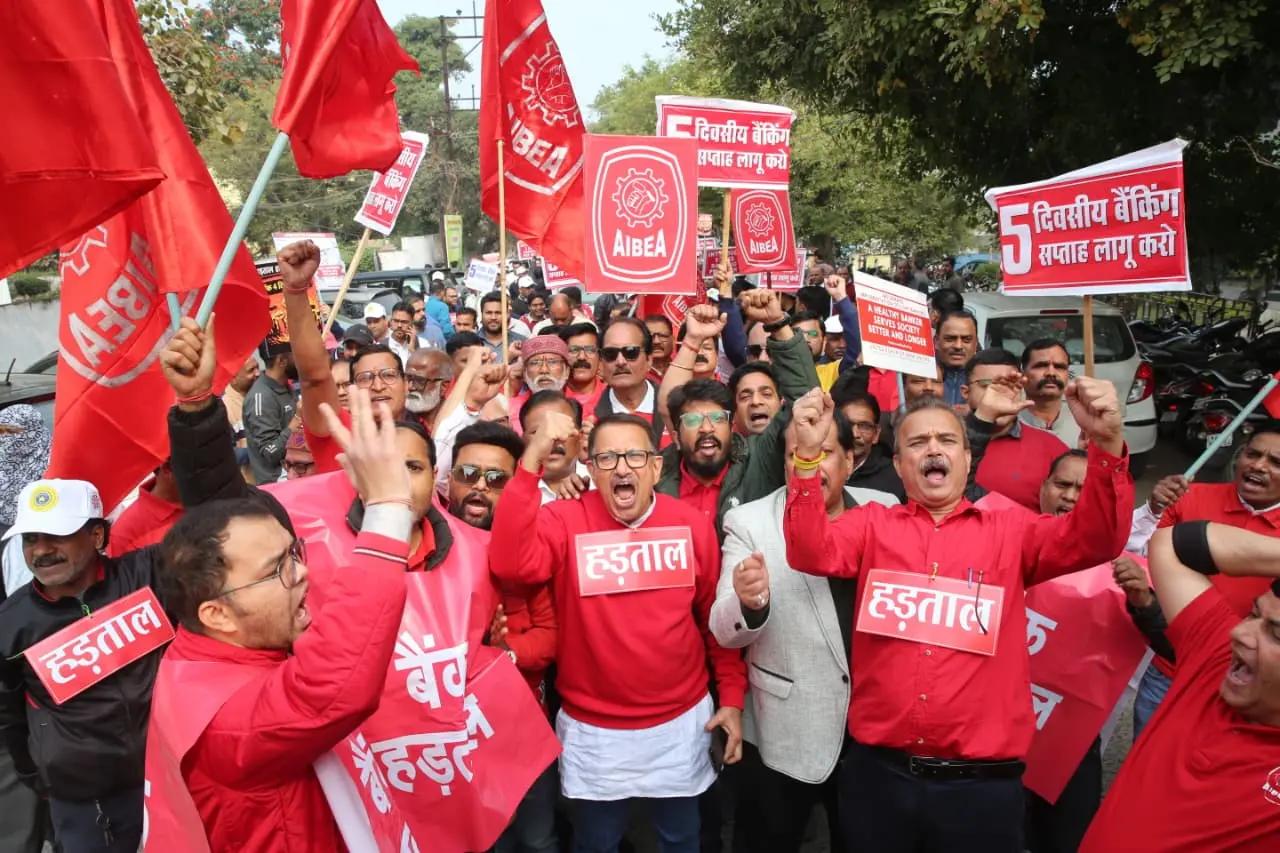
Banking operations have been disrupted across several parts of India today as employees and officers affiliated with the United Forum of Bank Unions (UFBU) observe a nationwide strike over long-pending demands, with the introduction of a five-day banking week at the centre of the agitation.
The UFBU is an umbrella body representing seven major bank employees’ and officers’ unions. The unions say they are pressing the government and bank management to implement the five-day week agreement and address outstanding employee-related issues.
The impact has been particularly visible in public-sector banks, while many private-sector banks are continuing operations, although the extent of disruption varies from institution to institution.
Why are bank employees striking?
The principal demand is the implementation of a five-day banking week, under which Saturdays would become holidays and banks would operate from Monday to Friday.
The unions point to the March 2024 settlement and joint note between the Indian Banks’ Association and employee organisations, under which employees had agreed to work additional hours during weekdays in exchange for a five-day week. The unions argue that implementation has still not taken place.
The unions are also raising concerns about the Performance Linked Incentive (PLI) system, along with wage, pension and other service-related matters.
What banking services are being affected?
The biggest impact is on branch-based, physical banking services.
Customers may experience difficulties with:
- Cash deposits and withdrawals at branches
- Cheque-related processing
- Passbook updates
- KYC-related work
- Locker services
- Certain loan and documentation services
- Pension-related branch work
- Some back-office and clearing operations
However, UPI, internet banking, mobile banking and ATM services are generally expected to remain available, subject to normal technical and cash-availability conditions.
What about SBI, PNB and other major banks?
The situation is slightly more complicated than simply saying that “all banks are closed.”
Banks including SBI and PNB have issued customer advisories, asking customers to use digital channels, ATMs and other available services for essential transactions. SBI has also said arrangements have been made to maintain essential services, while warning that branch-level work could nevertheless be affected by employee participation in the strike.
Therefore, customers should check their particular branch or bank before assuming that it is closed.
Protests reported across cities
The strike has moved beyond workplace action, with demonstrations being held in several cities.
In Bhopal, UFBU-affiliated unions organised a protest march demanding implementation of the five-day banking week. Similar demonstrations have been reported in Chennai.

Madhya Pradesh sees major participation
The scale of the disruption is particularly evident in Madhya Pradesh.
According to reports from The Times of India, around 42,000 bank employees across approximately 7,000 branches in the state participated in the strike, affecting banking business estimated at nearly ₹5,500 crore for the day.
The figures underline why the dispute is receiving attention beyond the banking sector: a nationwide strike involving such a large workforce can have a measurable effect on everyday commercial activity.
Customers could face an extended disruption
The timing of today’s strike is significant.
September 11 is followed by:
September 12 — Second Saturday
September 13 — Sunday
In some states, September 14 is also a bank holiday for Ganesh Chaturthi.
As a result, customers in some parts of the country could face several consecutive days without normal branch operations, even though the reasons for the closures are different.
More strikes have been announced
Today’s action is also not necessarily the end of the dispute.
Bank unions have announced another three-day strike from September 28 to September 30, while an indefinite nationwide strike has been announced from October 26 if their demands remain unresolved.
That could make the issue considerably more consequential for businesses and customers if negotiations fail to produce a settlement.
What should bank customers do?
For anyone needing urgent branch-based services, the safest approach is to contact the individual branch before visiting.
For routine transactions, customers can continue to rely on:
UPI • Mobile banking • Internet banking • ATMs • Bank apps
Those needing cash should also avoid leaving withdrawals until the last moment, since ATM availability can vary according to local cash replenishment.
The bigger question
The bank strike has brought renewed attention to a question that affects millions of Indians: should India’s banking system finally move to a complete five-day working week?
For bank employees, the issue is about working conditions and implementation of an earlier understanding. For customers, however, the immediate concern is uninterrupted access to essential banking services.
With further industrial action already announced for later this month and October, the standoff between bank unions and authorities could become one of the more significant labour disputes in India’s financial sector this year.
