
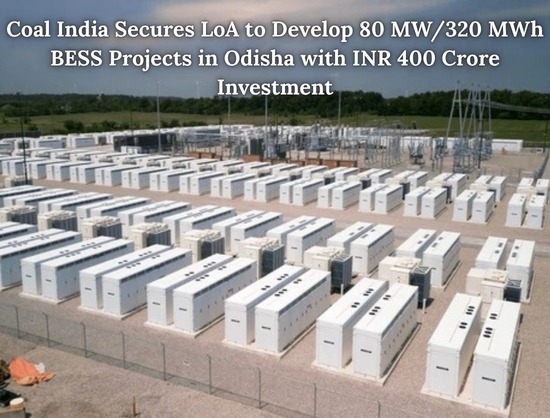
In a significant move that reflects the evolving dynamics of India’s energy sector, Coal India Limited has secured a ₹400 crore contract from GRIDCO Limited to build a 320 MWh Battery Energy Storage System (BESS) in Odisha. For a company long identified with coal, the development reads as more than a routine contract; it signals a gradual but deliberate shift towards the future of energy. The project, with a storage capacity of 320 megawatt-hours, will be capable of supplying 80 MW of power for up to four hours. It will be developed across two clusters: Padampur – Bolangir and Bhatli – Basta and is expected to be completed within 18 months of formal agreement. While the numbers are substantial, the significance lies not just in scale, but in timing. As India leans more heavily into renewable energy, the need for reliable storage has moved from being optional to essential.
At its core, a Battery Energy Storage System performs a deceptively simple task: it stores excess power when supply is abundant and releases it when demand peaks. Yet, in practice, this function is transformative. Renewable sources such as solar and wind, while clean, are inherently inconsistent. Storage bridges this gap, smoothing out fluctuations and ensuring that electricity remains available when it is needed most. In a state like Odisha, where renewable capacity is steadily growing, such systems become the backbone of a stable grid. The tariff for the project hovering around ₹3 lakh per MW per month also points to a broader shift. Technologies that once seemed prohibitively expensive are now entering a space of commercial viability. This matters, because affordability will ultimately determine how quickly such solutions can be scaled across the country.
For Coal India, the implications run deeper than a single project. For decades, it has stood at the centre of India’s fossil fuel economy. Its entry into battery storage suggests not a rejection of its past, but an acknowledgment of what lies ahead. The energy transition is no longer abstract; it is unfolding in real time, compelling even legacy institutions to adapt. This project, then, becomes part of a larger narrative one where sustainability, resilience, and diversification are no longer aspirations, but necessities. For GRIDCO, the investment is both strategic and timely. As demand patterns grow more complex and renewable integration deepens, the ability to store and dispatch power efficiently will define the next phase of energy management.

Taken together, this partnership is less about a single contract and more about convergence between old energy and new, between certainty and change. In that sense, Coal India’s latest step is not just forward-looking; it is quietly transformative, marking the contours of a more balanced and sustainable energy future.
