
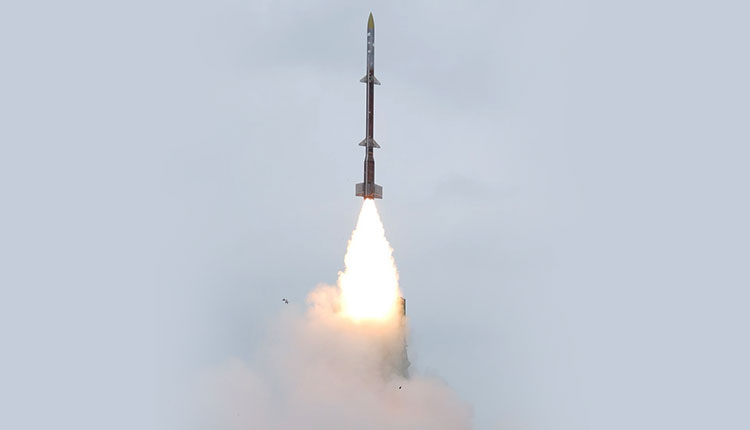
An important milestone in India’s air defense capabilities was reached when the Defence Research and Development Organization (DRDO) successfully carried out the first flight test of the domestic “Kusha” Long-Range Surface-to-Air Missile (LRSAM) from the Integrated Test Range at APJ Abdul Kalam Island off the coast of Odisha. An electronic target that simulated a high-speed, high-altitude aircraft danger was used for the first test. The Ministry of Defense claims that the missile effectively intercepted and neutralized the target, proving the efficacy of the recently created air defense system.
The ‘Kusha’ missile system has been designed to engage a wide range of aerial threats, including fighter aircraft, missiles, unmanned aerial vehicles (UAVs) and large enemy aircraft across an extended range and altitude envelope. The complete weapon system, including the missile, radar, command and control centre, has been developed indigenously by various DRDO laboratories in collaboration with industry partners. Defence Minister Rajnath Singh congratulated the DRDO and industry partners on the successful maiden test, describing it as a major milestone in India’s defence research and development programme. He said the achievement demonstrates India’s capability to develop advanced long-range surface-to-air missile systems, a technology currently possessed by only a handful of nations. He added that the system would significantly reduce the country’s dependence on imports while strengthening its air defence capabilities.
Rajesh Kumar Singh, the Secretary of Defence and Secretary of the Department of Defence R&D, who oversaw the launch operations, praised the engineers, scientists, and other staff members involved in the successful flight test. Under India’s domestic defense development program, the successful first testing is another significant step toward self-reliance in cutting-edge defense technology and is anticipated to strengthen the nation’s multi-layered air defense infrastructure.
