

Lord Bhairava is one of the most intense and revered deities in Hinduism, embodying both the ferocity and the compassion of Lord Shiva, his primary source. Known for his terrifying appearance and divine authority, Bhairava represents destruction, protection, and spiritual purification. Although his form can be fearsome, he is also a deeply protective and compassionate god who ensures the safety of his devotees and removes obstacles from their paths.
The Origin of Lord Bhairava
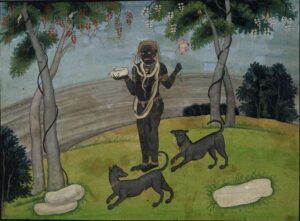
Bhairava’s origins are linked to Lord Shiva, who, in his form as Bhairava, took on a wrathful incarnation to maintain the cosmic order. The most famous myth surrounding Lord Bhairava involves the story of Brahma and Vishnu, which is recounted in several ancient Hindu texts, including the Puranas.
According to the legend, once Brahma and Vishnu were engaged in a dispute over who was superior. To resolve the matter, Shiva appeared as a huge column of fire (the Jyotirlinga), which was so immense that neither Brahma nor Vishnu could see its beginning or end. Vishnu, in an attempt to find the base of the column, took the form of a boar and burrowed deep into the earth, while Brahma transformed into a swan and flew upward.
Neither succeeded in their task, but Brahma, in a moment of dishonesty, lied about his quest to find the top of the fire. This angered Shiva, who emerged from the column as Bhairava, a terrifying and destructive form. To punish Brahma for his falsehood, Bhairava decapitated him, cursing that Brahma would no longer be widely worshiped. The head of Brahma was later transformed into a kala or skull, which Bhairava carries as his weapon.
The Iconography of Lord Bhairava
Lord Bhairava is often depicted as a fierce figure, embodying both terror and reverence. His iconography can be unsettling for some, but it also signifies the power to annihilate evil and purify the universe. Some of the typical features in depictions of Bhairava include:
- Appearance: Bhairava is often shown with a wild, matted hair, a fierce face with wide eyes, and a mouth that displays sharp teeth, creating a terrifying visage.
- The Garland of Skulls: One of the most distinctive features of Bhairava is the garland made of human skulls, symbolizing the annihilation of ego and the transient nature of life.
- Weapons: Bhairava is typically armed with a trident (trishul), which is a weapon of destruction, and a drum (damru), which symbolizes the rhythm of creation and destruction in the universe.
- Vehicle – A Dog: Bhairava is commonly depicted riding or accompanied by a dog, symbolizing loyalty, alertness, and the ability to protect. In some stories, the dog also symbolizes the protection of one’s inner spirit and the guide to the afterlife.
- Black or Red Color: The deity is sometimes portrayed in dark or fiery colors, further emphasizing his fierce and destructive nature.
Bhairava’s Role in Hinduism
While Bhairava’s appearance and powers may seem intimidating, his role is multifaceted. He is primarily regarded as a protector deity and a guardian against evil forces and spirits. His devotees believe that worshiping him removes fears, negates obstacles, and provides divine protection.
1. Guardian of Time and Space:
Bhairava is also seen as a deity who governs time and space. As a protector of the sacred, he ensures that the cosmic order is preserved. His role as a guardian extends to protecting temples and sacred shrines, where he is often invoked before entering sacred spaces to safeguard the devotees.
2. Destroyer of Evil and Negative Forces:
Bhairava is deeply associated with the destruction of negative energies, evil spirits, and harmful influences. In this sense, he acts as a destroyer, similar to Lord Shiva’s role as the force of annihilation, ensuring the renewal of life by eliminating the old, the unwanted, and the harmful.
3. Spiritual Purification:
Bhairava’s power is often linked to spiritual purification. His fierce form destroys the ego, the primary obstacle in spiritual growth, and removes impurities of the mind and soul. Devotees believe that through Bhairava’s grace, they can attain liberation (moksha) and overcome their limitations.
Worship of Lord Bhairava

Bhairava’s worship is particularly prevalent in specific regions of India, such as Kashmir, Rajasthan, and Tamil Nadu, as well as in Nepal. His temples are often located at sacred sites and places where the energies of protection and purification are believed to be concentrated.
Bhairava Ashtami:
One of the key festivals dedicated to Lord Bhairava is Bhairava Ashtami, which falls on the eighth day of the waning moon in the month of Kartika (October-November). Devotees fast, offer prayers, and participate in rituals to invoke his blessings for safety, prosperity, and spiritual growth.
Bhairava in Tantra and Occult Practices:
In the tradition of Tantra, Bhairava is often seen as the ultimate deity of the left-hand path, where his worship can involve rituals that seek to control and transcend ordinary consciousness. In these practices, Bhairava is revered not just as a god of destruction but as a deity who can lead the devotee to spiritual enlightenment.
Lord Bhairava, with his fierce and protective persona, holds a unique place in Hindu mythology and religious practice. His fearsome appearance masks his deeper qualities as a divine protector, purifier, and remover of obstacles. Through his worship, devotees seek safety, spiritual growth, and protection from evil forces. Bhairava reminds us of the paradoxical nature of the divine — that destruction and creation are intertwined, and that even the most terrifying forms can embody profound grace and compassion.
