Suparjya swain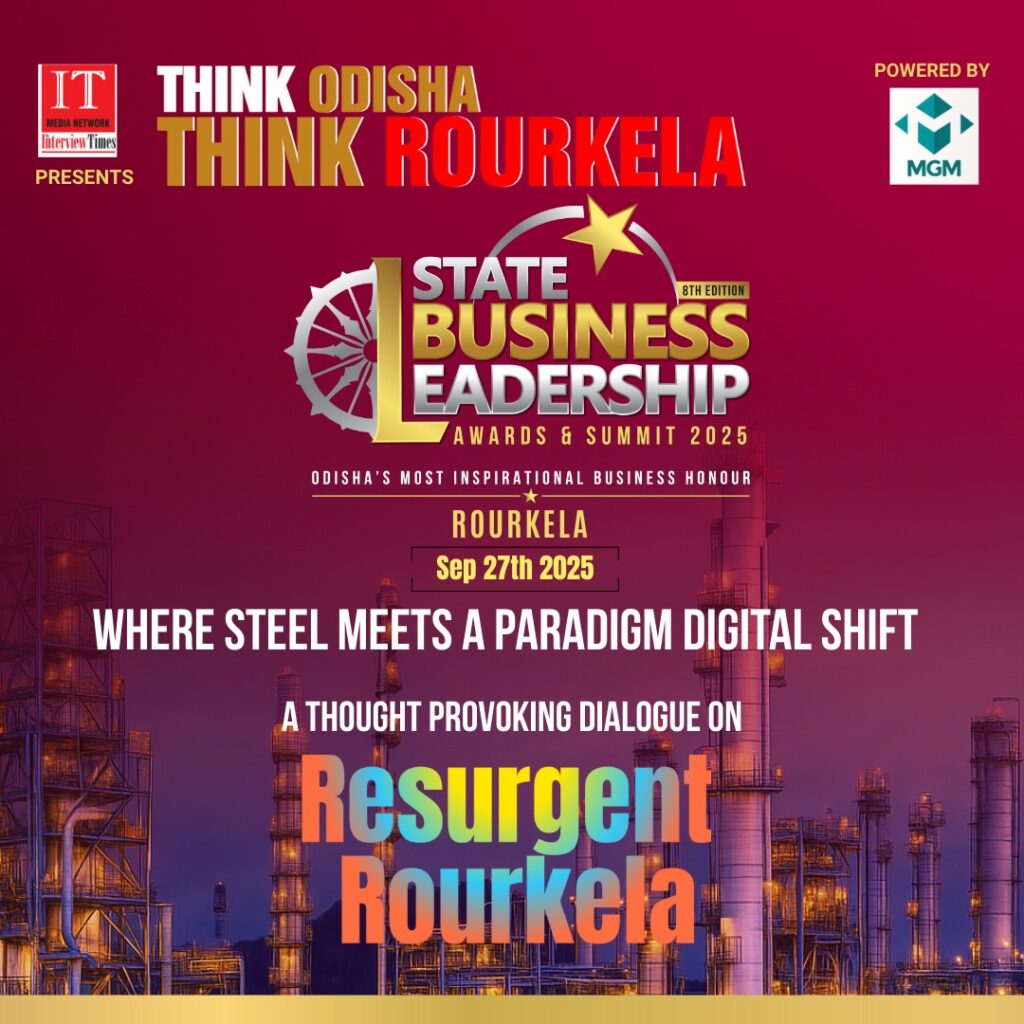
 Feature: If cities could speak, Rourkela would sound like an old maestro tuning a sitar — plucking the strings of its past, yet constantly rehearsing for a future symphony. For decades, Odisha’s “Steel City” has stood as an emblem of India’s post-independence aspirations — a symbol of Nehruvian industrial ambition, forged in fire and sweat, yet cushioned by German precision and planning. But today, Rourkela is rewriting its script. The city that once wore steel as its sole identity is now layering itself with new tones of technology, innovation, sustainability, and digital enterprise. In many ways, Rourkela’s resurgence is less a story of rebirth and more of reinvention — a rare act of industrial cities adapting themselves without losing their soul.
Back in the 1950s, when Pandit Jawaharlal Nehru dreamt of building India’s “temples of modernity,” Rourkela became one of its sanctums. The Steel Authority of India’s Rourkela Steel Plant (RSP), built with German collaboration, was more than an engineering marvel; it was a cultural experiment. Thousands of German engineers and Indian workers worked side by side, creating not just a steel plant but a planned city — sectors carved like chessboards, gardens landscaped with European sensibilities, and quarters designed for a modern industrial township. For many locals, Rourkela was their first encounter with the idea of cosmopolitan India. Tribal communities rubbed shoulders with engineers from Berlin; Odia families shared markets with migrants from Punjab and Bihar.
It wasn’t just industry being forged here — it was identity. This is why Rourkela came to be called “Mini India.” You could hear Bengali in the bazaar, Odia in the lanes, Hindi in the factories, and German murmurs at the Indo-German Club library. It was here that Odisha’s cultural roots intertwined with modernity, and the city grew into a living experiment of social engineering long before “smart cities” were even imagined.
And yet, for all its pioneering spirit, Rourkela endured a paradox: while it fueled India’s industrial growth, its own identity remained tethered to steel alone. For decades, the narrative was simple — Rourkela produced steel; the rest of India consumed it. But as India entered the digital century, cities that failed to diversify risked slipping into irrelevance. Rourkela saw the writing on the furnace walls early.
The turning point came when Odisha’s vision for “Viksit Odisha” and “Purvodaya — The Rise of the East” began intersecting with Rourkela’s own transformation. The expansion plan of RSP — a ₹30,000 crore mega investment aimed at doubling capacity from 4.4 MTPA to 9.4 MTPA by 2030 — is no small feat. This single project is expected to contribute nearly 25% of SAIL’s national output, generating tens of thousands of jobs. But this resurgence isn’t just about more steel; it’s about how Rourkela is using its industrial muscle to pivot into new sectors.
Look at NIT Rourkela — once known primarily for producing engineers for PSU jobs, it is now emerging as a national research hub under the PAIR (Partnership for Accelerated Innovation & Research) program. A ₹27-crore extension centre in Bhubaneswar is being set up to accelerate startup incubation, creating a pipeline where Rourkela’s intellectual capital connects seamlessly with Odisha’s digital economy. Similarly, Rourkela’s IT ecosystem, powered by its Software Technology Parks of India (STPI) hub, is positioning itself as a satellite to Bhubaneswar’s tech leadership. In 2025, Chief Minister Mohan Charan Majhi announced plans to transform Rourkela into a digital hub alongside Cuttack, Sambalpur, and Berhampur — a strategic move aimed at decentralizing Odisha’s IT boom beyond the state capital.
The city’s reinvention mirrors an orchestra tuning new instruments while keeping its percussion steady. On one hand, steel, mining, and manufacturing remain the dominant basslines. On the other, there’s an emerging treble of semiconductors, chip design, blockchain innovation, and AI-led research. Memoranda of Understanding signed during TiEcon Bhubaneswar 2025 — including the O-Chip program with the Semiconductor Fabless Accelerator Lab (SFAL) — have put Rourkela squarely on India’s semiconductor map. In a nation racing to de-risk chip supply chains, this is no small positioning.
But Rourkela’s resurgence isn’t confined to factories and research labs; it’s visible in its streets, parks, and riverfronts. Take the “Rourkela One” project, an ambitious Smart City initiative integrating urban renewal, digitized governance, and sustainability. Picture this: Integrated Command and Control Centres that coordinate traffic, drainage, CCTV, and emergency response in real-time; CityGov portals that allow residents to pay bills, lodge grievances, and track services online; public Wi-Fi corridors lighting up previously neglected neighbourhoods; and smart streetlights cutting energy consumption. The city is effectively building a digital nervous system to complement its industrial skeleton.
One might think infrastructure is where Rourkela stops, but its aspirations run deeper. The Brahmani riverfront, once a neglected patch, is being redeveloped into a green corridor with parks, cycling tracks, and eco-tourism spaces. The Town Planning Scheme (TPS), borrowed from Bhubaneswar’s success, is reconfiguring old, chaotic neighbourhoods into well-planned residential clusters — a shift that’s more than cosmetic. When locals pool land under TPS, they don’t just get back 60% of redeveloped plots with better drainage, utilities, and roads; they inherit dignity, connectivity, and a stake in the city’s future.
Transport connectivity has been another cornerstone of the revival story. The reopening of Rourkela Airport under the UDAN scheme in 2023 plugged the city into India’s aviation map, and its upcoming runway upgrade for Airbus and Boeing landings could change business logistics forever. The 4th and 5th railway lines nearing completion will ease freight congestion on the Howrah-Mumbai route, making Rourkela a more efficient industrial node. The Hockey World Cup 2023 served as a catalyst, refurbishing roads, ring routes, and bypasses — turning the city into a more livable, event-ready destination.
And yet, for all its steel-and-silicon ambitions, Rourkela hasn’t lost its soul. Festivals like Loknatya Mahotsav, Path Utsav, and the Rourkela City Festival are rekindling community spirit, drawing locals and tourists alike into a carnival of food, music, and theatre. Vedvyas, a sacred riverside shrine, is being redeveloped into an eco-cultural park, while the upcoming Tribal Museum under the Smart City plan promises to preserve the stories of the indigenous communities who once shaped the city’s early identity. These initiatives remind us that a city’s greatness isn’t just in its GDP, but in its ability to carry its people’s memories forward.
The environmental lens is equally critical to Rourkela’s transformation. The “Solarising Rourkela” campaign is on track to achieve 30% renewable energy penetration by 2030, supported by rooftop installations, a proposed 30 MW solar park in Lathikata, and incentives under PM Surya Ghar. Electric vehicle adoption has skyrocketed — from barely 139 registered EVs in 2020 to over 2,500 by 2024 — while smog towers and emission controls are curbing the industrial pollution that once plagued the city. Urban forests and parks, like those planned in Bisra Hills and Koel Nagar, are gradually stitching green back into Rourkela’s industrial canvas.
But this is not to romanticize the city’s journey. Rourkela’s resurgence still battles familiar dragons: monsoon flooding, uneven healthcare access, and socio-economic disparities between its planned Steel Township and its underdeveloped peripheries. The RSP expansion requires acquiring 1,200 acres of farmland and resettling hundreds of families — a process fraught with cultural and emotional complexities. Air quality remains fragile, with over 60 surrounding industrial units contributing to emissions despite stricter norms. Balancing growth with sustainability remains the single most defining challenge for Rourkela’s next chapter.
And yet, optimism lingers in the air like the smell of wet earth after the first rain. By 2047, Odisha envisions 60% urbanization, positioning Rourkela as a strategic urban hub. Its designation as India’s “fastest-moving city” in the East Zone is not just a statistic; it’s a promise — one that rests on an interplay of industrial might, digital aspiration, and cultural vitality. Rourkela, in its own way, represents the paradox of modern India: a city that was born in the furnace of Nehruvian planning now dreams in the cloud servers of artificial intelligence.
What makes Rourkela’s story unique is not just its ability to produce steel but its capacity to bend without breaking, to evolve without erasing its origins. Cities, like people, have biographies, and Rourkela’s is still being written — one highway, one startup, one solar panel at a time. Its future lies not in choosing between smokestacks and silicon, but in harmonizing the two to compose an urban symphony that is as sustainable as it is ambitious.
For decades, outsiders viewed Rourkela as an industrial outpost. Today, it stands as a metaphor for Odisha’s larger metamorphosis — from a resource-driven economy to a knowledge-driven one, from a peripheral player to an emerging eastern powerhouse. If Bhubaneswar is the brain of Odisha’s digital revolution, Rourkela is its beating heart, pumping steel, data, and dreams into the state’s economic bloodstream.
The story of Rourkela is not about what it was, but about what it is daring to become — a city where steel meets semiconductors, where tribal heritage meets AI research, and where every street, park, and research lab hums with the energy of reinvention. Rourkela is not just resurging; it is reimagining itself — and in doing so, it is quietly scripting a new chapter for Odisha and, perhaps, for India itself.