
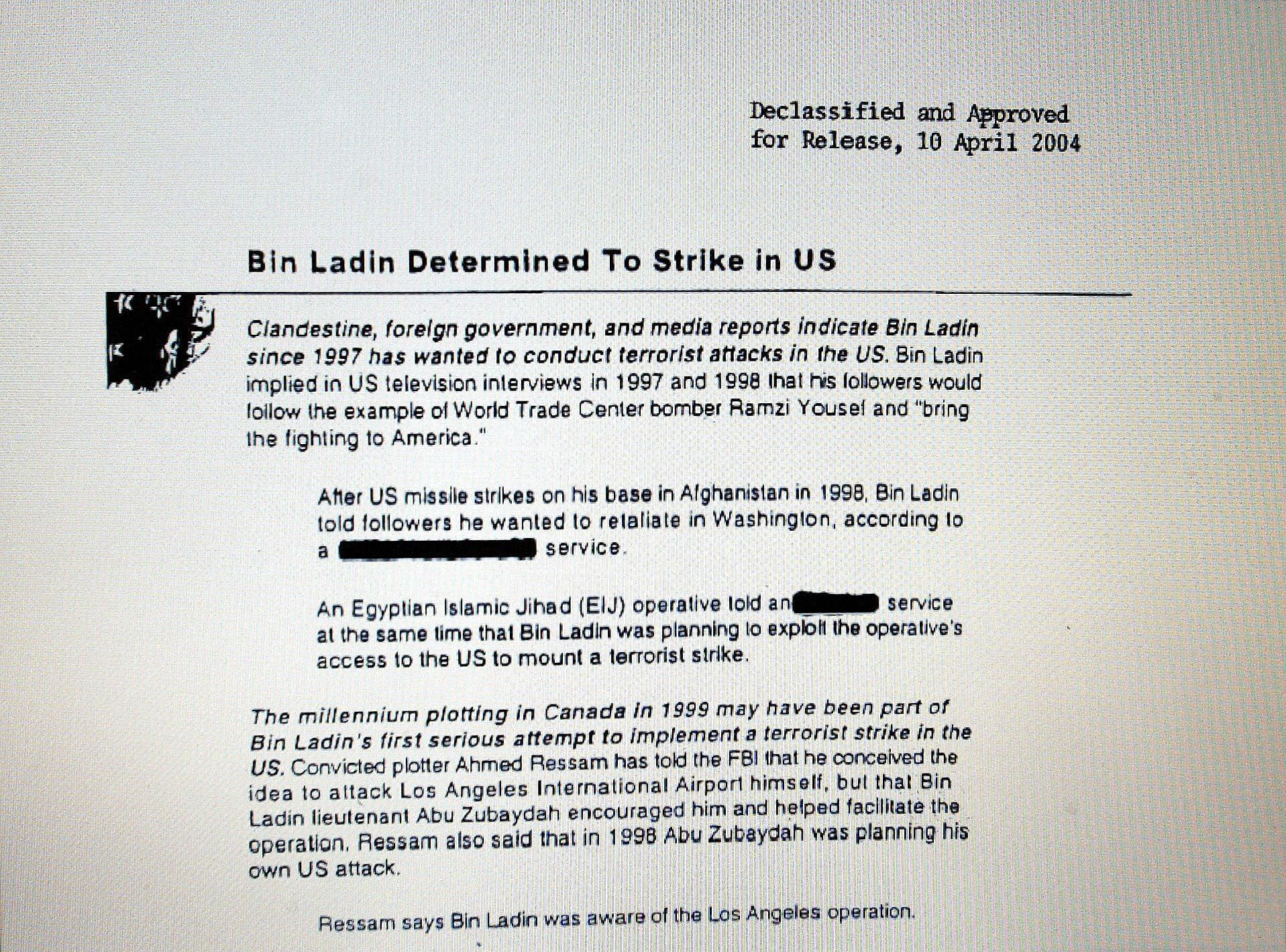
A newly declassified set of CIA intelligence documents has revealed that India was among the countries Osama bin Laden and his network were considering for terrorist attacks as early as 1998 — three years before the September 11 attacks in the United States. The revelation is now being widely reported by Indian media, including NDTV, Times of India, India Today, Hindustan Times and The Week.
The documents were released as part of the 25th-anniversary disclosures surrounding the September 11, 2001 attacks.
And there is one particular document that makes this story especially significant for India.
A CIA presidential intelligence brief dated August 28, 1998, titled “Bin Ladin Terrorist Network Still a Threat,” assessed that bin Laden intended to conduct attacks in multiple countries. India and Pakistan were specifically named, alongside Egypt, countries in the Arabian Peninsula, Uganda and potentially Nigeria.
The document does not identify a specific Indian city, target or planned date.
That distinction is important.
The files don’t show that bin Laden had a fully developed operational plan to attack a particular Indian location. Instead, they demonstrate something broader — that American intelligence had identified India as one of the countries within al-Qaeda’s potential global targeting ambitions years before the 9/11 attacks.
And that changes the historical picture.
What did the CIA know about bin Laden in 1998?
The newly released collection contains 71 presidential daily briefs, covering the period from February 1998 through September 2001. They provide a detailed picture of how American intelligence agencies were tracking bin Laden’s network, its international connections and its ambitions.
The CIA was already warning senior American officials that bin Laden represented a growing international terrorist threat.
One of the 1998 assessments stated that bin Laden and other terrorist leaders based in Afghanistan had survived U.S. strikes and that their communications networks remained intact. Training at terrorist camps had resumed, while some camps were being relocated.
The assessment also said bin Laden could draw on individuals and allied groups in at least 60 countries to conduct attacks.
That is what makes the India reference so important.
It wasn’t an isolated mention.
It appeared within an intelligence assessment describing a global terrorist network with the ability to operate across multiple countries.
India wasn’t the only country being considered
The documents indicate that bin Laden’s ambitions extended far beyond Afghanistan and the United States.
The August 1998 assessment mentioned India and Pakistan along with several countries in the Middle East, Africa and South Asia. This reflects the international nature of al-Qaeda’s network at the time.
But the India reference has attracted particular attention in the Indian media because it provides a previously classified historical record of how U.S. intelligence assessed the threat to India before 9/11 transformed global counter-terrorism policy.
The revelation is especially striking because the August 1998 document came shortly after the U.S. embassy bombings in Kenya and Tanzania, which killed hundreds of people.
The CIA was already connecting bin Laden to an expanding international terrorist infrastructure.
Then came 9/11
Three years later, al-Qaeda carried out the attacks that changed international security forever.
On September 11, 2001, hijacked commercial aircraft were deliberately crashed into the World Trade Center towers in New York and the Pentagon in Washington, while another aircraft crashed in Pennsylvania.
Nearly 3,000 people were killed.
The newly released files show that U.S. intelligence had been receiving warnings about bin Laden and al-Qaeda for years before the attacks. The documents include intelligence about his movements, his network, efforts to obtain weapons of mass destruction and potential terrorist operations.
One of the most significant aspects of the release is therefore not simply that India appeared on a 1998 list.
It is that the documents illustrate how the threat from bin Laden was being understood internationally long before the full scale of the 9/11 plot became apparent.
Was there an actual attack planned for India?
The released document does not establish that.
This is probably the most important caveat for reporting the story accurately.
The CIA assessment says bin Laden intended to carry out attacks in India and other countries, but the publicly released passage does not identify a particular target, date or operational plan inside India.
So the headline should not say that the CIA discovered a specific Indian 9/11-style attack plot.
What the documents establish is that India was identified as a potential target within bin Laden’s broader terrorist ambitions.
That is already a significant historical revelation.
Why this matters in India today
The story is going viral because it connects three things that immediately capture public attention:
India. Osama bin Laden. And 9/11.
It also comes at a moment when the world is marking 25 years since the September 11 attacks, making the declassification particularly newsworthy.
Indian outlets are prominently covering the India angle because the newly released intelligence provides a rare glimpse into how U.S. intelligence assessed the terrorist threat to India in the late 1990s.
And there is a larger historical lesson here.
The threat posed by al-Qaeda was never confined to the United States.
Bin Laden’s ideology and network were global, and the CIA was already assessing its ability to operate across dozens of countries.
India was part of that threat landscape years before 9/11.
The newly released documents don’t reveal a forgotten attack on India.
They reveal something arguably more important for historians and security experts: how early international intelligence agencies understood that bin Laden’s network had ambitions that extended far beyond Afghanistan and far beyond America’s borders.
And in India’s case, that warning was sitting inside a classified CIA briefing three years before the world would learn just how dangerous al-Qaeda had become.
