
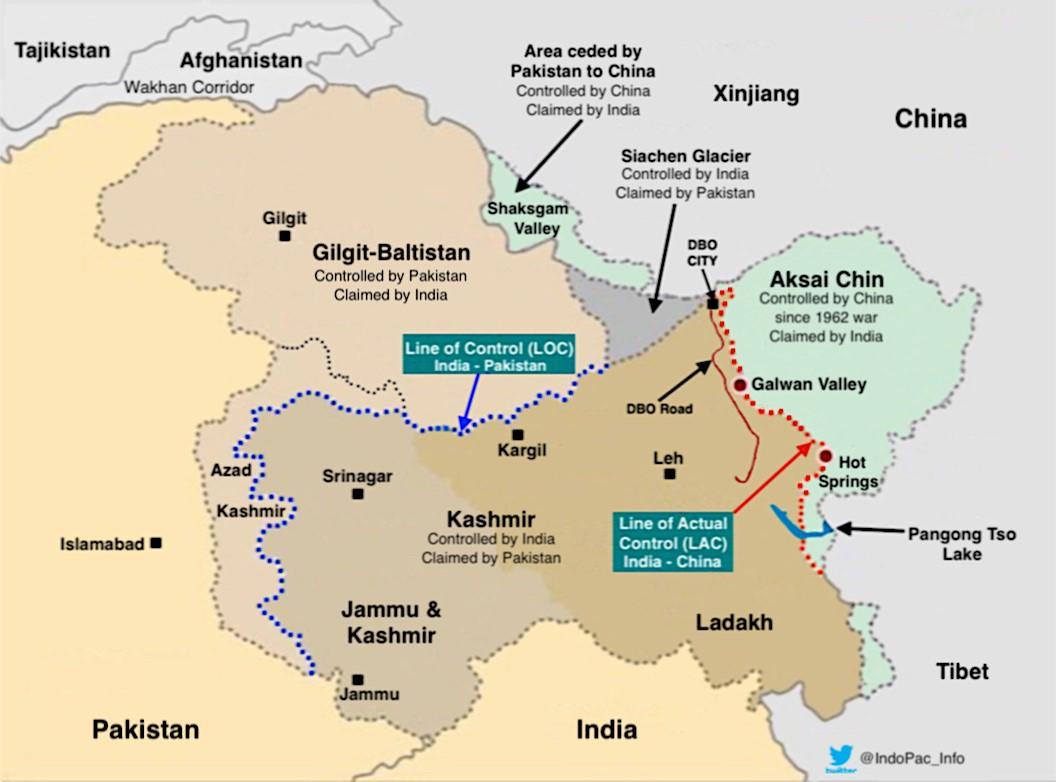
India has strongly rejected the recently established Pakistan-China Boundary Joint Commission, describing the body as having no legal basis to make arrangements concerning territories that India considers to be under illegal occupation. The issue has emerged as a major diplomatic development in South Asia on September 17, 2026.
The Indian response followed the first meeting of the Pakistan-China Boundary Joint Commission in Islamabad. India’s Ministry of External Affairs said that Pakistan does not have the authority to enter into arrangements concerning Indian territory that is under its occupation.
India’s position is connected to the long-standing dispute surrounding the territories of Jammu & Kashmir and Ladakh and the 1963 Pakistan-China boundary agreement. New Delhi has consistently maintained that the agreement between Pakistan and China concerning territory in the region was illegal and invalid because it involved areas that India claims as part of its territory.
The latest dispute is significant because Pakistan and China have maintained close strategic, economic and defence ties for decades. Their cooperation includes the China-Pakistan Economic Corridor (CPEC), portions of which pass through territory that India claims.
The Indian government has repeatedly opposed projects in areas of Pakistan-administered Kashmir, arguing that infrastructure or other bilateral arrangements cannot change India’s position regarding sovereignty over Jammu & Kashmir and Ladakh.
The establishment and functioning of the joint commission has therefore brought a longstanding territorial issue back into diplomatic focus. India’s response indicates that New Delhi does not recognise the commission as having authority over the disputed territory.
Indian officials have also reiterated the government’s position that Jammu & Kashmir and Ladakh are integral parts of India. The Ministry of External Affairs has maintained this position consistently in its public statements concerning the India-China-Pakistan territorial question.
The development is being watched closely because the region involves three nuclear-armed states—India, Pakistan and China—and has a history of military confrontations, border disputes and competing territorial claims.
At the same time, India and China have separately maintained diplomatic engagement over their own boundary dispute. In August, India’s National Security Adviser Ajit Doval and Chinese Foreign Minister Wang Yi held the 25th round of Special Representatives’ talks on the India-China boundary question in Beijing, where both sides discussed border management and efforts toward a political settlement.
The Pakistan-China commission therefore adds another layer to an already complicated regional security environment.
For India, the immediate significance lies in the diplomatic principle being asserted: New Delhi does not recognise bilateral arrangements between Pakistan and China as capable of determining the status of territory that India claims. The issue could remain an important subject in India’s diplomatic engagement with both Beijing and Islamabad.
The latest development also demonstrates how territorial questions in South Asia continue to influence India’s foreign policy, regional security calculations and relations with both neighbouring countries.
