

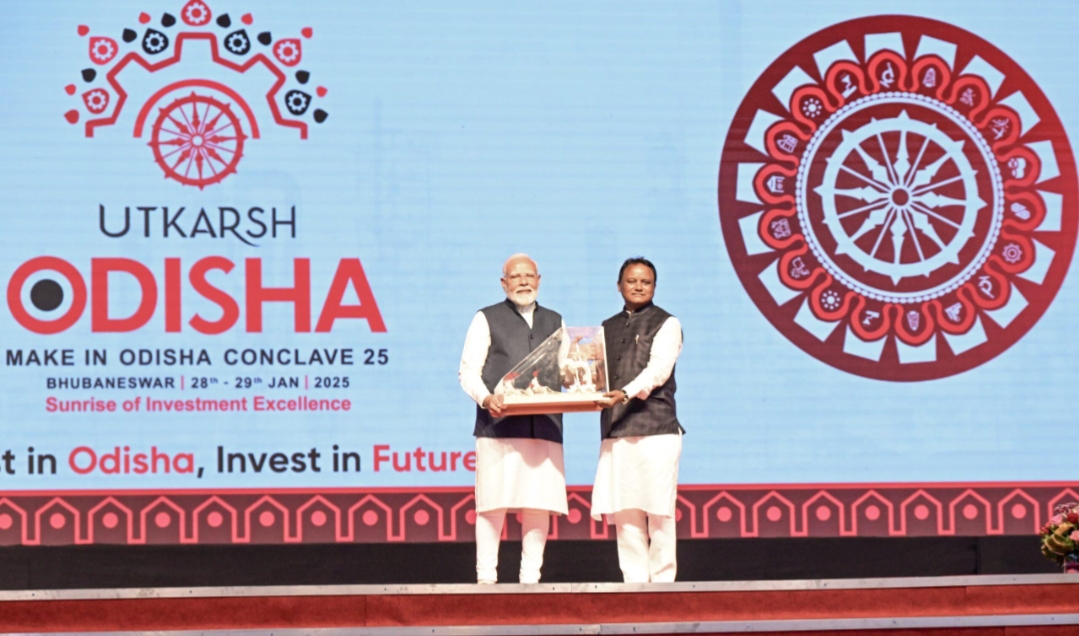
A New Economic Vision for Odisha
Odisha is entering a new phase of economic transformation, with an ambition to emerge as one of India’s leading investment and manufacturing destinations. The state’s development strategy is increasingly moving beyond its traditional dependence on mineral resources toward technology-driven, value-added and sustainable industries.
At the centre of this transformation are two long-term roadmaps — Vision 2036 and Vision 2047. While Vision 2036 targets a $500-billion state economy by the centenary of Odisha’s statehood, Vision 2047 aims to take the state towards a $1.5-trillion economy by the centenary of India’s Independence. Together, these visions seek to generate more than 1 crore jobs while building a stronger and more diversified economy.
From Investment Commitments to Actual Execution
Odisha has significantly stepped up its efforts to attract domestic and international investors. Initiatives such as the Utkarsh Odisha Conclave 2025, international roadshows and hundreds of one-to-one investor meetings have helped the state build a strong pipeline of potential investments.
Over the past two years, more than 475 industrial projects worth around ₹9.5 lakh crore have received approval, alongside more than 300 MoUs across different sectors. More importantly, the government is now focusing on converting investment commitments into projects on the ground.
As part of this approach, 151 projects worth approximately ₹3.11 lakh crore have already been inaugurated or grounded. These projects are expected to create around 2.41 lakh immediate employment opportunities, signalling a shift from announcing investments to delivering tangible economic outcomes.
Diversification Beyond Mining
For decades, Odisha’s economy has been strongly associated with its abundant mineral resources, including iron ore, coal, bauxite, chromite and limestone. However, the state’s new industrial strategy is increasingly focused on extracting greater value from these resources through downstream and value-added manufacturing.
Industrial parks, plug-and-play infrastructure and sector-specific investment ecosystems are being developed to support industries ranging from advanced manufacturing to emerging technologies.
The state is also targeting sectors such as semiconductors, Electronics System Design and Manufacturing (ESDM), specialty chemicals, aerospace and defence, data centres, green hydrogen and green ammonia. This diversification could help Odisha reduce its dependence on traditional industries while positioning itself in some of the fastest-growing sectors of the future.
Building an Eastern India Textile Hub
Textiles and apparel are emerging as another important pillar of Odisha’s industrial strategy. Investments from major players such as MAS Holdings, Shahi Exports, Hindelico and Sport King India are contributing to the development of an integrated textile ecosystem.
With investments spread across manufacturing and supporting infrastructure, Odisha is aiming to establish itself as a major textile and apparel hub for eastern India. The sector could also provide significant employment opportunities, particularly for the state’s growing workforce.
Odisha’s Technology Push
The state’s technology ambitions received a major boost through Odisha Tech 2025, where 33 MoUs worth around ₹7,888 crore were secured. These investments are expected to generate more than 53,300 jobs across districts including Khordha, Cuttack and Sambalpur.
The expansion of technology-oriented industries reflects a broader shift in Odisha’s economic profile — from a resource-driven economy toward one that increasingly combines manufacturing, digital infrastructure and emerging technologies.
Ports, Coastline and Global Trade
Odisha’s 575-kilometre coastline provides another major strategic advantage. Its deep-draft ports are being leveraged to strengthen logistics, manufacturing supply chains and international trade.
The state’s maritime infrastructure is particularly important for sectors such as seafood, minerals and manufactured goods. Expanding port-led development could strengthen Odisha’s position as a gateway connecting eastern India with Southeast Asia and the wider Indo-Pacific region.
Taking Industrial Growth to Rural Odisha
The transformation is not limited to major cities and industrial corridors. Rural areas are increasingly becoming part of Odisha’s industrial growth story through investments in food processing, cold chains, warehousing and dairy modernisation.
By connecting agriculture with processing and logistics infrastructure, the state aims to create stronger links between farmers and markets. Such investments can help reduce wastage, improve supply chains and create additional income opportunities across rural communities.
Reforms to Make Odisha Investor-Friendly
Large-scale investment requires an environment where businesses can establish and operate efficiently. Odisha has therefore focused heavily on administrative and regulatory reforms.
Initiatives such as Deregulation 2.0, Go-SWIFT, Jan Vishwas reforms and integrated single-window clearance systems are designed to simplify approvals, reduce regulatory friction and enable time-bound project clearances. Continuous project monitoring is also being emphasised to ensure that approved investments move towards implementation.
The Road Ahead
Odisha’s economic transformation is no longer centred solely on its mineral wealth. The state is attempting to build a broader industrial ecosystem combining manufacturing, technology, green energy, textiles, logistics, agriculture and emerging industries.
The real test, however, will be execution — converting investment announcements and MoUs into operational projects, sustainable employment and long-term economic value. If Odisha can maintain this momentum while balancing industrialisation with environmental sustainability and inclusive growth, its Vision 2036 and Vision 2047 ambitions could fundamentally reshape the state’s position in India’s economic landscape.