


India’s largest passenger-vehicle maker commissions its first green-hydrogen plant at Manesar, turning surplus solar electricity into manufacturing fuel as it builds a broader low-carbon production ecosystem
Manesar | September 25, 2026
India’s automotive transition is no longer confined to what comes out of the showroom. Increasingly, it is also about what happens inside the factory.
Maruti Suzuki India has commissioned its first green-hydrogen plant at its manufacturing facility in Manesar, Haryana, introducing hydrogen into its portfolio of clean-energy solutions for manufacturing operations. The pilot project is built around a 300 kW green-hydrogen electrolyser and represents an attempt to use renewable electricity more efficiently while reducing dependence on conventional process fuels.
The development is significant not because 300 kW is enormous in industrial terms, but because India’s largest passenger-vehicle manufacturer is beginning to test how green hydrogen can practically fit into large-scale automotive manufacturing.
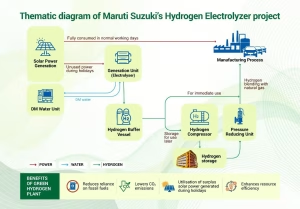
FROM SURPLUS SUNLIGHT TO INDUSTRIAL FUEL
The operating model is particularly interesting.
Maruti Suzuki’s Manesar facility already generates solar electricity. During holidays, some solar energy can remain underutilised. The new electrolyser provides another destination for that electricity: it can be used to produce green hydrogen, which can then be stored for subsequent use.
The hydrogen produced at Manesar will be blended with natural gas and used as process fuel in the company’s manufacturing operations.
In effect, the project creates a chain:
Surplus Solar Energy → Electrolysis → Green Hydrogen → Storage → Manufacturing Process Fuel
That gives the project significance beyond the electrolyser itself. It demonstrates how renewable power that might otherwise be underutilised can potentially be converted into another form of usable energy.
300 kW TODAY, A LARGER EXPERIMENT TOMORROW
Maruti Suzuki has described the Manesar installation as a pilot project.
That distinction matters. The company is not claiming that hydrogen has suddenly replaced conventional fuels across its factories. Instead, Manesar will provide operational experience that can inform a possible larger deployment.
Based on lessons from the pilot, Maruti Suzuki says it intends to scale up the adoption of green-hydrogen technology across its manufacturing facilities in Haryana and Gujarat.
That makes Manesar something of a testing ground.
Questions surrounding production efficiency, storage, integration with existing manufacturing processes and economics can be evaluated before hydrogen is deployed more widely.
THE BIGGER NUMBER: 615,000 → 266,000 TONNES
Behind the hydrogen announcement sits a much larger decarbonisation ambition.
Maruti Suzuki says it aspires to reduce the carbon footprint of its manufacturing operations from approximately 615,000 tonnes currently to 266,000 tonnes in FY2030-31 through multiple clean technologies.
If achieved, that would represent a reduction of approximately 349,000 tonnes, or about 57%, from the stated current level.
The important point is that the company is not relying on hydrogen alone.
Its manufacturing-energy strategy increasingly resembles a portfolio of technologies rather than a single solution.
SOLAR + HYDROGEN + BIOGAS + BATTERY STORAGE
Maruti Suzuki’s clean-manufacturing push now incorporates several different technologies.
The company uses in-house solar power, renewable electricity procured from government sources, and solar- and wind-based power-purchase arrangements with third parties.
At its Kharkhoda facility in Haryana, Maruti Suzuki has also recently commissioned a 1 MWh Battery Energy Storage System. Meanwhile, a 10-tonnes-per-day biogas plant is in an advanced stage of development there and is expected to be commissioned during FY2026-27.
The company has also begun integrating compressed biogas (CBG) as a process fuel. Its board has approved four CBG projects with a budget of ₹561 crore (₹5,610 million).
Taken together, the initiatives reveal a broader strategy:
300 kW green hydrogen electrolyser
1 MWh battery energy storage
10 TPD biogas plant under development
4 CBG projects with ₹561 crore earmarked
Rather than treating decarbonisation as one technology replacing another overnight, Maruti Suzuki is building multiple energy pathways around its manufacturing system.
WHY GREEN HYDROGEN MATTERS FOR MANUFACTURING
Green hydrogen has attracted considerable attention because it can potentially help decarbonise applications where direct electrification is difficult or where industrial processes still require fuel.
The distinction between conventional and green hydrogen lies primarily in how the hydrogen is produced.
When electricity from renewable sources powers electrolysis—the process of splitting water into hydrogen and oxygen—the resulting hydrogen can be produced with substantially lower operational carbon emissions than hydrogen derived from fossil-fuel-intensive processes.
For Maruti Suzuki, the immediate application is comparatively straightforward: blend the hydrogen with natural gas and use the mixture as process fuel.
The larger question is whether experience gained from projects such as Manesar can eventually support wider industrial adoption.
MANUFACTURING COMPETITIVENESS IS CHANGING
The announcement also points toward a changing definition of industrial competitiveness.
Manufacturers have traditionally competed around factors such as production cost, quality, supply-chain efficiency, scale and speed. Carbon intensity is increasingly entering that equation as companies, investors, regulators and global supply chains pay greater attention to emissions.
Maruti Suzuki Managing Director and CEO Hisashi Takeuchi said the company is building capabilities to support a lower-carbon and more energy-efficient manufacturing ecosystem, while linking the green-hydrogen initiative with the company’s wider use of solar energy, biogas and battery storage.
This is particularly relevant for an automotive industry undergoing simultaneous changes in products, energy systems, supply chains and manufacturing technology.
NOT JUST ABOUT ELECTRIC CARS
Much of the public conversation around automotive decarbonisation focuses on the vehicle itself: battery-electric vehicles, hybrids, compressed biogas, hydrogen and alternative fuels.
But the environmental footprint of the automobile industry also extends upstream.
Steel and components must be produced. Factories consume electricity and process fuels. Vehicles and components must be transported. Supply chains operate across multiple industrial locations.
Consequently, a low-emission vehicle produced through carbon-intensive manufacturing does not represent the entire decarbonisation story.
The Manesar initiative shifts some attention from what powers the car to what powers the factory that makes the car.
THE SUZUKI CONNECTION
Maruti Suzuki’s broader clean-energy strategy also extends through its parent, Suzuki Motor Corporation.
According to the company, Suzuki is working with organisations including the National Dairy Development Board (NDDB) and dairy-industry unions to establish 10 biogas plants across India, of which three are already operational in Gujarat.
This illustrates another aspect of the group’s approach: renewable energy is being explored across different technologies rather than through a single prescribed pathway.
INDIA’S GREEN-HYDROGEN AMBITION MEETS THE FACTORY FLOOR
The Manesar project also sits within India’s wider push toward green hydrogen.
Maruti Suzuki specifically says the 300 kW installation is aligned with the Government of India’s National Green Hydrogen Mission.
Large national ambitions ultimately have to translate into practical industrial applications. Pilot projects therefore matter because they help companies understand what works under real operating conditions.
The Maruti project is modest compared with the gigawatt-scale renewable-energy and hydrogen proposals frequently announced across India.
But its importance lies elsewhere.
This is green hydrogen being integrated into the operating environment of one of India’s largest manufacturing companies.
THE REAL TEST COMES NEXT
As with any pilot, commissioning is only the beginning.
The real measure of the Manesar project will come from operational performance: how efficiently surplus solar electricity can be converted into hydrogen, how effectively that hydrogen can be stored and integrated with existing process fuels, what economics emerge from the experiment, and whether the model proves suitable for larger deployment.
Maruti Suzuki itself has framed the project around learning before scaling.
That makes it important not to interpret the commissioning of a 300 kW electrolyser as wholesale decarbonisation of the company’s manufacturing operations.
Instead, it should be viewed as another piece of a much larger transition.
FROM CARMAKER TO CLEAN-MANUFACTURING LABORATORY
Maruti Suzuki built its position in India by making mobility accessible at enormous scale. Its next manufacturing challenge is different: finding ways to maintain industrial scale while progressively reducing the carbon intensity behind it.
Solar power captures renewable electricity.
Battery systems help store electricity.
Biogas and compressed biogas provide alternative process fuels.
And now green hydrogen provides another pathway for converting renewable electricity into usable industrial energy.
Individually, none of these technologies represents a complete answer.
Together, however, they reveal how the factory of the future could evolve.
The most important number from Manesar may therefore not ultimately be 300 kW.
It may be what comes after it.
KEY NUMBERS
300 kW — Capacity of Maruti Suzuki’s pilot green-hydrogen electrolyser at Manesar
615,000 → 266,000 tonnes — Company’s stated manufacturing carbon-footprint aspiration through FY2030-31
1 MWh — Battery Energy Storage System commissioned at Kharkhoda
10 TPD — Biogas plant under development at Kharkhoda
₹561 crore — Budget earmarked for four CBG projects