


India’s journey towards next-generation mobility has gained fresh momentum as BEML Limited secured an order worth approximately ₹5,400 crore from the National High Speed Rail Corporation Limited (NHSRCL) for the country’s ambitious bullet train programme.
The major order represents a significant development for the public-sector engineering enterprise and highlights the growing role of domestic manufacturing capabilities in India’s rapidly evolving railway infrastructure.
Linked to the Mumbai–Ahmedabad High-Speed Rail Corridor, the development places BEML within one of India’s most technologically ambitious transport projects. The approximately 508-kilometre corridor is expected to establish a new benchmark for high-speed inter-city connectivity while simultaneously encouraging the development of advanced railway engineering and manufacturing capabilities within the country.

BEML Steps Further into High-Speed Rail
BEML has long been associated with India’s strategic engineering landscape, with operations spanning rail and metro systems, defence and aerospace, and mining and construction equipment.
Its increasing participation in high-speed rail represents an important expansion into a technologically demanding segment of transportation engineering.
The ₹5,400-crore order strengthens BEML’s position within India’s developing high-speed mobility ecosystem and comes at a time when the country is making substantial investments in railway modernisation, metro networks, dedicated freight corridors and advanced passenger transportation.
For the company, the project offers an opportunity to further develop expertise in sophisticated rolling-stock engineering, manufacturing and maintenance.
Mumbai–Ahmedabad Corridor: India’s Flagship Bullet Train Project
The Mumbai–Ahmedabad High-Speed Rail Corridor is being developed as India’s first dedicated high-speed railway corridor.
Extending for approximately 508 kilometres, the corridor will connect Mumbai with Ahmedabad while passing through key economic and industrial regions in western India.
The project is significant not only because of the speed and connectivity it promises, but also because of the wider industrial ecosystem required to support high-speed rail.
Unlike conventional railway projects, high-speed rail demands extremely high standards across areas including precision engineering, rolling-stock manufacturing, signalling, electrical systems, track infrastructure, safety technology and maintenance.
This creates opportunities for Indian manufacturers, engineering companies, technology providers and specialised component suppliers to participate in an emerging high-value industrial ecosystem.
₹5,400 Crore Order Carries Wider Industrial Significance
While the headline value of the order immediately attracts attention, its strategic significance extends beyond ₹5,400 crore.
Large-scale infrastructure programmes can create long-term capabilities when investment in physical infrastructure is accompanied by development of engineering expertise, technology, specialised manufacturing and skilled human resources.
BEML’s involvement therefore assumes importance in the context of India’s broader efforts to strengthen domestic manufacturing capabilities.
The development could also have implications for the wider supply chain. Advanced railway programmes require specialised components, precision manufacturing, electronics, electrical equipment, engineering services and maintenance expertise.
As domestic participation grows, opportunities may emerge for both established manufacturers and specialised MSMEs operating within India’s engineering ecosystem.
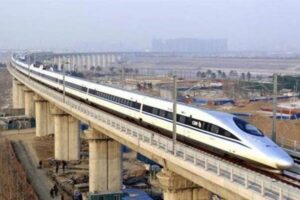
Building an Indigenous High-Speed Rail Ecosystem
India’s high-speed rail ambitions extend beyond constructing tracks and introducing faster trains.
Developing a sustainable high-speed rail network requires an ecosystem capable of supporting trains throughout their lifecycle—from engineering and manufacturing to testing, operations, maintenance and future technological upgrades.
BEML has already been strengthening its capabilities in advanced railway manufacturing, including work associated with high-speed train development at its Bengaluru facilities.
Such capabilities could become increasingly valuable as India evaluates future high-speed and semi-high-speed corridors.
The long-term significance therefore lies in whether projects of this scale can help Indian companies acquire the knowledge, infrastructure and engineering depth required to participate more extensively in sophisticated mobility programmes.
From Conventional Rail to Advanced Mobility
India’s railway sector is undergoing a broader technological transformation.
Modern stations, electrification, dedicated freight corridors, metro networks, semi-high-speed trains and advanced signalling systems are changing the country’s transportation landscape.
High-speed rail represents another major step in that transformation.
For a company such as BEML, the transition presents an opportunity to move further from conventional rolling-stock manufacturing towards technologically advanced mobility solutions.
That evolution also reflects a larger shift taking place across India’s public-sector enterprises, many of which are increasingly participating in areas involving advanced engineering, digital technologies, clean energy, defence manufacturing and next-generation infrastructure.
PSU Capability Meets National Infrastructure Ambition
Public-sector enterprises have played an important role in India’s industrial development for decades.
However, the next phase of infrastructure growth will demand more than production capacity alone. Companies will increasingly need advanced research, engineering expertise, precision manufacturing and the ability to work with sophisticated global technologies.
BEML’s participation in the bullet train programme demonstrates how traditional engineering PSUs can become part of this emerging technology-intensive infrastructure landscape.
The project brings together four strategically important themes for the Indian economy—infrastructure investment, advanced engineering, domestic manufacturing and technological capability.
Creating Opportunities Beyond the Rail Sector
The economic impact of a high-speed railway ecosystem can extend well beyond the trains themselves.
Large transportation projects require extensive networks of contractors, component manufacturers, engineering consultants, technology companies and service providers.
They can also stimulate demand for specialised skills in areas including mechanical engineering, electronics, automation, railway systems, safety engineering and maintenance.
Over time, the development of these capabilities could support India’s ambitions to establish itself as a stronger manufacturing and engineering hub.
Experience gained from executing technologically complex domestic projects may also improve the ability of Indian companies to pursue opportunities in international railway and infrastructure markets.
Infrastructure as an Engine of Industrial Capability
India’s current infrastructure expansion is increasingly interconnected with its manufacturing ambitions.
Railways, highways, ports, airports, logistics corridors and urban transportation projects create demand for materials, machinery, technology and engineering services.
High-speed rail adds another technologically sophisticated layer to this ecosystem.
If supported by sustained domestic manufacturing and knowledge development, such projects can create capabilities that remain valuable long after the original infrastructure has been commissioned.
The BEML order therefore represents more than a commercial contract. It is part of a broader story about how major infrastructure expenditure can potentially translate into domestic industrial capability.
The Road Ahead
The Mumbai–Ahmedabad High-Speed Rail Corridor remains one of the most closely watched infrastructure projects in India.
As construction and technological development progress, attention will increasingly focus on the extent to which Indian companies participate across different parts of the high-speed rail value chain.
For BEML, the approximately ₹5,400-crore order represents both a major business opportunity and an important technological milestone.
Its successful execution could strengthen the company’s position in advanced railway engineering while contributing to India’s longer-term objective of developing greater domestic capability in next-generation mobility.
Beyond the Bullet Train
India’s high-speed rail programme ultimately represents something larger than reducing journey times between Mumbai and Ahmedabad.
It is an opportunity to develop expertise in sophisticated transportation technology, strengthen domestic manufacturing, create specialised engineering capabilities and build an industrial ecosystem around advanced mobility.
BEML’s latest order illustrates how India’s infrastructure transformation is increasingly intersecting with its manufacturing and technological ambitions.
As the country builds the physical foundations of its future transport network, the larger challenge will be to ensure that these projects also generate lasting knowledge, industrial capacity and technological expertise.
The ₹5,400-crore BEML mandate could therefore be viewed not simply as another large infrastructure contract, but as another step towards building India’s capability to engineer, manufacture and maintain the transportation systems of the future.
Key Highlights
₹5,400 Crore — Approximate value of BEML’s order from NHSRCL
508 KM — Approximate length of the Mumbai–Ahmedabad High-Speed Rail Corridor
Key Players — BEML Limited and National High Speed Rail Corporation Limited
Sector — High-Speed Rail, Infrastructure and Advanced Manufacturing
Industrial Opportunity — Rolling stock, precision engineering, technology, components and maintenance
Strategic Significance — Strengthening India’s emerging high-speed mobility and domestic engineering ecosystem