

27 projects, 15 districts and more than 50,000 potential jobs — Odisha’s latest mega clearance puts digital infrastructure, artificial intelligence and next-generation industries alongside the state’s traditional strengths in steel and power.
Odisha Clears ₹2.47 Lakh Crore in a Single Investment Push
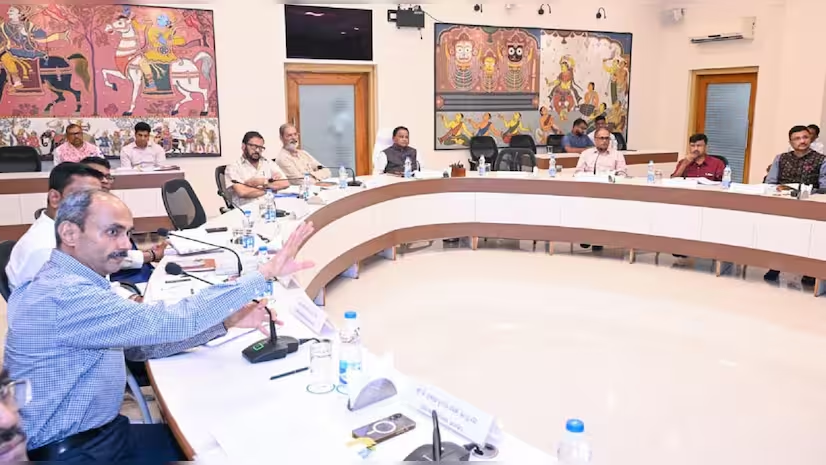
Odisha has unveiled one of its biggest industrial investment pushes, with the 46th High-Level Clearance Authority (HLCA) approving 27 major projects involving a cumulative proposed investment of ₹2,47,115.70 crore.
The projects are spread across 15 districts and carry a combined employment potential of 50,162 jobs. The approvals cover a remarkably diverse industrial portfolio — from artificial intelligence and data centres to semiconductors, power, steel, green hydrogen, lab-grown diamonds, healthcare, chemicals, textiles, shipbuilding and advanced manufacturing.
But the most striking part of the announcement is not simply the ₹2.47-lakh-crore headline.
It is where the money is going.
AI and Data Centres Take Centre Stage
For a state historically identified with minerals, metals and heavy industry, the composition of the latest investment pipeline is significant.
Four projects in IT, IT-enabled services and data centres together account for approximately ₹1,42,941 crore — more than half of the total investment approved in this round.
That makes digital infrastructure the single largest investment segment in the latest HLCA approvals.
The development points towards a potentially important evolution in Odisha’s industrial story: from being primarily a supplier of minerals and metals to also competing for the infrastructure that powers the digital and AI economy.
₹1.04-Lakh-Crore Data Centre Planned for Khordha
The biggest individual proposal comes from High Density Datacentre Limited, which plans an integrated data-centre project in Khordha involving an investment of approximately ₹1,04,550 crore.
The project carries potential employment for around 1,000 people.
Its sheer investment size makes it the standout proposal in the latest clearance round and places Khordha at the centre of Odisha’s emerging digital-infrastructure ambitions.
HCL Technologies Makes a ₹14,257-Crore AI Bet
Another major name entering the picture is HCLTech.
The technology major proposes an AI-optimised data centre in Khordha, involving an investment of ₹14,257 crore and potential employment for 385 people.
The significance goes beyond the number of direct jobs.
AI infrastructure requires high-performance computing, reliable power, connectivity, cooling systems, cybersecurity, cloud infrastructure and specialised technical capabilities. The development of such facilities can therefore create demand across a much wider supporting ecosystem.
Puri Gets a ₹22,634-Crore AI and GCC Proposal
Puri, globally recognised primarily as a religious and tourism destination, is also part of this emerging technology map.
Sentraforge AI Limited proposes to establish an AI data centre and Global Capability Centre (GCC) in the district with an investment of ₹22,634 crore.
The proposal has an employment potential of approximately 2,320 jobs, making it one of the more employment-intensive digital projects in the package.
If implemented as proposed, the project could add a distinctly different dimension to Puri’s economic identity.
Cuttack Joins the Data-Centre Map
The fourth project in the digital-infrastructure group comes from RKD Construction Private Limited, which proposes a ₹1,500-crore data centre in Cuttack, with potential employment for around 220 people.
Taken together, the four proposals create a potential digital corridor encompassing Khordha, Puri and Cuttack.
The Big Numbers
₹2,47,115.70 CRORE — Total proposed investment
27 PROJECTS — Cleared by the 46th HLCA
15 DISTRICTS — Geographic spread
50,162 JOBS — Potential employment
₹1,42,941 CRORE — IT, ITES & data-centre investment
₹1,04,550 CRORE — Largest individual data-centre proposal
Power Remains a Major Pillar
Odisha’s new-economy ambitions do not mean that traditional infrastructure is disappearing from the investment landscape.
Four projects in the power and renewable-energy sector account for another ₹54,287.70 crore, with potential employment for around 5,300 people.
Among the largest is a proposal by NLC India Limited for a 3,200 MW thermal power project in Deogarh, involving an investment of ₹34,763.51 crore.
NLC India also proposes a 1,080 MW thermal power project in Angul, involving another ₹11,604.19 crore.
The package additionally includes pumped-storage hydro proposals in Rayagada and Koraput, illustrating the continuing importance of energy infrastructure to Odisha’s investment strategy.
Steel Is Still Part of the Story
Odisha’s established industrial backbone remains visible.
Two steel-sector projects proposed in Sundargarh involve a combined investment of approximately ₹14,000 crore.
That creates an interesting contrast.
Odisha is not simply replacing its traditional industrial strengths. Instead, the latest pipeline suggests an attempt to build new technology-intensive sectors alongside metals, power and manufacturing.
Lab-Grown Diamonds: An Unexpected ₹10,680-Crore Cluster
One of the more unusual elements of the clearance package is the emergence of lab-grown diamond manufacturing.
Five projects in this segment account for approximately ₹10,680 crore in proposed investment and carry an employment potential of around 8,850 jobs.
For Odisha, this represents diversification into a higher-value manufacturing category far removed from the state’s conventional image as a producer of raw materials.
Semiconductors Add Another Layer
The semiconductor sector is also represented in the latest approvals.
SiCSem Private Limited proposes a ₹2,078-crore silicon-carbide wafer and gallium-nitride manufacturing facility in Khordha, with potential employment for around 1,200 people.
This comes as Odisha is separately promoting an 870-acre “Odisha Silicon Valley” at Naraj near Cuttack and says it received approximately ₹23,600 crore in semiconductor investment proposals at SEMICON India 2026.
Taken together, these developments show that semiconductors are becoming a recurring element of Odisha’s industrial-development agenda rather than a one-off announcement.
15 Districts Enter the Investment Map
The 27 projects span Angul, Bhadrak, Cuttack, Deogarh, Dhenkanal, Ganjam, Jajpur, Kalahandi, Kendrapara, Khordha, Koraput, Nuapada, Puri, Rayagada and Sundargarh.
That geographic spread matters.
Industrialisation in Odisha has traditionally been concentrated around specific mineral, port and manufacturing belts. A broader distribution of projects could create opportunities for infrastructure development and employment beyond the state’s established industrial centres — although those outcomes will ultimately depend on project implementation.
From Mineral Economy to Digital Economy?
For decades, Odisha’s economic identity has been closely associated with iron ore, coal, bauxite, aluminium, steel and power.
Those industries remain fundamental.
But the latest clearance package presents a noticeably broader picture.
Artificial intelligence. Data centres. Semiconductors. Global capability centres. Lab-grown diamonds. Green hydrogen. Advanced manufacturing.
The emerging question is therefore not whether Odisha will abandon its mineral economy.
It is whether the state can use the infrastructure, energy base and industrial capabilities created by that economy to move further into technology-intensive and higher-value industries.
Approval Is Only the Beginning
There is, however, an important distinction in interpreting the ₹2.47-lakh-crore figure.
These are approved investment proposals, not ₹2.47 lakh crore of investment already spent or projects already commissioned.
Odisha’s investment-facilitation system uses the HLCA as the apex clearance mechanism for large industrial projects, while implementation still requires subsequent stages including land, financing, infrastructure, construction and regulatory execution. Invest Odisha describes the HLCA, chaired by the Chief Minister, as part of the state’s three-tier single-window clearance mechanism.
The real economic impact will therefore depend on how many of these projects progress from approval to groundbreaking, construction and commercial operation.
That distinction is particularly important when dealing with projects of extraordinary scale.
The Bigger Odisha Story
The 46th HLCA approvals offer a snapshot of where Odisha wants its next phase of industrial growth to come from.
Steel and power remain important, but the investment mix is expanding rapidly.
The most eye-catching statistic may be ₹2.47 lakh crore, but perhaps the more consequential number is ₹1.43 lakh crore — the amount represented by just four IT, ITES and data-centre proposals.
If these projects move from proposals to functioning assets, Odisha could begin developing an industrial identity that combines its traditional strengths in resources, manufacturing and energy with emerging capabilities in AI, digital infrastructure, semiconductors and advanced technology.
For now, the state has secured the approvals.
The next chapter will be written by execution.