

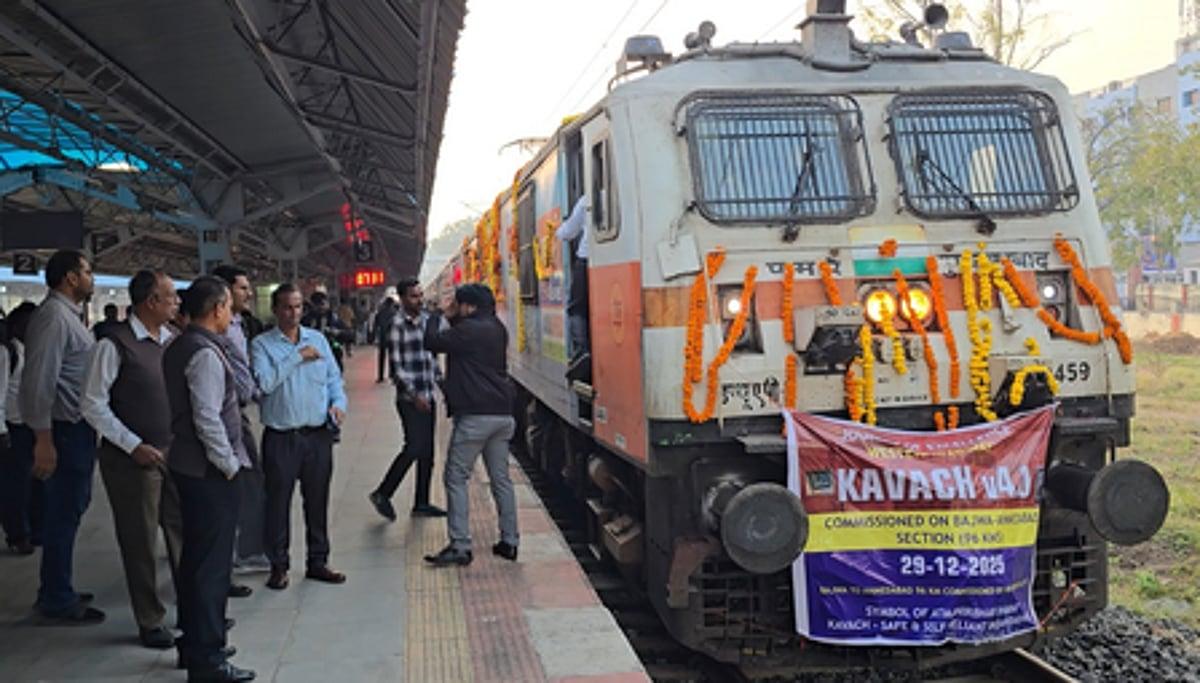
Hyderabad, September 23, 2026: Indian Railways has commissioned KAVACH Version 4.0 for the first time on South Central Railway, marking a significant development in India’s indigenous automatic train-protection programme.
The upgraded system has been deployed across 108 route kilometres between Malkajgiri and Kamareddi in the Hyderabad Division of Telangana. The Ministry of Railways announced the development on Wednesday.
The latest deployment represents an upgrade from KAVACH Version 3.2 and incorporates several technological improvements designed to increase the accuracy and reliability of India’s automatic train-protection infrastructure.
What is KAVACH?
KAVACH is India’s indigenous Automatic Train Protection (ATP) system.
The technology is designed to assist locomotive pilots in maintaining prescribed speed limits and can automatically apply brakes when required if the driver fails to respond appropriately.
One of its important functions is helping prevent Signal Passing At Danger (SPAD) — a situation in which a train passes a signal indicating that it must stop.
The system is also designed to control train speeds in critical situations and reduce the risk of collisions.
KAVACH requires Safety Integrity Level-4 (SIL-4) certification, the highest safety-integrity level used for such systems.
What is new in Version 4.0?
KAVACH 4.0 incorporates several improvements over the earlier version.
One of the most important is increased location accuracy.
More precise train positioning can help the system determine where a train is operating and respond appropriately to signals and other railway conditions.
The new version also provides improved information about signal aspects in larger railway yards.
Another important feature is the station-to-station KAVACH interface through Optical Fibre Cable (OFC).
The system can also interface directly with existing Electronic Interlocking Systems, allowing the automatic protection technology to work more closely with railway signalling infrastructure.
Experience from Version 3.2
The latest version has been developed using experience gained from deploying KAVACH 3.2 across 1,465 route kilometres on South Central Railway.
This existing network provided Indian Railways with operational experience that could be used to improve the next generation of the system.
The move from Version 3.2 to 4.0 on the Malkajgiri-Kamareddi section is therefore not simply a new installation but an upgrade of existing railway safety infrastructure.
How does the system work?
KAVACH involves equipment installed both on trains and along railway infrastructure.
Locomotives are fitted with Loco KAVACH equipment, while railway sections require supporting equipment such as RFID tags, station installations, communication infrastructure and other signalling components.
The system continuously processes information relevant to train movement and signals.
If a train approaches a dangerous situation and the required corrective action is not taken, KAVACH can intervene by automatically applying brakes.
This is particularly important because railway safety involves thousands of trains operating across an enormous network every day.
Why the latest deployment matters
Indian Railways operates one of the world’s largest railway networks, carrying millions of passengers and large volumes of freight.
Automatic train protection systems can provide an additional layer of safety by assisting locomotive crews and responding to certain dangerous situations automatically.
The government’s stated objective is to expand KAVACH deployment across more parts of the national railway network.
The commissioning of Version 4.0 therefore represents a step towards a wider technology upgrade rather than an isolated installation.
Technology and indigenous development
KAVACH is also significant from a technology-development perspective because it has been developed for India’s specific railway environment.
Indian Railways has to operate trains across highly diverse geographical and operational conditions, from dense urban railway corridors to long-distance routes.
The latest version has been developed to address the varied operational requirements of this network.
The direct interface with existing electronic interlocking systems is particularly relevant because India’s railway network contains infrastructure developed across different periods.
Improving compatibility between automatic protection systems and signalling infrastructure can make broader deployment more practical.
What happens next?
The government has indicated that KAVACH 4.0 is intended for large-scale deployment across Indian Railways.
However, nationwide deployment requires substantial infrastructure.
Trackside equipment, communication networks, RFID installations and locomotive equipment all have to be installed and integrated.
The system’s effectiveness also depends on proper testing, maintenance and operational training.
Therefore, the 108-kilometre deployment announced today should be viewed as an important stage in a much larger national railway-safety programme.
The bigger picture
The commissioning of KAVACH 4.0 comes at a time when Indian Railways is increasingly relying on technology to improve safety and operational efficiency.
Automatic protection systems cannot eliminate every possible railway accident, but they can provide an additional technological safeguard in situations involving speed, signals and train movement.
The latest deployment demonstrates the transition from the earlier KAVACH system towards a more advanced version with improved positioning, communication and signalling integration.
For passengers, the most important aspect is ultimately safety: the system is designed to provide another layer of protection during train operations.
For Indian Railways, the larger challenge will be scaling the technology across a network of enormous size while ensuring that the supporting infrastructure remains reliable.
The commissioning of KAVACH 4.0 on the Malkajgiri-Kamareddi section is therefore both a local railway-safety upgrade and a milestone in India’s broader effort to modernise train-protection technology.