

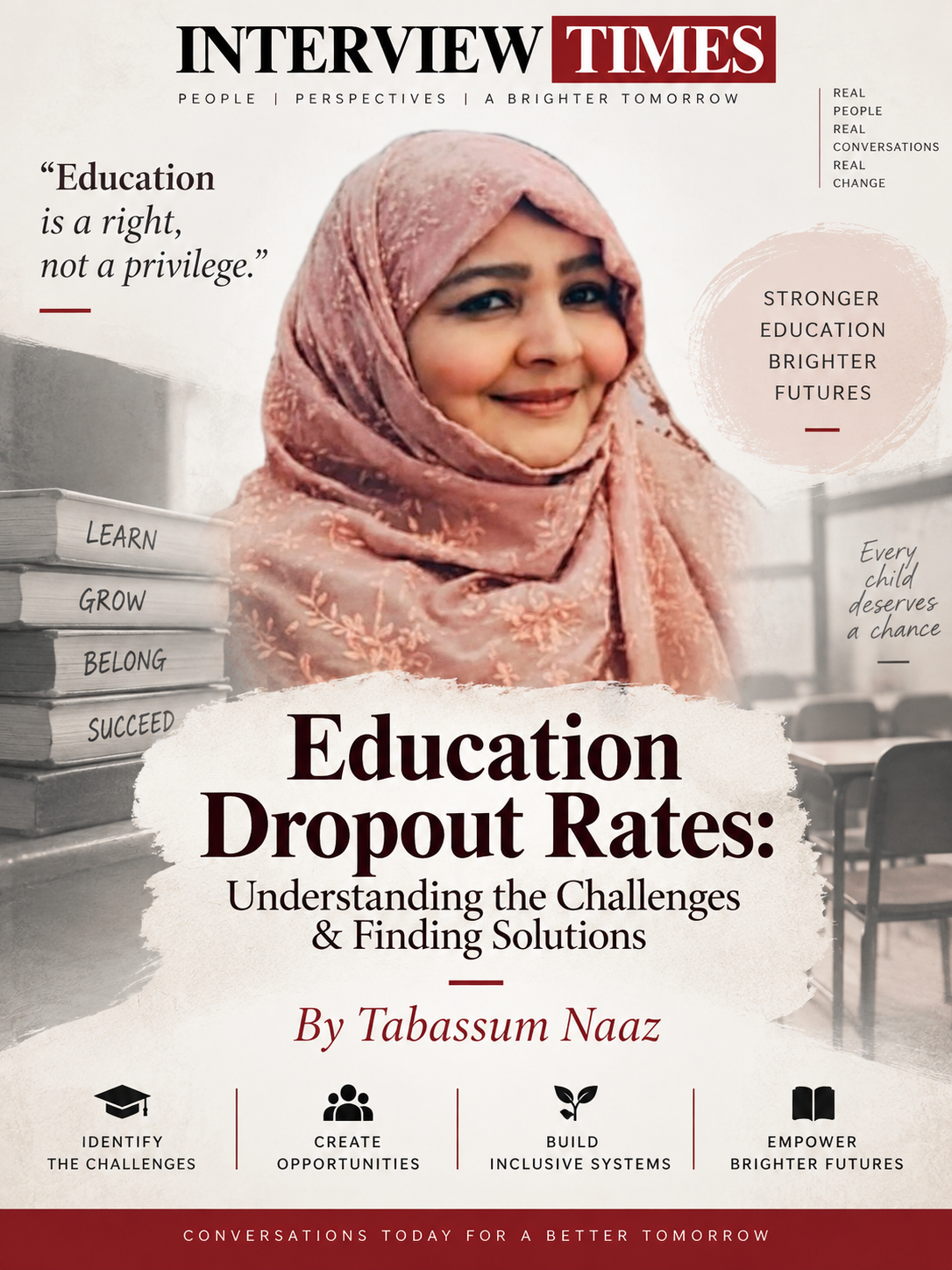
A Women’s Perspective on the Pros, Cons & Social Impact of Leaving Education Early
Education plays a crucial role in shaping an individual’s future, yet many students—particularly girls and young women—are unable to continue their education due to financial, social, family, or personal circumstances.
Through this questionnaire, we explore the reasons behind high dropout rates, their impact on women, and possible ways to make education more accessible and sustainable.
Questionnaire
- What, according to you, are the major reasons behind the high dropout rates in the education system, particularly among girls and young women?
Answer:
There is never just one reason why a girl leaves her education. Behind every dropout, there is often a story that people do not see.
For some families, financial hardship comes first. When money is limited, the education of a son may be given priority, while the daughter is expected to adjust. In other cases, household responsibilities, caring for younger siblings, looking after elderly family members, or helping the mother become more important than her studies.
Social thinking also plays a major role. Some families still believe that a girl ultimately has to marry and move to another home, so spending too much on her education is unnecessary. Safety concerns, lack of proper transport, distance from educational institutions and fear of harassment can also force parents to stop a girl’s education.
Sometimes, it is not even the family that gives up. A girl herself may lose confidence after repeated failures, financial difficulties, emotional struggles or a lack of encouragement.
I strongly feel that behind every dropout there is a reason, and before judging the girl, we should try to understand that reason.
- How do financial difficulties and family responsibilities influence a girl’s decision to discontinue her education?
Answer:
Financial difficulties can change a girl’s dreams very quickly. A girl may have the ability and the desire to study, but when the family is struggling to meet basic needs, education can become a luxury in their eyes.
Many girls quietly take responsibility for their families. They look after younger brothers and sisters, help their mothers with household work, care for sick family members and sometimes even start working to support the household. They may leave their books behind, not because they have stopped dreaming, but because someone at home needs them.
What hurts is that such sacrifices are often treated as normal because they are girls.
I believe family responsibilities should be shared, and a girl’s education should not always be the first thing sacrificed when a family faces difficulty. Financial assistance, scholarships, flexible learning opportunities and support from family can make a tremendous difference.
A girl should not have to choose between being responsible for her family and building her own future.
- Do you think social expectations, early marriage, safety concerns, or gender-based responsibilities contribute significantly to girls dropping out? Why?
Answer:
Yes, they do, and sometimes they work together.
A girl is often expected to learn how to run a home before she is encouraged to build a life of her own. In some families, marriage is considered the natural destination for a girl, while education is seen only as something useful until she gets married.
Early marriage can bring an abrupt end to education. After marriage, household responsibilities, pregnancy, childcare and expectations from the new family can make returning to education extremely difficult.
Safety is another genuine concern. Parents may worry about their daughters travelling long distances, studying late or living away from home. These concerns should not simply be dismissed; instead, society must create safer environments so that girls do not have to sacrifice education for safety.
We need to change the thinking that a girl’s responsibilities begin and end within the four walls of a home. A woman can be a caring daughter, wife and mother and still have dreams, ambitions and an identity of her own.
- What are some of the positive and negative consequences of leaving education before completing school, college, or higher studies?
Answer:
Sometimes leaving education temporarily may be necessary because of difficult circumstances, and we should not judge someone for making that choice. Life does not always follow the path we plan.
But leaving education permanently can close many doors. It can limit employment opportunities, financial independence and the confidence that comes from being able to stand on one’s own feet. It may also make a woman more dependent on others for important decisions.
There can also be an emotional cost. Years later, a woman may wonder what her life could have been if she had received the opportunity to continue studying.
At the same time, education is not the only measure of a person’s intelligence or worth. Many people who could not complete their education go on to build meaningful lives through skills, experience, determination and self-learning.
Therefore, I believe that even if formal education is interrupted, learning should never stop. A closed classroom should never mean a closed future.
- How can education help women become financially independent, confident, and better equipped to make decisions about their own lives?
Answer:
Education gives a woman much more than a degree. It gives her the confidence to understand the world around her and the courage to question what she does not understand.
An educated woman is more likely to know about her rights, financial matters, health, opportunities and responsibilities. Education can help her find employment, start a business, manage money and contribute to the financial security of her family.
But for me, one of the greatest gifts of education is confidence.
When a woman can read, understand, communicate and make informed decisions, she does not have to depend on someone else for every step of her life. She can stand beside her family rather than always standing behind someone.
Education does not teach a woman to reject her family or traditions. It teaches her to make informed choices while respecting herself and others.
A woman who is educated can educate an entire generation after her. That is why educating a girl is never an investment in one person alone.
- What changes can schools, colleges, governments, families, and communities make to encourage girls to continue their education?
Answer:
The first change has to begin with the way we think.
Families need to understand that a daughter’s education is not an unnecessary expense. Schools and colleges should provide safe surroundings, counselling and support for students who are struggling financially or emotionally.
Scholarships, affordable education, transport facilities, hostels for girls, flexible learning options and opportunities to return to education after a break can help many students who otherwise have no way forward.
Families also need to share household responsibilities. A girl cannot study peacefully if she is expected to complete all the domestic work before opening her books.
Communities have an important role too. Instead of questioning a girl about why she wants to study so much, we should ask what we can do to help her continue.
Most importantly, girls need encouragement. Sometimes one teacher, one parent or one person saying, “Don’t give up; you can do this,” can change the direction of a young girl’s life.
- As a woman, what message would you like to share with girls and young women who are considering leaving their education because of financial, social, or family challenges?
Answer:
I would tell them: Please do not give up on yourself.
I know that life does not always give us the circumstances we deserve. Sometimes family responsibilities come before our dreams. Sometimes money becomes a wall between us and the future we imagined. Sometimes we have to pause, compromise and wait.
But a pause does not have to become the end.
If you cannot continue today, look for another way tomorrow. Learn a skill. Continue reading. Take an online course. Ask for help. Return to your education when the circumstances allow it. Do whatever is possible, but do not convince yourself that your dreams are no longer important.
And never believe that being a girl makes your dreams less valuable.
You may have responsibilities towards your family, but you also have a responsibility towards yourself. Your education, your confidence and your ability to make decisions are not selfish things.
Life may change your path many times, but do not let difficult circumstances make you forget the person you wanted to become.
Sometimes the strongest women are not the ones who had an easy journey. They are the ones who continued walking, even when the road was difficult.