
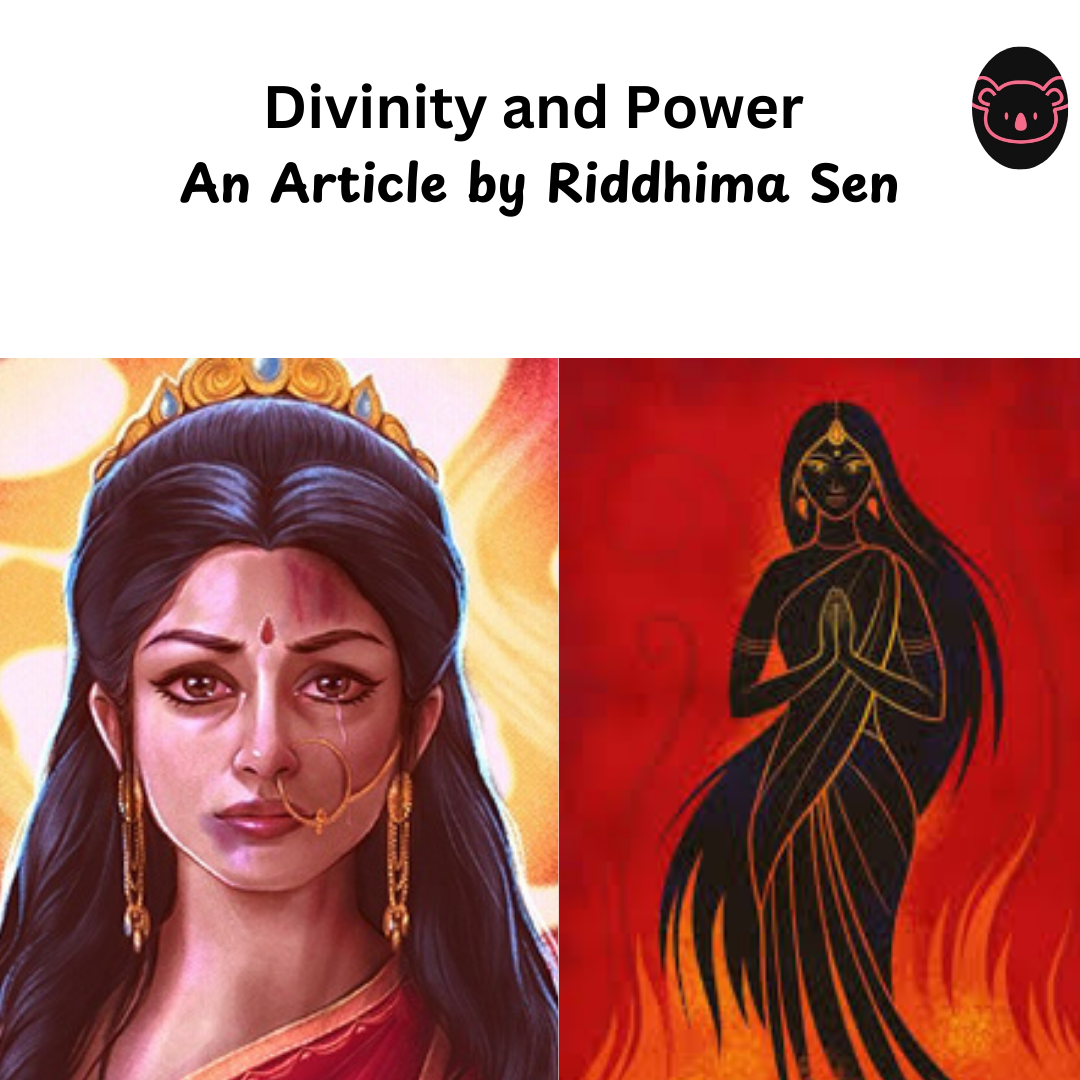
Divinity refers to the idea of being divine in entirety. The spectrum of divine is something which is varying on a great range from person to person. What means divine to one individual won’t necessarily mean same to the other. Power, on the contrary, is directly intertwined with divinity. Divinity lies in each and every individual, as much as it does within gods.
Mythological characters like Sita and Draupadi are the insignia of power and dominance, but in a positive manner. Sita is oftentimes considered to be the ideal daughter-in-law, the ideal wife as well as the ideal woman.
Her fire ordeal is metaphorical of the trials and ordeals women go through on a daily basis, be it mentally or physically. The fire ordeal questions her character, and poses a question on her vestal purity. Sita’s stand for herself lies in the fact, that later on in the epic, in the Uttar Kanda, she decides to return to the womb of her mother, mother earth, after being posed with the question of ‘purity’ again. Draupadi, on the opposite, was a woman who was as pure and fierce as the fire. Both of these women were the signifiers of extreme power and female divinity at its very best.
