
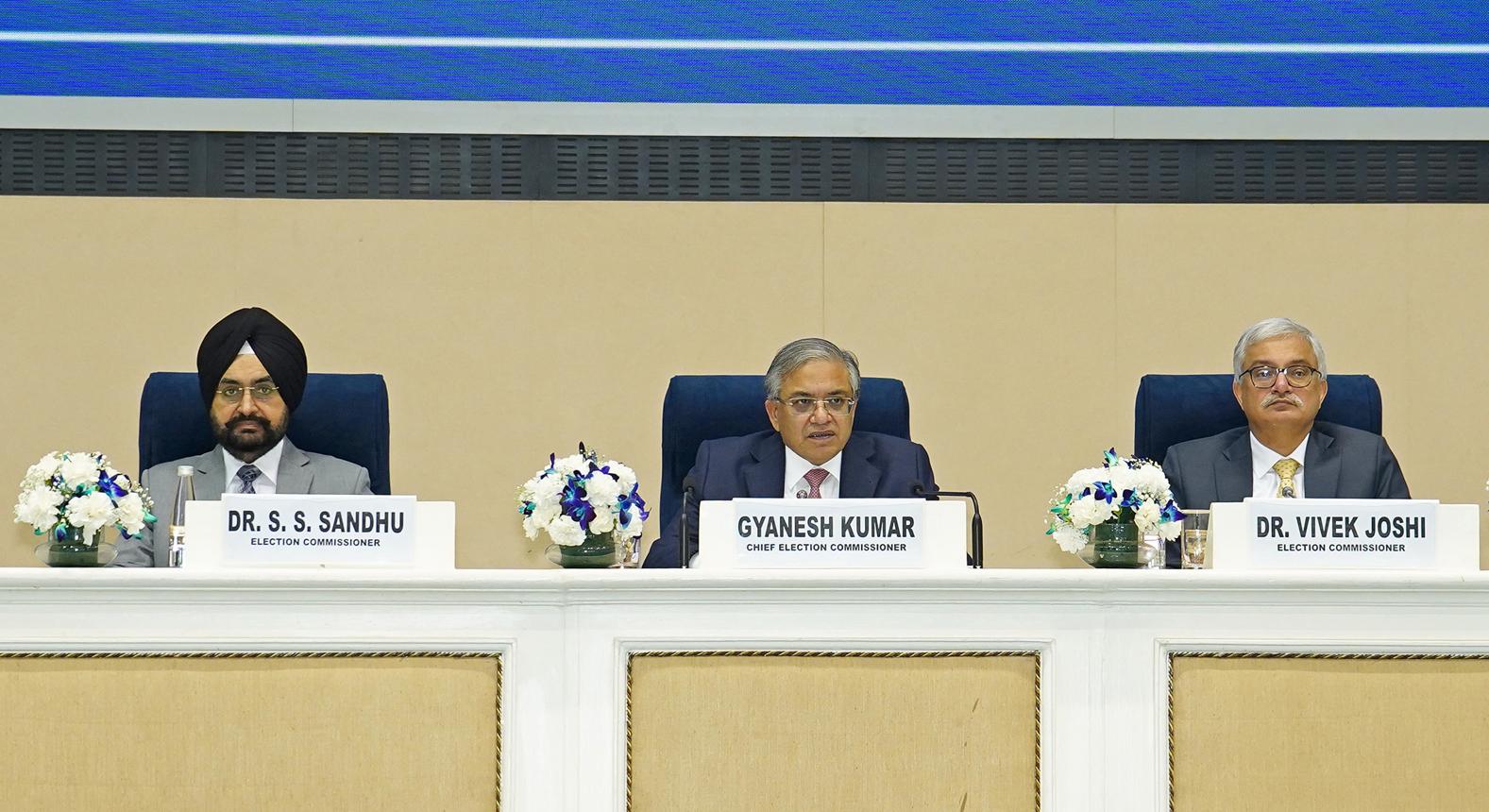
New Delhi, September 23, 2026: The Election Commission of India has come under renewed public and political scrutiny following a report that Election Commissioners Sukhbir Singh Sandhu and Vivek Joshi recorded objections on 14 occasions over a period of roughly 10 months concerning decisions and processes undertaken by the poll panel.
The report, published by The Indian Express on Wednesday, has triggered a wider debate about the functioning of the country’s constitutional election authority, particularly its handling of electoral rolls and the ongoing Special Intensive Revision (SIR) exercise.
According to the investigation, the objections covered several issues, including the treatment of new voters, deletion of names from electoral rolls and questions surrounding access to voter databases. The report also said that the two commissioners had described some steps as “unauthorised” or “illegal” in their recorded observations.
The developments come against the backdrop of the Election Commission’s nationwide electoral-roll revision exercise. The SIR process, which began in Bihar in 2025, has since expanded to several states and Union Territories. The process has become a politically sensitive issue because electoral rolls determine who is eligible to vote in elections.
What triggered the controversy?
The Indian Express report said that the two Election Commissioners had raised objections at different points over decisions taken by the Commission. Among the concerns reported were questions over the addition and deletion of voters and the increasing centralisation of electoral data.
The report has also brought renewed attention to the ECI’s digital systems and the manner in which voter information is managed.
The issue quickly became a major political story on Wednesday, with opposition parties questioning the functioning of the Commission and demanding greater transparency. Several opposition leaders publicly reacted to the report and linked it to their broader concerns about the electoral-roll revision process.
However, the Election Commission itself has rejected the suggestion that the reported differences demonstrate a breakdown within the institution.
In its response, the Commission said that observations, questions and differences during institutional deliberations are normal. It stressed that official decisions and orders carry legal authority and said that major decisions have been taken collectively.
ECI’s response
The Commission’s response is significant because it directly addresses the interpretation being placed on the reported objections.
The ECI maintained that the existence of written observations or questions from individual commissioners should not automatically be interpreted as an institutional split. It said that deliberations can involve different views before a final decision is reached.
The Commission also defended the legal basis of its orders and administrative directions.
This has produced two competing narratives around the same development. The Indian Express investigation has highlighted the substance and frequency of objections recorded by two commissioners, while the ECI has emphasised that deliberative disagreement does not mean that the Commission’s final decisions were not collectively authorised.
Why electoral rolls are so important
Electoral rolls form the foundation of India’s election system. A person’s ability to participate in an election depends on their name appearing on the relevant electoral roll.
The SIR process is intended to update and verify electoral rolls, but large-scale revisions inevitably attract scrutiny because deletion or omission of names can directly affect an individual’s ability to vote.
That is why the current dispute has attracted attention well beyond the technical functioning of the Election Commission.
Questions concerning voter databases, verification procedures and the authority responsible for making changes to electoral records can have consequences for millions of voters.
Political reaction
The report prompted strong reactions from opposition parties on Wednesday. Opposition leaders questioned whether the reported objections represented deeper disagreements within the Commission and called for greater transparency surrounding the electoral-roll revision process.
The BJP and the Election Commission have defended the institution’s functioning, while opposition parties have continued to question the process.
At this stage, the central factual issue is that two Election Commissioners did record objections, while the Commission says that such differences form part of normal institutional deliberation and that its final decisions were taken collectively.
What happens next?
The controversy is likely to keep attention focused on the Election Commission’s handling of electoral rolls and its digital voter-management systems.
The issue could become particularly significant as India approaches several important state elections, making questions surrounding voter-list accuracy, inclusion and deletion increasingly consequential.
For voters, the practical issue is straightforward: electoral-roll revisions can affect whether an individual is able to cast a ballot. For the institution itself, the current debate concerns how such revisions are authorised, documented and communicated.
The controversy therefore goes beyond an internal disagreement between officials. It has developed into a larger public discussion about electoral administration, transparency and the management of India’s voter database.
