
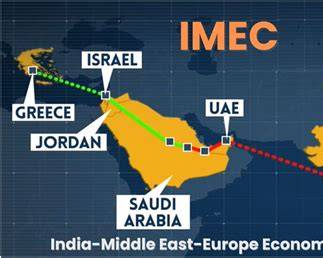
New York, September 23, 2026: The India–Middle East–Europe Economic Corridor (IMEC) has returned to the centre of international attention after US President Donald Trump expressed strong support for the project during meetings with Gulf and Arab leaders on the sidelines of the United Nations General Assembly.
Trump linked the importance of alternative energy and trade routes to continuing instability in West Asia and disruptions affecting commercial shipping. His remarks have renewed focus on a project first unveiled at the G20 Summit in New Delhi in September 2023.
For India, the development is important because IMEC was conceived as a multimodal connectivity network linking India with the Gulf and Europe through a combination of shipping, rail, energy and digital infrastructure.
What is IMEC?
The India–Middle East–Europe Economic Corridor is a proposed transportation and economic network designed to connect three major regions.
The eastern portion would connect India with the Gulf, while the northern section would connect the Gulf with European markets.
The original agreement involved India, the United States, Saudi Arabia, the United Arab Emirates, France, Germany, Italy and the European Union.
The proposed system includes maritime transportation, rail links and supporting infrastructure. Plans have also included electricity transmission, digital connectivity and clean-hydrogen infrastructure.
The project attracted considerable attention when it was announced because it offered the possibility of creating a new connectivity route between India and Europe.
Why is IMEC back in the news now?
The immediate reason is the changing security situation in West Asia.
The conflict involving Iran has created renewed concern about the security of major maritime routes and energy infrastructure. The Strait of Hormuz, in particular, is one of the world’s most important energy chokepoints.
Trump argued that recent attacks affecting commercial shipping demonstrated the need for alternative routes for energy and trade.
Speaking during a meeting with Gulf Cooperation Council leaders, he said his administration strongly supported IMEC and other infrastructure options that could move energy without depending as heavily on vulnerable routes.
His comments have consequently transformed IMEC from primarily a long-term connectivity project into part of the current international discussion about energy security.
What does this mean for India?
India sits at the eastern end of the proposed corridor and could potentially benefit from improved physical connectivity with the Gulf and European markets.
Indian goods could move by sea to Gulf ports before being transported through rail and other land-based infrastructure towards Europe.
Such a network could provide exporters with an additional logistics option and strengthen India’s economic links with Gulf countries.
The project could also create opportunities for Indian companies in infrastructure, logistics, manufacturing, technology and related services.
However, IMEC remains a project requiring extensive infrastructure development and coordination among multiple countries.
The geopolitical dimension
IMEC is also significant because of the broader competition surrounding global connectivity infrastructure.
China’s Belt and Road Initiative has established extensive infrastructure links across Asia, Europe, Africa and the Middle East.
IMEC involves India, the United States, European countries and major Gulf economies, giving the project a wider strategic dimension.
Analysts cited by international and Indian media have described IMEC as an alternative connectivity framework involving India and Western and Gulf partners.
At the same time, the corridor should not be viewed as an immediate replacement for existing maritime routes.
Building railways, ports, energy infrastructure and digital networks across multiple countries requires years of investment and coordination.
The Hormuz factor
The current West Asian conflict has highlighted the vulnerability of energy supplies to disruptions at maritime chokepoints.
The Strait of Hormuz connects the Persian Gulf with the Gulf of Oman and the wider Indian Ocean and is critical for the movement of oil and gas.
The Red Sea and Bab el-Mandeb are also important for trade between Asia and Europe.
The renewed discussion around IMEC therefore centres on diversification — creating additional routes rather than relying entirely on a single transportation pathway.
Challenges ahead
Despite renewed political support, IMEC faces considerable challenges.
The corridor passes through a geopolitically sensitive region, and several sections require major infrastructure investment.
Political stability, financing, construction, customs coordination and security arrangements will all influence how quickly the project can progress.
The corridor also requires cooperation between countries with different economic and strategic priorities.
Therefore, Trump’s endorsement does not itself mean that the entire corridor will immediately become operational.
Why this is important now
The timing of Trump’s comments is significant for India because global trade routes are currently being reassessed amid continuing instability in West Asia.
If implemented, IMEC could give India an additional pathway towards European markets, deepen India’s economic relationship with the Gulf and strengthen the country’s position in international connectivity networks.
The immediate development is therefore not the completion of IMEC, but the renewed political backing for the project at a moment when alternative trade and energy routes have become a major international priority.
For India, the project remains a long-term connectivity proposition whose significance could grow as countries seek more diversified and resilient supply chains.
