Subhechcha Ganguly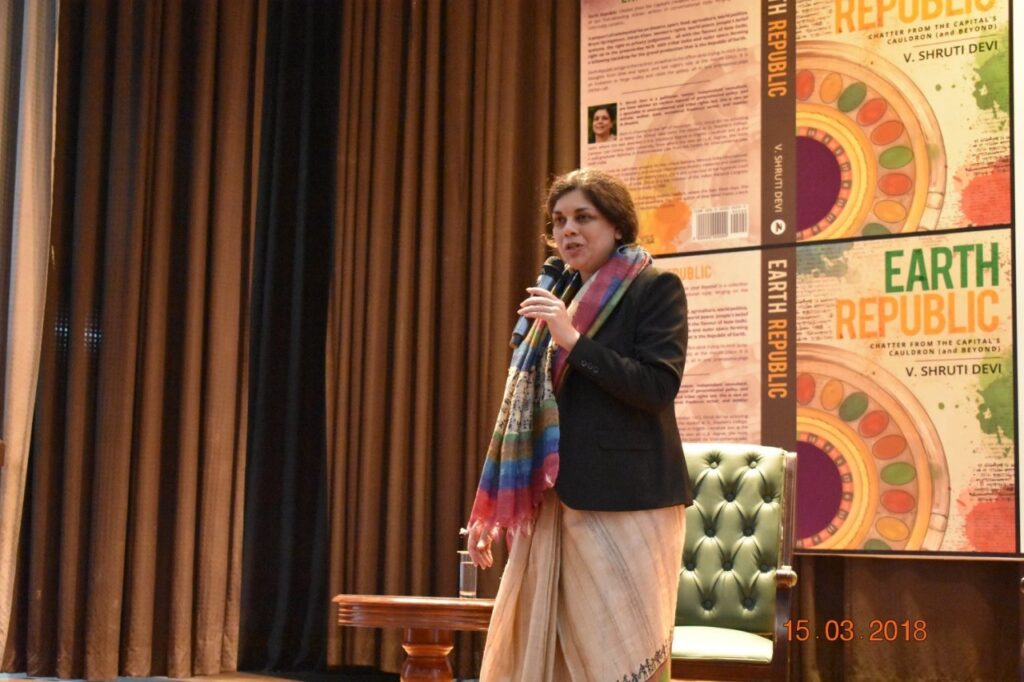
Meet V. Shruti Devi an individual who wears several hats with grace. As an accomplished advocate at the Supreme Court of India and a prominent member of the All India Congress Committee, she combines legal expertise with a passion for politics. Her solo book, “EARTH REPUBLIC: Chatter from the Capital’s Cauldron (and Beyond),” reflects her insightful views on societal matters. Beyond her legal and political pursuits, she finds joy in acting, voiceovers, playing the guitar, exploring new destinations, indulging in literature, and expressing herself through writing. With a flair for folk dances and an active presence on social media, V. Shruti Devi’s diverse interests truly define her vibrant personality.
1. Could you share the inspiration behind your book “EARTH REPUBLIC: Chatter from the Capital’s Cauldron (and Beyond)” and how your experiences as both an advocate and a politician have influenced its content?

V. Shruti Devi, election-time studio photo for INC party posters, Vizianagaram Town, Andhra Pradesh
Ans: In 2017, my work of fiction, Deep Wood Trance, had been published by Writers Workshop, Calcutta. The book incorporates a range of themes that draw from, and build upon the philosophy of environmental law. The publishers of Deep Wood Trance release sets of limited-edition books, which are hand-bound, and many-hued heritage sarees with golden lettering are upcycled to create book covers. It was an honor to have been accepted for publication by Writers Workshop. With the acclaim (from precise and highly valued quarters, the Head of the Department of English Literature at the time when I’d studied at St. Stephen’s College, Delhi) that I received after the publication of Deep Wood Trance, I felt encouraged to plan the publication of another book. While I do write poetry on an ongoing basis, and publish it on my creative blog (my latest book, Ad Altiora Nitimur, is, in fact, a book of poetry with narrativesetting end-notes), I felt I needed to put a publication out there, that anchored people’s perception of me back to my real-life politico-legal work. I do post my views, messages, and articles on another blog as well as elsewhere on social media. However, I felt a tangible non-fiction book would be in order at that point of my political career. While trying to make decisions on which publisher to approach, I came across my publishing partners (of Earth Republic, and of Ad Altiora Nitimur), Notionpress, online. The idea of complete control over content, the post-publication opportunities presented to the author, the fact that I already had ideas in place, for what I wanted to write and publish next, and why, and frankly, if I remember correctly, there was a timely Independence Day discount offered online by the publishing partners. I think I also watched an Indian author of fiction being interviewed on national television, who said he’d written a book of long fiction in three months! I wanted to bring out a publication that would provide reasons and occasions for discussing several policy-related issues, and around which events could be held. We’re talking post-UPA, though our party was in power in some states. I also anticipated that it would help to showcase some of my own work over time. I already had one unpublished non-fiction theme (written in 2013, a web-viewed analysis of Imran Khan’s election campaign), which I intended to put into a book of non-fiction, and was writing (and posting online), a series of articles reviewing a book by a musician (Bruce Springsteen, whose work in musical showmanship and lyric-writing I’ve always admired). I chose to incorporate these pieces into the jigsaw-puzzle that is Earth Republic! In terms of my political career, as well, I thought it was time to display and take ownership of a tangible product, and plan events and discussions around the topics that the non-fiction book deals with.
2. Balancing a career as a Supreme Court advocate and a political figure can be demanding. How do you manage these two roles effectively and ensure your contributions are impactful in both realms?

Ans: I made the decision very early in my legal career, to choose a path in the legal profession that did not involve going to court everyday for litigation-related activities. In 1999, I think that was a more unconventional choice than it is today. However, I made that decision after receiving highly specialized training and grounding as far as litigation work in the Supreme Court of India was concerned. As an Independent Legal Consultant who also participated in litigation processes, I had more control over my time, and was able to dedicate it to my political work. Dedicating time, years, and energy to political work was a conscious decision. Political work is a 24 X 7 process. There is always something urgent, inputs from the public are always to be attended to, travel at short notice is inevitable, people with problems, political supporters and others expect to be met at short notice, there is no document that is not urgent, when you’re assisting, or creating support for legislative processes. Such work had been driven by the sheer ideological force of the Congress Party and its local as well as global aims and destinies. Small signs of appreciation and reward in the non-fiction field go a long way to encourage an author’s mission. It was wonderful, being awarded a Certificate of Honour for having written Earth Republic: Chatter from the Capital’s Cauldron (and Beyond), as well as Deep Wood Trance, by the Supreme Court Bar Association on Constitution Day at an event on the lawns of the Supreme Court of India in the presence of stalwarts from the legal field, including the then Chief Justice, the Attorney General, the Law Minister, the President of the Bar Association, and other judges and senior colleagues from the bar.
3. Your book covers a range of societal issues. Can you highlight one topic that you feel particularly passionate about and explain how you hope your perspectives can drive positive change?

Ans: At the most macro level, the overview is aimed, literally, at arriving at World Peace, and a Glorious Future for out Planet. Good governance would have a lot to do with how this is achieved. Time is also of essence, especially in the contexts of Environment and Human Rights. To draw from some eastern spiritual thought-processes: in a non-ego-drivenmanner, sometimes, if you put yourself at the center of a situation, you find answers for yourself. If your own quest is for world peace, it is worthwhile to explore how this might be brought about through leveraging semi-autobiographical matter for the good of humanity. The chapters are dealt out as clues or ingots for readers who might chance upon and recognize the opportunities that probably exist.
4. From your hobbies of acting, voiceovers, and folk dances, to your profession and political engagements, you’re involved in various fields. How do these diverse interests complement and enhance each other?
Ans: My passion is acting, as in, theatre…I see voiceovers as an extension of the acting bug! The big ambition there, however, is to act in an English film. I’ve been an on-screen presenter and been in a docu-drama years ago. For many years, I chose to dovetail my interest in theatre into my work as an activist, and used theatre workshops and street theatre to connect with people, and create awareness on socio-political issues. A t present, I sometimes use the social media space to upload videos of my experiments with performances (primarily in English, but also in Telugu, Hindi and Oriya). This also serves to create a sustained connection with The People. Dhimsa folk dances (or rather, activities), are practiced by our communities along the eastern ghaat hill range. These are impromptu cultural indulgences. I do not view these folk dances as performing arts, but as in situ participatory events. The topography, the prevailing ambience, the folk music, beats and instruments are an essential part of those events. In fact, the local phrase in Telugu translates to Play (and not dance) the Dhimsa. In the past, there have been many occasions when hamlet-level or village-level gatherings that I’ve been a part of, have included dhimsa-playing. Snippets have been video-recorded on occasion. I believe that I might have played a small role in creating a sense of pride, value, and recognition amongst dhimsa players for their practice, in many pockets of the eastern ghaats over the past few decades.
5. As an active voice on social media, how do you navigate the challenges and opportunities presented by the digital age, especially in the context of your roles in law and politics?
Ans: I’m pleased to note that you’ve described me as an “active voice on social media”. I’m acutely conscious of the fact that as far as social media is concerned, so far, my audience is by no means a gigantic one. However, I initially took inspiration from the fact that one of our leading national newspapers used to be said to have a circulation of only three thousand people, but those were probably three thousand change-makers and catalysts. Yes, I’d probably qualify as being on social media 24X7 and beyond! A large part of participating in social media that is not immediately visible to anyone as a tangible product, is the work done by reading and analyzing what others say and do. I am, indeed, very, very regular on Facebook, though I also use Twitter, and have recently joined Instagram, and have started organizing my Youtube uploads into Podcasts, Playlists, Shorts and Live broadcasts. These are in addition to my two blogs. Before social media came into its own, followed by WhatsApp communications, one used to write emails on issues, and either send them out to sets of people, or participate in Yahoo e-groups etc. By the end of the day, or the week, one had a sense of who all had read one’s writings, often leading to fruitful law-and-policy outcomes. So, at one level, if you’re looking for the impact of your ideas, it would only be a question of whose attention you manage to capture and influence. Depending on what you’re trying to achieve, that could be a very niche audience, or you might need to talk to billions of people! So far, I’ve not made concerted efforts or investments into gaining mass followings on social media as a politician. I have not, so far, treated social media as a means to mass-influence voters. However, as a writer and netizen, moving ahead, I do plan to use these media to enhance my professional goals of lawyering, writing, and performing. I think I’m on the brink of that universe, and it is challenging to wrap one’s brain around how it’s to be tackled.
6. Writing requires a different creative process compared to legal and political work. Could you describe how you approach writing, especially when sharing your insights on complex issues?
Ans: In politico-legal communications, I value brevity. Being a poet sometimes arms you with skills to economize with words, but to transfer those exact modes to legal writing would only obfuscate attempts to communicate! I think every politician (and maybe every lawyer with a broad Constitutional overview) necessarily deals with a variety of people, situations, settings, concerns, and modes of social interaction. One person’s consciousness into which mind-boggling varieties of inputs are bombarded in a way that would leave John Donne, the metaphysical poet who yoked together opposites, flabbergasted. One of the tricks, so to speak, is to be able to navigate through these myriad situations without losing out on your own priorities, style, voice, call it what you will. This agility in life, ideally, is also reflected in one’s ability to write to (and for) an array of fora with the perfect mix of consistency and flexibility.
7. Your involvement in the All India Congress Committee showcases your commitment to public service. What policy areas do you prioritize, and what changes do you envision for the betterment of your constituents?
Ans: I aim to uphold the ideals set forth in my party’s Constitution, and am inspired by the high standards for humanity that were set by our party’s founders. I believe that each one of my party colleagues today is also committed to the causes of democracy, freedom, the rule of law, the betterment of the people, sustainable development, world peace, the ideals of the Constitution of India, and appropriate human advancement. We are a dynamic concern, and take corrective action when required, as we attempt to shape history. I have personally worked on issues connected to the equitable access to natural resources, the entire set of environment-related legislations, and have played a key role in many areas of Scheduled Tribe and Adivasi rights. Gender justice as a cross-cutting theme across all laws and situations, and in niche areas, is also foremost in my activism, including in seemingly mundane day-to-day lived experiences. The launch of Earth Republic in 2018 was timed so that it was just a day ahead of when a party colleague from my generation took over as the President of the AICC for a few years. Earth Republic was launched the year that I became an AICC member (after twenty years of formally working for the party as a card-holder). With the responsibility of being an AICC Member, I felt, personally, that I needed to clarify, to myself, at least, my positions (or reconciliations, or individual or multigenerational distinctions) on some debatable elements of my party’s distant history, as well as take global credit on behalf of the party, for key roles played by our party leaders and other politicians in the past. I would encourage you to read the book to treasure-hunt these references. My politics is also influenced by the fact that I’m from a political family.
Coming from a line of Zamindar-Rajahs who were legally recognized as Scheduled Tribe tribal chiefs by India after independence, there have been fascinating worlds for me to juggle, from tribal India, to Lutyens Delhi and beyond. I have always chosen the path of duty towards “our people”, and I now extend that identity to the entire planet. As I stated at the outset, my essential aim is to help bring about World Peace, and for this, attempting to understand global geo-politics through the energy and environment debate, and to understand the politics of other countries through preferred (if oblique) lenses is what I sometimes embark upon, as reflected in some of the chapters of Earth Republic.
8. In your book, you discuss your love for reading and literature. Are there any authors or books that have significantly influenced your perspectives or writing style?
Ans: I can’t recall specifically having mentioned a love for reading and literature in Earth Republic, but I’m sure the fact that I find reading enjoyable and entertaining is evident, and perhaps conveyed through the fact that one of the chapters of Earth Republic is in the form of a book review. [Incidentally, I’m also a bit of a conspiracy theorist, and read the entire manuscript of Earth Republic, an eighty-thousand-plus-words book approximately fifteen times to check for mistakes or interpolations. When you write, sometimes, you’re on a roll, and surprise yourself with your own turns of phrase when you go back and read your work. A conspiracy theorist could well imagine that computer hackers have been at work! (With the advent of AI, conspiracies would quadruple!) My resolution to such situations as an indie author with print-on-demand publications has been to read the entire manuscript at each stage of the technical product-quality checks (to make sure that nothing has been edited) without depending on soft-wares to do the comparisons, and to take final responsibility for the final version that goes out there. I do not believe the files are tampered with thereafter.] [Note: Please note that the three paragraphs above, which are in square brackets, could be deleted in the interest of brevity, along with this present note which is also in square brackets]. I think I read much more fiction, poetry and drama, and some biographies and autobiographies in the days when I was a student at school and college than after I started studying law. Different authors, poets and playwrights might have influenced one for different reasons. I don’t think I’ve ever consciously tried to emulate any writer, but one could take a journey through the ideas, eras, and areas of writing that one might have thought of as ‘the way to write’ at various points of time. The influences that might be discerned with reference to the style of writing in Deep Wood Trance, for example, would be more on the lines of Renaissance poets and playwrights such as Shakespeare and Tennyson, mystics such as Blake, and authors of classics such as Thomas Hardy and the Bronte sisters, and authors of science fiction: Carl Sagan, Arthur C. Clarke, JR Tolkien, Indian authors like Salman Rushdie, Vikram Seth, Shobha De, while also shooing in elements from Jeffrey Archer, Sidney Sheldon, Arthur Hailey, and all the works of Enid Blyton, Carolyn Keene, Franklin W. Dixon, Alfred Hitchcock, and even James Hadley Chase, to name a few. As far as the pith and substance, or the core themes that have had an impact, all the sea-faring classics which were a precursor to one understanding colonial and post-colonial narratives, especially in the development sector; classics such as Black Beauty, and a range of other farm-life-related books, such as Heidi, and Rebecca of Sunnybrook Farm, Shadow the Sheepdog, assorted Russian folk tales, all created an appreciation for, and made Shangrilas out of visions encompassing natural beauty and abundance, and inspiring a fondness for all creatures. Works such as Uncle Tom’s cabin, and the writings of Mahatma Gandhi would move one to come to grips with the fact of racism worldwide. A.J. Cronin’s The Stars Look Down would introduce one to harsh worlds and human conditions, and books on the World War, as well as on the India – Pakistan partition would warn one of the utter brutality that the human specie is capable of. Ayan Rand would create mirages, and attempt to draw you into a world of chasing mirages. Books by various authors from India on the days of the British Raaj, and on Feudal life, would fascinate one, and make one aware of the fact that one was located in a truly historic city: Delhi, the capital of India. Larry Collins and Dominique La Pierre, and even Shashi Tharoor’s The Great Indian Novel, and Clarence Darrow’s books were information-and-zeitgeist-filled at various levels, and took one beyond one’s history textbooks, and career guides. The humorous works of PG Wodehouse, though devoured long ago, might sometimes colour the brand of humour of some of my more recent poetic works. I think the English translation of the Oriya book, Paraja, by Gopinath Mohanty, based on the lives of indigenous communities only several hours from my ancestral home, had a lasting impact on me, on the same lines of the kind of impact that The Stars Look Down by AJ Cronin did. While there are always feministic takes on any work of literature, I think novels by Pearl S. Buck and the like served to caricature patriarchal attitudes and associated aspirations from certain eras in the western world, as did the Little Women series: all great ammunition for a young reader to develop a strong resolve to counter all sorts of offensive traits of humanity! Books on the lives of sporting greats, or others who’ve fought against odds to achieve their goals and succeed, pages that inspire humanity, and propel the human condition to aspire have helped to draw attention to the importance of sports, games and outdoor activities, and my vision of presenting my fellowmortals with opportunities in their fields of passion and ability germinate in a chapter on sports and games in Earth Republic. The book might sound like it carries varied mandates, but the chapters are all carefully crafted to be a part of a larger picture in which humanity is victorious, benevolent, just, non-violent, and ever-expanding in its respect for all life and living. From the mid-1990s till the present day, I sometimes manage to squeeze in reads from the most welcome army of Indian authors who rule much of the literary space today. About ten or fifteen years ago, I was a part of a book club in Delhi. I remember doing a comparative analysis of two books by Indian authors, which were a feminist approach to the life of Draupadi from Indian mythology, Yagnaseni by Pratibha Ray, and Palace of Illusions by Chitra Benerjee Divakaruni. Such books are sharp reminders of the gender-disparity that exists, that needs to be dealt with at all levels, and that therefore merits a chapter in Earth Republic. I believe that if one reads a number of judgements by a particular judge, and the style of writing is worthy of being emulated, there is a chance that this permeates into one’s non-fiction writing. (Though I daresay my chapter on a court judgement, intended to draw clueless members of the reading public into learning about the law has more of a Bertie Wooster nonchalance about it, rather than a Lord Denning timbre). In some of the chapters, I think nostalgic reveries have led to stream-ofconsciousness styles of high-fiving childhood memories, which, in the most extreme analysis, simply echo or mirror voices and sentiments of the style of speaking or reminiscing of some of the self-same dramatis personae! As years progressed, my almost non-stop reading revolved around news, newsanalysis and governmental and non-governmental reports. There was a time, in the last few years of the UPA government’s rule, when I began the day with reading and analyzing up to fifteen newspapers every day. A sure-fire way to defragment all literary influences up until such times and readings! Harry Potter, since it’s inception, definitely finds some sort of subconscious place in all one’s writings that aspire towards the victory of good over evil, especially in the non-fiction arena. It’s an evolving theory of mine, that if you’re capable of refining your consciousness to a near-pure state, or a near-neutral state, then, at any given moment, you take on the characteristics of whatever surrounds you. This would also apply to audio influences, sounds, tones. The tone of the chapters that were written for Earth Republic was often influenced by Chennai accents, for the obscure reason that one was mostly writing in solitude, and was telephonically in touch with publishing consultants from the Chennai offices of the publishers while not fielding phone-calls from my aunt in Chennai! A fitting tribute to the city of my birth! Similarly, I find that my syntax, accent, and tonality, while writing, often takes on the characteristics, or reflects or brings to life, the subject-matter of the immediate context. This is not a very deliberate tool. It’s more like attending a theme party…the nifty tone in the poem that flits through social life in a city is distinguishable from the gravitas of patriotically-inclined verses. This might not be a unique trait.
9. Advocacy often involves taking a stance on controversial matters. How do you maintain objectivity and professionalism when dealing with cases or issues that might evoke strong emotions?
Ans: First of all, I think one needs complete clarity of thought on whatever the topic is. The aim should therefore be to transparently work towards achieving that clarity, including seeking and receiving information from diverse sources. When one’s own objectives are genuinely free of deliberate bias, or corrupt or self-serving needs, then one gains the trust of discussants and stakeholders. The idea is to, at all times, communicate and reason with all those concerned. Transparency, impartiality, honesty, a humble attitude that enables communication are key.
10. Traveling is another passion of yours. How do your journeys inspire your work and provide you with fresh perspectives that you can apply to both your legal and political roles?
Ans: Experiencing nature, observing the many creations of humans and human communities, and interacting with people from various cultures is always a learning experience, and a luxury, even if you’re a backpacker. I think Responsible Tourism is important, and has many components to it, including honouring the priorities of local governments and of people at the grassroots. However, one should know where to put one’s foot down in the light of cultural malpractices such as oppressive dress codes and diktats to cover people’s bodies that might be indicated by elements from within local communities. Making new connections and creating goodwill are an integral part of the travel experience for me. Multi-tasking while being a tourist by promoting one’s ideas through talks or informal discussions, or campaigning or advocating for causes always has the potential to be a win-win situation for all concerned. I’ve done a spot of freelance travel writing in the early days of the internet for the launch of a travel company in India that is currently wildly successful, and would love to travel to write (or vlog!) again… certainly for my social media, my youtube channel and blogs (those are ongoing), and perhaps for other publications. Answers from V. Shruti Devi 22nd August, 2023