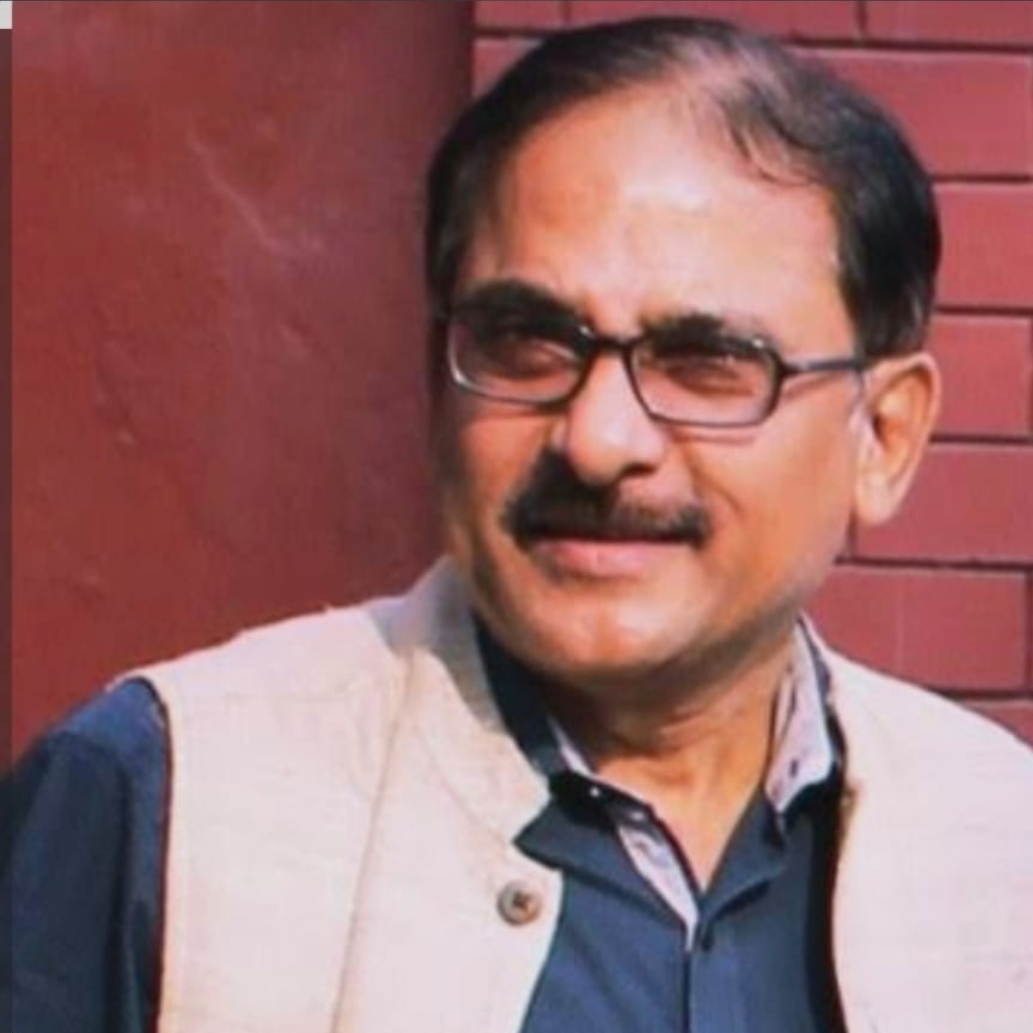
Reimagining the University: Prof. Chandi Prasad Nanda’s Blueprint for 2036 and Beyond

There are leaders who administer institutions, and then there are those who interrogate them—who question their purpose, reframe their relevance, and rebuild their direction.

Chandi Prasad Nanda belongs firmly to the latter category.

His appointment as Vice Chancellor was not, by his own admission, a moment of triumph—it was a moment of introspection.

“The first thought was not authority. It was responsibility. A quiet appeal—for clarity, strength, and direction.”

That tone defines everything that follows.

The Weight of Time: Why 2036 Is Not Just a Date

For Prof. Nanda, the future is not abstract—it is time-bound.

2036 (Odisha @ 100) and 2047 (India @ 100) are not symbolic milestones. They are strategic deadlines.

“No conversation about the future of this region can ignore 2036. No institution can ignore 2047.”

This shifts the role of a university—from a passive academic space to an active engine of civilizational progress.

The Real Challenge: Not Resources, But Relevance

In an age where public universities are constantly compared to private institutions, Prof. Nanda rejects the premise outright.

“Analogy is a bad form of logic.”

His argument is sharp:

Private institutions have a different mandate

Public institutions operate in a different ecosystem

Therefore, comparison is strategically meaningless

The real issue is not scarcity.

“Resources are not the problem. Channelization is.”

This is a critical insight.

India’s higher education system today does not suffer from lack of inputs—it suffers from lack of:

Strategic deployment

Institutional alignment

Outcome visibility

Legacy vs. Relevance: The False Binary

Most legacy institutions struggle with a fundamental tension:

Preserve heritage

Or adapt to modern demands

Prof. Nanda reframes the problem:

“Legacy must be retained. But discipline practices must evolve.”

The failure is not of disciplines—it is of stagnant pedagogy.

History cannot remain archival

Physics cannot remain theoretical

Literature cannot remain isolated

Relevance must be engineered.

The Death of Silos: Rise of Interdisciplinary Thinking

One of the most powerful ideas emerging from the conversation is this:

“No discipline has died. What we have lost is the momentum to evolve.”

The traditional divide between:

Natural Sciences

Social Sciences

Humanities

…has collapsed.

We are now operating in what can only be called a convergence economy of knowledge.

Take climate, for instance.

It is no longer:

A scientific issue

Or a historical issue

It is both.

And more.

The idea of the Anthropocene—where humans are a geophysical force—forces disciplines to collaborate in ways never imagined before.

Historians must engage with geology.

Scientists must engage with philosophy.

From Campus to Ecosystem

The university, in Prof. Nanda’s vision, is not infrastructure—it is a living system.

Spread across hundreds of acres, the campus becomes:

An ecological model

A learning environment

A behavioral laboratory

“We are not expanding. We are revealing.”

From water bodies to green zones, from visibility to design—the campus itself becomes a pedagogical tool.

Citizen Journalism: Owning the Institutional Narrative

Perhaps one of the most disruptive innovations is the idea of internal storytelling.

“Every student is a citizen journalist.”

Every event:

Documented

Curated

Archived

Retrieved

This creates:

Institutional memory

Real-time documentation

Accreditation readiness

Student engagement

The university stops being observed—and starts observing itself.

Cleaning as Philosophy: The Idea of Epistemic Reform

A simple act—cleaning the campus—is elevated into a powerful metaphor.

“Cleaning is not physical. It is epistemic.”

This extends to:

Academic processes

Administrative systems

Governance structures

It is about removing intellectual clutter and systemic inefficiency.

Students as Stakeholders, Not Consumers

A defining shift in Prof. Nanda’s leadership philosophy:

“Students are not beneficiaries. They are partners.”

They are:

Co-creators

Contributors

Problem-solvers

“You cannot be part of the problem. You must become part of the solution.”

This is not motivational rhetoric.

It is institutional doctrine.

The Industry-Academia Gap: A Manufactured Problem

The long-standing debate:

Industry says students lack skills

Academia says change is difficult

Prof. Nanda dismisses it as a comfort-zone narrative.

Because the ecosystem already has answers.

Within proximity exist:

IITs

IIMs

Skill centers

“If we don’t talk to them, the gap will remain.”

The solution is simple:

Collaboration

Immersion

Resource sharing

Dialogue

The problem is not absence. It is disengagement.

Geography as Strategy: The Coastal Advantage

One of the most underutilized lenses in higher education is geography.

For a university in Odisha, the roadmap is obvious:

Marine Science

Blue Economy

Logistics & Supply Chain

Data & Analytics

“If we ignore our coastline, we ignore our opportunity.”

This is not academic planning.

It is geo-economic intelligence.

Technology: Not a Rival, But a Layer

The fear that technology is replacing traditional disciplines is misplaced.

The real model is:

Integration, not replacement

History + Data

Literature + Analytics

Anthropology + AI

Technology is not a domain. It is an enabler.

The Alumni Economy: Rethinking Sustainability

With limited state resources, universities must evolve financially.

“We cannot depend entirely on the state.”

The solution:

Activate global alumni

Introduce virtual teaching

Build revenue-generating programs

Alumni move from being donors to active institutional drivers.

Leadership: Alignment Over Authority

In a fragmented ecosystem of diverse stakeholders, leadership cannot be imposed.

“Strategy must be discussed, not dictated.”

The task is to align:

Students

Faculty

Administration

Industry

Alumni

…into a unified thought structure.

Ideology: From Conflict to Aspiration

On campus politics, Prof. Nanda offers a disarming perspective:

“My ideology is growth. My ideology is aspiration.”

This reframes everything.

From:

Ideological conflict

To:

Developmental alignment

Interdependence: The Core Philosophy

If there is one idea that anchors his entire vision, it is this:

“Nothing makes sense in isolation.”

We are living in an age of interdependence.

Disciplines depend on each other

Institutions depend on ecosystems

Individuals depend on systems

“Wherever you are, you must understand the system—and your role in it.”

This is the shift from:

Individual excellence → System intelligence

Competition → Collaboration

Isolation → Integration

A Journey of 38 Years: Experience as Insight

Prof. Nanda’s journey reflects depth and continuity:

Ravenshaw College

JNU (Master’s & PhD)

Sambalpur University

Utkal University

Ravenshaw University (Dean for over a decade)

Gati Shakti University

Nearly four decades of academic engagement—across institutions, disciplines, and systems.

This is not just experience.

It is institutional memory with perspective.

The Final Thought

At a time when higher education is caught between:

Market pressures

Policy shifts

Technological disruption

Prof. Nanda offers a clear, grounded, and deeply intellectual roadmap.

Not built on:

Comparison

Complaint

Convention

But on:

Clarity

Convergence

Conviction

And perhaps the most defining line of the conversation:

“You are not what you believe. You are what you build.”

This is not just the story of a Vice Chancellor.

It is a blueprint for how Indian universities must think—if they are to matter in 2036 and beyond.

Rate this post

Subscribe to our Newsletter