
 The “Champua Model”: How Creative Governance is Reimagining Tribal Livelihoods
CHAMPUA, KEONJHAR: In the rugged terrains of the Champua subdivision, where tribal communities like the Bhuyan, Gond, and Kolha make up 60% of the population, development was once a slow-moving target. For decades, these communities faced a “triple threat”: a complete lack of energy for irrigation in hilly areas, persistent exploitation by middlemen due to a lack of storage, and the gradual decay of traditional crafts.
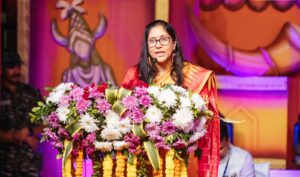
However, during her tenure as Project Administrator of ITDA Champua, IAS officer Parul Patwari introduced a vision of “Creative Convergence” that has since been recognized by the Ministry of Tribal Affairs (MOTA) as a national best practice. Instead of relying on generic aid, the administration focused on low-cost, high-impact innovations that respected both the geography and the culture of the region.
Solving the Energy Crisis with Ancient Tech
The most striking example of this creative pivot is the Hydram Project in Kaliabeda village. Historically, tribal farmers in hilly regions were unable to irrigate their crops because traditional pumps required expensive electricity or fuel—resources that were often unavailable.
Patwari’s administration installed Hydraulic Ram (Hydram) pumps, an ancient technology that uses natural water pressure to lift river water to higher gradients without any external power. This zero-energy solution provided a sustainable irrigation lifeline for ST farmers at a fraction of the cost of traditional infrastructure.
Breaking the Middleman Cycle
For marginal farmers, the inability to store produce often meant selling at throwaway prices to middlemen. To solve this, ITDA developed Zero-Energy Cool Chambers (ZECC) across Champua and Jhumpura.
The Innovation: Using the principle of direct evaporative cooling, these chambers reduce temperatures by 10–15 degrees and maintain 95% humidity.
The Impact: This low-cost “fridge for farmers” significantly extended the shelf life of horticultural produce, allowing them to wait for better market prices and avoid middleman exploitation.
Professionalizing Tradition: The Aadi Shakti Group
While sal leaf plate making was a traditional activity, it rarely fetched a sustainable income. The administration creatively professionalized this by forming the “Aadi Shakti Producer Group,” bringing together 252 tribal women from eight villages. By providing a dedicated unit at Bardhana and aligning it as a green initiative, the project turned a traditional forest skill into a modern, sustainable business model.
Education Through “Speaking Walls”
The creative transformation extended into the classroom with the “Speaking Walls” initiative. Recognizing that tribal children often struggled with standard curricula, the administration transformed school and hostel walls into interactive visual learning aids.
The Pilot: Originally tested at the Ramala Ashram School, it was replicated across 25 primary schools with support from the Odisha Mining Corporation (OMC).
The Result: These immersive walls have significantly enhanced comprehension and retention levels by turning the school building itself into a teacher.
A Scalable Future
From the revival of Tussar silk rearing in Kasia village to the introduction of soil-less nurseries using Indo-Israel technology, the “Champua Model” proves that tribal development does not always require massive budgets. By combining traditional wisdom with innovative tech and multi-departmental convergence, Parul Patwari has created a blueprint that the Ministry of Tribal Affairs now views as a replicable framework for tribal empowerment across India.
