Interview Times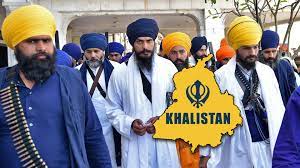
What is Khalistan Movement?
The Khalistan movement is a separatist movement seeking to create a homeland for Sikhs by establishing an ethno-religious sovereign state called Khalistan in the Punjab region. The call for a separate Sikh state began during the 1930s, when British rule in India was nearing its end. In 1940, the first explicit call for Khalistan was made in a pamphlet titled “Khalistan”. It was discovered by Jagjit Singh Chohan. Chohan established the Council of Khalistan at Anandpur Sahib on 12 April 1980 and became its first self‐styled president.
The Rise of Bhindranwale in 1980s
Jarnail Singh Bhindranwale was the leading figure of Khalistani movement in the early 1980s He was the fourteenth leader, of the prominent orthodox Sikh religious institution Damdami Taksal. In 1982, Bhindranwale and his group moved to the Golden Temple complex and made it his headquarters. Bhindranwale would establish what amounted to a “parallel government” in Punjab, setting cases and resolving disputes, while conducting his campaign. Bhindranwale has remained a controversial figure in Indian history. While the Sikhs’ highest temporal authority Akal Takht describe him a ‘martyr’, but the Indians saw him as spearheading a “revivalist, extremist and terrorist”.
Increasing militant activity in 1984
Widespread murders by followers of Bhindranwale occurred in 1980s’ Punjab. Armed Khalistani militants of this period described themselves as Kharku. On its own, the year 1984 (from 1 January to 3 June) saw 775 violent incidents, resulting in 298 people killed and 525 injured.
Operation Bluestar
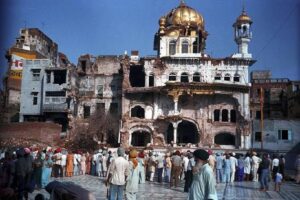
Operation Bluestar was an Indian military operation ordered by then Prime Minister Indira Gandhi, between 1 and 8 june 1984 to remove militant religious leader Jarnail Singh Bhindranwale from the famous Golden Temple in Amritsar.Later Since the inception of the Dharam Yudh Morcha to the violent events leading up to Operation Blue Star, Khalistani militants had directly killed 165 Hindus and Nirankaris, as well as 39 Sikhs opposed to Bhindranwale, while a total of 410 were killed and 1,180 injured as a result of Khalistani violence and riots. As negotiations held with Bhindranwale and his supporters proved unsuccessful, Indira Gandhi ordered the Indian Army to launch Operation Blue Star. Bhindranwale was killed in the operation, while many of his followers managed to escape. Army casualty figures counted 83 dead and 249 injured. Later Rajiv Gandhi admitted that over 700 Indian soldiers were martyred.
Operation Black Thunder
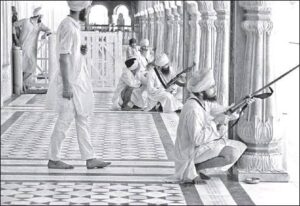
Operation Black Thunder is the name given to two operations that took place in India in the late 1980s to flush out remaining pro-Khalistan Sikh militants from the Golden Temple using ‘Black Cat’ commandos of the National Security Guards and commandos from Border Security Force. Like Operation Blue Star, these attacks were on the Sikh militants based in the Golden Temple in Amritsar, Punjab.
Operation Black Thunder I
The first Operation Black Thunder took place on 30 April 1986. About 200 radical Sikh militants had been occupying the temple premises for the last 3 months. The operation was commanded by Kanwar Pal Singh Gill, who was the DGP of Punjab. About 300 National Security Guards commandos stormed the Golden Temple, the holiest shrine of the Sikhs, along with 700 Border Security Force troops and captured about 200 Sikh militants. One person was killed and two were injured. All of those who were arrested were released a few months after the Operation on account of a lack of evidence. The operation, which lasted eight hours, was approved by then Chief minister of Punjab Surjit Singh Barnala of Shiromani Akali Dal.
Operation Black Thunder II
Operation Black Thunder II began on 9 May 1988 in Amritsar and ended with the surrender of the militants on 18 May. The operation was under control of the Union Home Ministry and had been planned since early 1988. In early 1988 the government created a model of the Golden Temple in the Aravail Hills where National Security Guards practiced the operation. They later practiced the Operation in a high school and college in Harayana. The Special Action Group commandos had already started to grow their hair so they could blend in as Sikhs during the operation.
Soon civilians and militants surrendered. Compared to Operation Blue Star, little damage was inflicted on the Golden Temple. In what was reported as a successful operation, around 200 militants surrendered, 41 were killed. Gill stated that he did not want to repeat the mistakes made by the Indian army during Operation Blue Star. This operation was described as a severe setback to the Anandpur Resolution implementation movement. In contrast to prior operations, minimum force was used under full public scrutiny. It is remembered for the free access the news media was provided unlike during Operation Blue Star. The day after the militants surrendered, nine reporters were allowed into the Temple complex. Kirtan was resumed at the Golden Temple on 23 May 1988 after a two-week break during this operation.
Conclusion
The movement was crushed in India following Operation Blue Star (1984) and Operation Black Thunder (1986 and 1988), but it continues to evoke sympathy and support among sections of the Sikh population, especially in the Sikh diaspora in countries such as Canada, the UK, and Australia.