Suparjya swain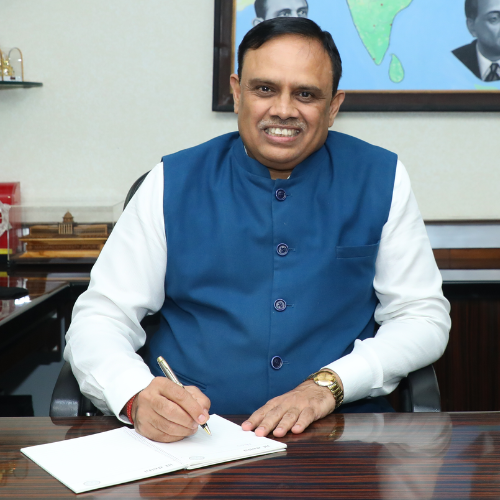
 FEATURE: In the quiet corridors of India’s technical education system, a revolution is unfolding under the steady hand of Professor T.G. Sitharam, the visionary Chairman of the All India Council for Technical Education (AICTE). His journey from a small-town student in Karnataka to one of India’s most influential education administrators reads like a blueprint for transforming an entire nation’s academic landscape. What makes his story remarkable isn’t just his personal achievements, but how he’s channeling them to prepare millions of Indian students for the technological tsunami reshaping global economies.
Professor Sitharam’s academic credentials reveal the making of an extraordinary mind. After completing his engineering degree in Mysore, he pursued advanced studies at the Indian Institute of Science, Bangalore, before earning his doctorate from Canada’s University of Waterloo in 1991. His international exposure included teaching stints at Waterloo and the University of Texas at Austin, where he contributed to pioneering research in geotechnical engineering. But unlike many bright minds who chose to remain abroad, he returned to India in the 1990s, bringing with him not just knowledge, but a burning desire to rebuild his country’s technical education infrastructure from the ground up.
His thirty-year tenure at IISc Bangalore became the stuff of academic legend. As a professor and researcher, he mentored over forty Ph.D. scholars, published more than five hundred research papers, and authored twenty books that have become essential reading in engineering education. His groundbreaking work in earthquake-resistant infrastructure and sustainable development earned him consistent placement in Stanford University’s prestigious list of the world’s top 2% scientists – a rare honor that speaks volumes about the global impact of his research.
When Professor Sitharam took charge as Director of IIT Guwahati in 2019, he inherited an institution with potential waiting to be unlocked. In just three years, he transformed it into one of India’s premier technical universities through a series of bold initiatives. He broke down traditional academic silos by creating five new interdisciplinary schools focused on emerging fields like artificial intelligence and renewable energy. Under his leadership, IIT Guwahati rose to become India’s second-ranked institute for research citations in global rankings. Perhaps most innovatively, he pioneered India’s first engineering-medical convergence by establishing a medical school and teaching hospital on campus – a model that’s now being replicated across the country.
Since assuming leadership of AICTE in December 2022, Professor Sitharam has initiated what many consider the most comprehensive reforms in Indian technical education since independence. His approach is both visionary and practical, recognizing that degrees alone don’t guarantee employability in an era of rapid technological change. He’s made entrepreneurship education compulsory across technical institutions, launching bootcamps that have trained over fifty thousand students in design thinking and business modeling. Understanding the critical importance of industry exposure, he mandated six-month internships for all technical students while forging partnerships with global tech giants like Google and Microsoft to bring cutting-edge certifications into college curricula.
What sets Professor Sitharam apart is his unwavering commitment to making quality education accessible to all Indians. He’s championed initiatives that deliver technical education in regional languages, breaking the English barrier that once excluded millions of students. His Anuvadini AI platform has translated over a million pages of technical content into Indian languages, while special scholarship programs ensure women get equal opportunities in STEM fields. These aren’t just policy decisions – they’re the building blocks of an education system that can truly harness India’s demographic dividend.
The academic world has recognized Professor Sitharam’s contributions with numerous honors, including the Sir C.V. Raman Young Scientist Award and the Sir M. Visvesvaraya Senior Scientist Award. But perhaps the truest measure of his impact lies in the classrooms across India where students are now learning skills relevant to the 21st century, in the startups emerging from college campuses, and in the growing confidence of Indian technical graduates on the global stage.
As India positions itself to become a global leader in the Fourth Industrial Revolution, Professor Sitharam is ensuring its education system evolves to meet this ambitious goal. He’s expanding international collaborations, implementing AI-powered learning systems, and creating industry-academia partnerships that keep curricula aligned with real-world needs. His vision extends beyond producing engineers – he’s nurturing problem-solvers, innovators, and leaders who can navigate the complexities of our technological age.
In Professor T.G. Sitharam, India has found that rare combination – a world-class scholar who understands ground realities, an institution builder who can navigate bureaucracy, and most importantly, an educator who never loses sight of the human element in technical education. His legacy won’t be measured in policies drafted or committees chaired, but in generations of Indian students empowered to build the nation’s future. As the digital transformation accelerates across industries, the quiet revolution Professor Sitharam is leading in India’s technical education system may well prove to be his most enduring contribution to his country’s rise as a knowledge superpower.