
The United States has drawn a clear distinction between Iranian athletes and certain members of their potential World Cup delegation, stating that while players are welcome to participate, individuals with alleged links to Iran’s security forces may not be allowed entry into the country.
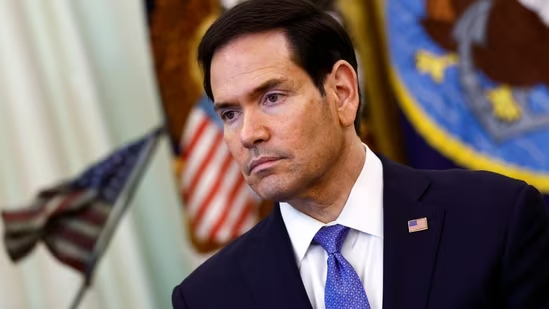
US Secretary of State Marco Rubio said Washington has no objections to Iran’s national football team taking part in the global tournament. However, he underlined that concerns remain over non-playing personnel who may accompany the squad, particularly those suspected of ties to the Islamic Revolutionary Guard Corps.
Speaking alongside President Donald Trump, Rubio clarified that the issue is not with the athletes themselves but with certain individuals who could be included in the broader delegation. “The problem with Iran would be not their athletes. It would be some of the other people they would want to bring with them, some of whom have ties to the IRGC,” he said.
Rubio further warned that the US would not permit individuals linked to the IRGC to enter under the guise of support staff. “They can’t bring a bunch of IRGC terrorists into our country and pretend that they are journalists and athletic trainers,” he added, indicating that visa restrictions could be applied selectively.
Despite the firm stance, Rubio emphasised that no official communication has been sent to bar Iran’s team from participating in the World Cup. “Nothing from the US has told them they can’t come,” he said, signalling that the pathway remains open for athletes to compete.
President Trump echoed this position, stressing that sportspeople should not be penalised amid geopolitical tensions. “We would not want to affect the athletes,” he said, reinforcing the administration’s intent to separate sport from politics where possible.
The remarks come against the backdrop of heightened tensions in West Asia following a series of US and Israeli strikes on Iran earlier this year, which triggered retaliatory actions by Tehran targeting Israel and Gulf states hosting American military bases. Although a fragile ceasefire has been in place for over two weeks, the situation remains volatile.
The broader regional conflict, including ongoing Israeli military operations in Lebanon, has resulted in significant casualties and displacement, further complicating diplomatic relations. In a related development, Trump recently indicated that a ceasefire between Israel and Lebanon has been extended by three weeks following what he described as productive discussions between US officials and regional envoys.
As preparations for the World Cup continue, the evolving geopolitical landscape is increasingly shaping decisions around participation, security, and logistics. The US stance highlights the delicate balance between maintaining international sporting engagement and addressing national security concerns, underscoring how global events are often influenced by forces beyond the playing field.
