

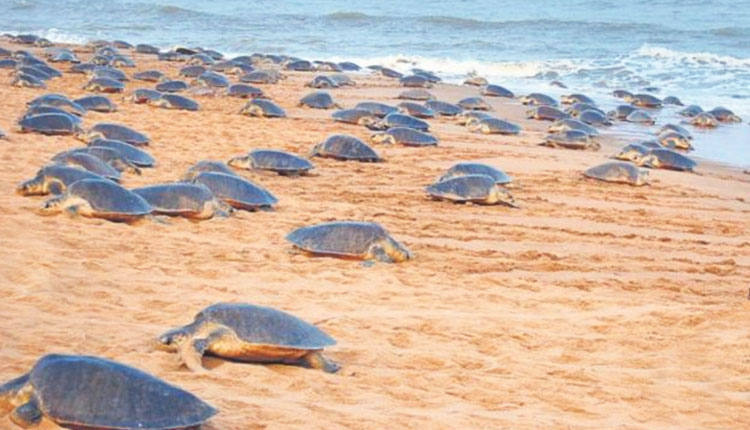
This year, the yearly mass nesting of endangered Olive Ridley turtles at Gahirmatha beach in the Kendrapara area has been skipped. Millions of Olive Ridley turtles typically congregate at Gahiramatha, which is close to Bhitarkanika National Park, between January and March to lay eggs. It is known as the largest rookery in the world.
Although turtles have occasionally arrived towards the end of March in the past, nesting has never been postponed past that time, according to Varadaraj Gaonkar, Divisional Forest Officer of Mangrove Forest Division (Wildlife), Rajnagar. He pointed out that another significant rookery in the state, the Rushikulya river mouth in Ganjam district, has already seen the start of mass nesting by turtles. They haven’t yet shown up at Gahirmatha, though.
“There is a possibility of turtles skipping mass nesting this year like they did in 2014, but we are not ruling out their arrival. Weather conditions and the beach profile at Agarnasi are still ideal for mass nesting,” Gaonkar said. The mass arrival of female turtles, known as ‘arribada’—a Spanish term for the phenomenon—is a unique natural event where millions of turtles converge on the beach at night to lay eggs before returning to sea.
“It is tough to predict why they have not appeared at the nesting beach so far,” the DFO added. Wildlife experts suspect unchecked trawl fishing and human interference may have disturbed the turtles, though no definite reason has been established.
According to officials, research on turtle behavior is still under progress, although it is yet unknown how they live. “There could be a number of reasons for the non-emergence at Gahirmatha, but these are still theories,” an official stated. According to records, in 2014, 2008, 2002, 1998, 1997, 1988, and 1982, turtles skipped arribada at Gahirmatha. Approximately 6.06 lakh turtles came to Gahirmatha for mass nesting in 2025 over the course of five days beginning on March 5.