
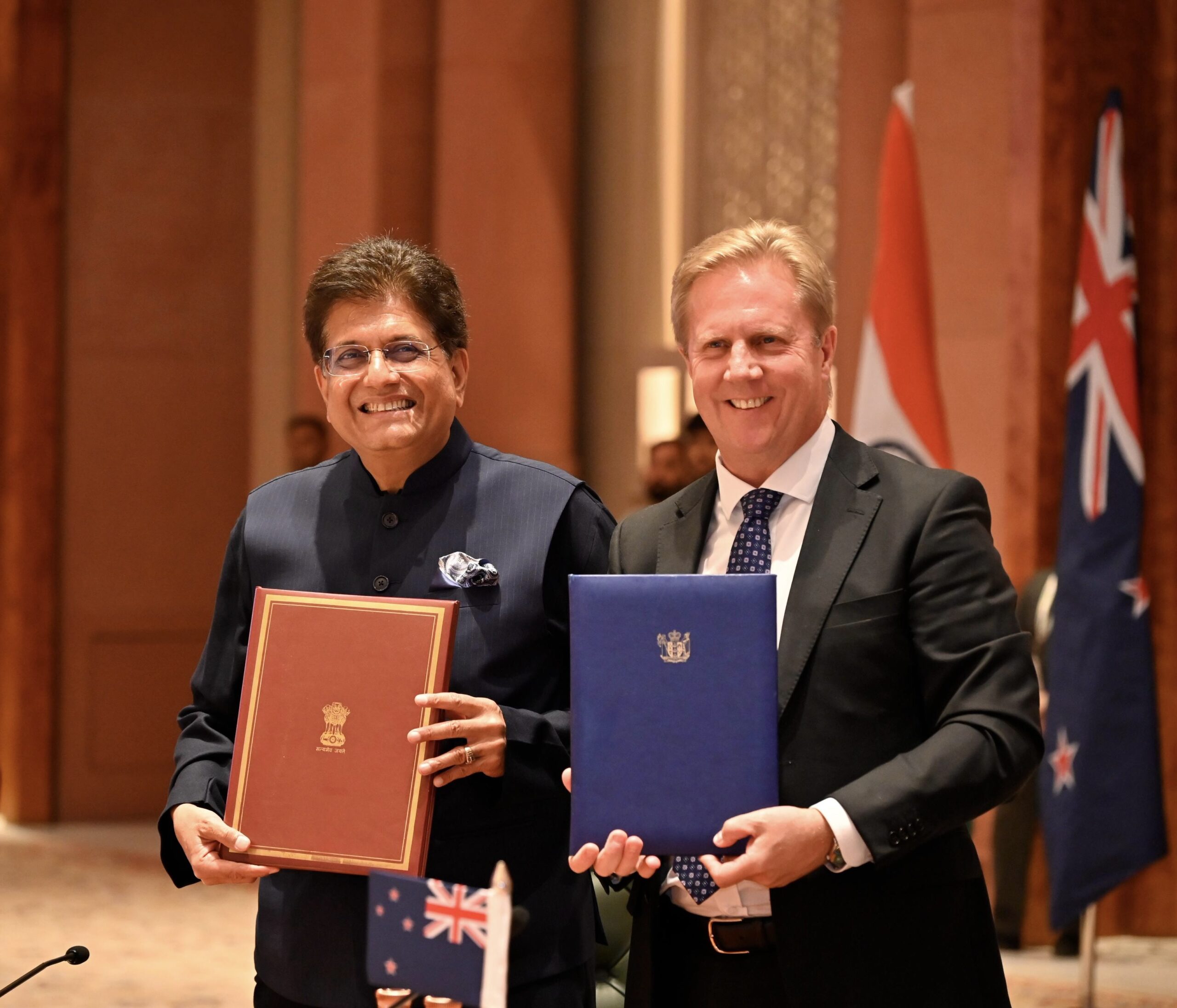
The India- New Zealand Free Trade Agreement (FTA) was signed between the Union Minister of Commerce and Industry, Piyush Goyal and New Zealand’s Minister for Trade and Investment, Todd McClay.
This follows the announcements made on 16 March 2025 about negotiations for a FTA between the two countries. The deal was concluded in a record of 9 months, making it the fastest concluded FTA signed by India. It will come in effect following ratification by the Parliament of New Zealand. Welcoming the deal, New Zealand’s Prime Minister Christopher Luxon posted on X that:
This is a once-in-a-generation agreement that gives NZ exporters unprecedented access to 1.4 billion people and an economy set to become the third-largest in the world
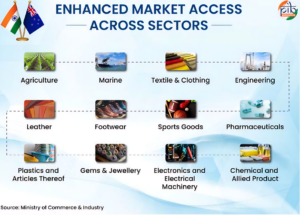
Youth, farmers, MSMEs, and workers will be the key beneficiaries as this FTA enhances market access and improved tariff conditions for Indian exports to New Zealand.
Major gains of India are: duty-free access for 100% of India’s exports to New Zealand; duty-free inputs for several of India’s manufacturing sectors; reduced trade barriers and regulatory uncertainty; structured cooperation for MSMEs.
Indians in New Zealand
Around 300,000 persons of Indian origin live in New Zealand, making up nearly 5% of its population. Therefore, the Indian diaspora in New Zealand through their valuable contribution to the economy also create the need for stronger bilateral ties and demand for Indian goods and services.
India became the first country with which New Zealand signed the Annex on Student Mobility and Post Study Work Visa– providing Indian students in New Zealand the opportunity to work 30 hours per week while studying. The agreement also extended post-study work visas for 3 years for STEM Bachelors and Masters’ students and 4 years for Doctoral students.
The FTA also establishes a new Temporary Employment Entry (TEE) Visa pathway with a quota of 5,000 visas for skilled Indians for stay up to 3 years. Professionals such as AYUSH practitioners, yoga instructors, Indian chefs and music teachers are sought after. Other sectors of interest are IT, engineering, healthcare, education and construction.
1,000 working holiday visas will be available annually for young Indians, allowing multiple entries into New Zealand for up to 12 months.
Agriculture and Farmers
To protect Indian farmers and domestic markets from getting flooded with imports certain products are kept in exclusion of the FTA such as dairy and animal products, vegetables, sugar, artificial honey etc.
New Zealand has agreed to create focused action plans for kiwifruit, apples, and honey to improve productivity, quality and sectoral capabilities of these fruit growers in India. There are projects especially for apple cultivators and sustainable beekeeping practices.
Plans include establishment of Centres of Excellence which will focus on improved planting material, capacity building for growers, collaborative research, technical support for orchard management, post-harvest practices, supply chains and food safety.
Areas of cooperation under agriculture also include horticulture, honey, forestry, livestock, fisheries, apiculture and the wine sector.
Investments and Economic Cooperation
New Zealand will invest USD 20 billion in India over the next few years, strengthening long-term economic ties. A Rebalancing Clause is incorporated into the agreement to provide a mechanism for addressing any shortfall in investment delivery, ensuring tangible and long-term economic outcomes.
New Zealand will also provide India ‘Most-Favoured Nation’ Commitment in about 139 sub-sectors apart from market access commitments in about 118 service sectors.
Cooperation has been agreed in AYUSH, audio visual industries, tourism, sports and traditional knowledge systems. The FTA promotes India’s AYUSH systems internationally, encourages medical value travel, and positions India as a global wellness hub.
New Zealand also committed to amend its laws within 18 months to provide EU-level protection for India’s Geographical Indications. The Agreement provides for a balanced and robust framework of Product Specific Rules of Origin (PSRs) to effectively prevent circumvention, misuse, or falsification of Rules of Origin criteria. Such an engagement on the level of Intellectual Property Rights ensures equal-footing of India as New Zealand’s trade partner.
These gains are expected to boost India’s exports, create jobs, and strengthen the competitiveness of Indian industries in the Oceania region.
From farmers and MSMEs to students, and working professionals, the India-New Zealand Free Trade Agreement reinforces India’s position as a trusted global partner, in line with the vision of a globally integrated Viksit Bharat 2047.
