Subhechcha Ganguly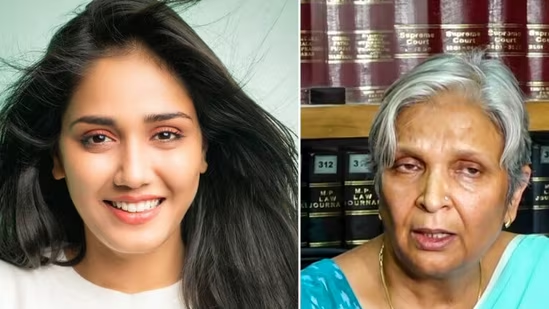
The Supreme Court on Monday was informed that the Central Bureau of Investigation is likely to assume charge of the investigation into the mysterious death of actor-model Twisha Sharma within a day. The development comes amid growing allegations of institutional bias, procedural lapses, and irregularities in the probe being conducted by the Madhya Pradesh Police.
A bench comprising Justices Surya Kant, Joymalya Bagchi, and Vipul M Pancholi noted the Madhya Pradesh government’s submission that it had already written to the Centre recommending a CBI investigation.
Appearing for the state, Solicitor General Tushar Mehta informed the court that the necessary notification from the Department of Personnel and Training (DoPT) authorising the CBI takeover was expected to be issued soon.
The apex court stressed that the investigation must remain “fair and dispassionate” and urged all parties, including the media, to avoid influencing the probe through public statements or witness interviews. The bench observed that although it had no doubts about the state police’s intentions, an independent investigation by the CBI would help restore public confidence.
The court also expressed concern over claims suggesting that the judiciary was interfering in the case because Sharma’s husband is a lawyer and her mother-in-law is a former judicial officer. Calling such allegations “unfortunate,” the bench clarified that the suo motu proceedings were initiated to address concerns regarding possible institutional bias and investigative discrepancies highlighted in media reports.
The case, registered by the Supreme Court under the title “In Re: Alleged institutional bias and procedural discrepancies in the unnatural death of a young girl at her matrimonial home,” has drawn nationwide attention. The court noted that a second autopsy had already been conducted in Bhopal by an AIIMS Delhi medical team following orders from the Madhya Pradesh High Court.
Senior advocate Sidharth Luthra, representing Sharma’s family, alleged delays in filing the FIR and failures in preserving evidence, warning that crucial evidence could disappear with time.
The bench assured the family that a transparent and impartial investigation would be ensured once the CBI formally takes over the matter.