
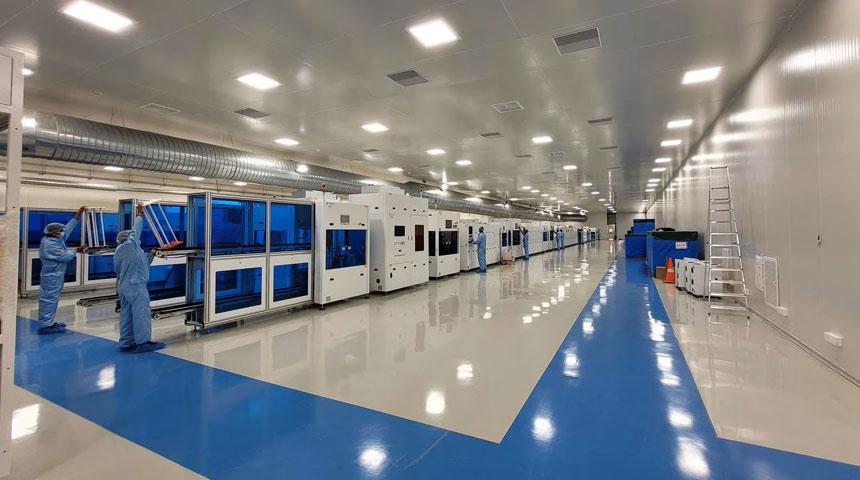

India’s solar manufacturing ambitions have received a significant boost with Premier Energies commissioning a new 7 GW N-type TOPCon G12R solar-cell manufacturing facility at Naidupeta, Andhra Pradesh.
Commissioned on September 21, 2026, the facility has begun trial runs and takes the company’s total solar-cell manufacturing capacity from 3.6 GW to 10.6 GW. Premier Energies describes the new unit as India’s largest solar-cell manufacturing plant.
₹3,293 Crore, 101 Acres and 7 GW
The scale of the project makes it particularly significant. Developed with a capital expenditure of approximately ₹3,293 crore, the manufacturing complex is spread across 101 acres.
At designed capacity, the facility can manufacture approximately 88,000 solar cells every hour, providing Premier Energies with considerably greater scale to serve demand for high-efficiency solar products in India and overseas.
For India, the development represents more than an increase in manufacturing capacity. It reflects the continuing effort to strengthen the domestic supply chain for technologies at the heart of the clean-energy transition.
Technology at the Heart of Manufacturing
The Naidupeta plant has been built around N-type TOPCon G12R technology, an advanced solar-cell architecture designed for high-efficiency applications.
Premier Energies has also integrated digital systems and artificial intelligence into the manufacturing environment. According to the company, these technologies support predictive performance analysis, tighter process control and precision manufacturing, while automated material movement, packing and packaging systems are intended to improve consistency and operational efficiency.
The facility is designed to accommodate future upgrades to TOPCon+ technologies, including advanced edge-isolation processes and poly-finger metallisation. Following stabilisation and ramp-up, the company is targeting average solar-cell efficiency of around 25.8%.
Building Scale for India’s Solar Future
The commissioning takes Premier Energies’ total solar-cell capacity to 10.6 GW, positioning the company at significantly greater scale in India’s domestic photovoltaic manufacturing industry.
The development also forms part of a broader strategy. Premier Energies plans backward integration into ingot and wafer manufacturing, with the objective of developing a more integrated solar-manufacturing platform.
For an industry where supply-chain resilience, technology and manufacturing scale increasingly determine competitiveness, deeper integration could become an important strategic advantage.
Manufacturing With Sustainability in Focus
Large-scale clean-energy manufacturing also carries its own environmental footprint. At Naidupeta, Premier Energies says it has installed a Zero Liquid Discharge (ZLD) system designed to maximise water recycling and reuse within the manufacturing operation.
This creates an important dimension to the story: the transition towards renewable energy increasingly depends not only on deploying clean-energy assets, but also on how sustainably the technologies behind those assets are manufactured.
From Energy Transition to Manufacturing Opportunity
India’s renewable-energy expansion is creating an industrial opportunity extending well beyond solar-power generation itself.
Solar cells, modules, wafers, ingots, equipment, automation and associated supply chains are increasingly becoming part of a wider domestic manufacturing ecosystem.
Premier Energies’ Naidupeta investment demonstrates the scale at which Indian manufacturers are beginning to participate in this transition.
The numbers tell the story:
₹3,293 crore investment.
101-acre manufacturing complex.
7 GW new solar-cell capacity.
Approximately 88,000 cells per hour.
10.6 GW total solar-cell capacity.
Together, they represent a substantial addition to India’s solar-manufacturing infrastructure.
A New Chapter in India’s Clean-Energy Manufacturing Story
India’s energy transition will ultimately require more than renewable-power installations. It will also require a competitive domestic industrial base capable of producing the technologies that make that transition possible.
With the commissioning of its Naidupeta facility, Premier Energies has added significant scale to that manufacturing equation.
As trial operations stabilise and production ramps up, the plant will be closely watched not simply for the volume of solar cells it produces, but for what it represents — India’s continuing effort to translate its clean-energy ambitions into domestic advanced-manufacturing capability.
