
Special coordination review focuses on railway rakes, road transport and plant-level requirements as Telangana prepares to sustain thermal power generation amid dry conditions associated with El Niño.
By Snigdha Mishra | The Interview Times
Hyderabad | September 29, 2026
As Telangana faces higher electricity requirements amid dry conditions associated with El Niño, Singareni Collieries Company Limited (SCCL) and Telangana State Power Generation Corporation Limited (TGGENCO) have drawn up an action plan targeting the supply of 75,500 tonnes of coal per day to the state’s thermal power plants.
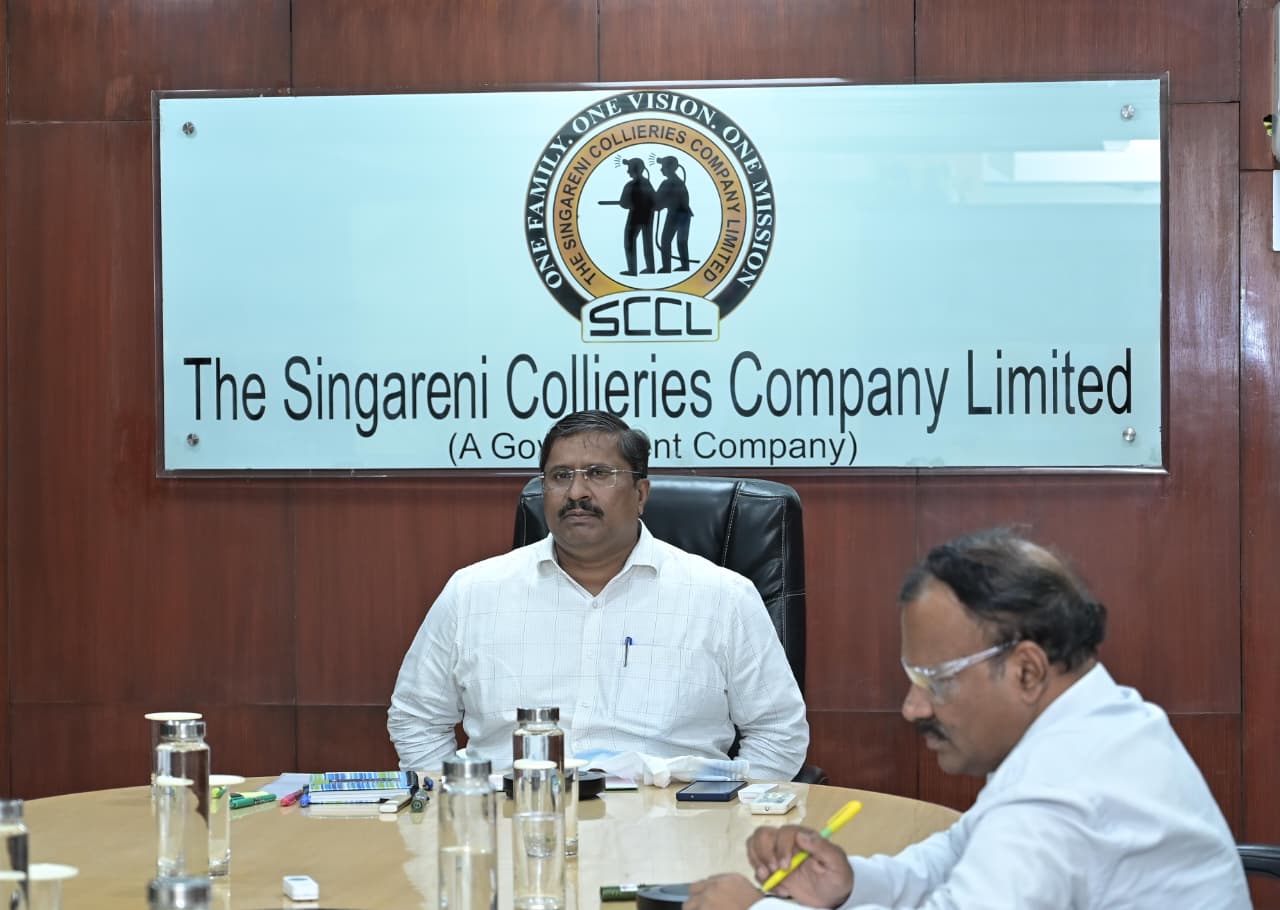
The plan was discussed at a special coordination review chaired by SCCL Chairman and Managing Director Dr. Jyoti Buddha Prakash and TGGENCO CMD S. Harish, with senior officials from the two organisations examining coal requirements, dispatches, railway rake availability, transportation and operational bottlenecks.
56,000 Tonnes by Rail, 19,500 Tonnes by Road
At the centre of the action plan is a two-pronged transportation strategy designed to maintain the movement of coal to TGGENCO’s generating stations.
Of the targeted 75,500 tonnes per day, around 56,000 tonnes is planned to be transported through 14 railway rakes, while another 19,500 tonnes is expected to move by road.
Together, the two modes account for the full daily target and underline the importance of transportation infrastructure in maintaining reliable coal supplies to thermal generating stations.
Officials reviewed coal quality, loading and unloading operations, rake availability and transportation challenges, with the focus on preventing logistical bottlenecks from affecting power generation.
Plant-Level Coal Requirements Under Review
The meeting also reviewed requirements at TGGENCO’s major thermal power stations, including Kothagudem, Kakatiya, Bhadradri and Yadadri.
Reported figures discussed during the review included 24,000 tonnes per day for Kothagudem, 4,500 tonnes for Kakatiya, 15,000 tonnes for Bhadradri and 34,000 tonnes for Yadadri.
Importantly, these plant-level figures should be viewed as requirements reviewed during the meeting, rather than as a mathematical breakdown of the 75,500-tonne overall supply target. The reported plant figures do not reconcile exactly with the overall daily target.
That distinction is significant in understanding the plan: the meeting considered individual plant requirements alongside the practical availability and movement of coal through rail and road networks.
Odisha’s Naini Coal Block Part of Supply Strategy
The review also put the spotlight on Singareni’s Naini coal block in Odisha, adding an interstate dimension to Telangana’s power-fuel strategy.
For Yadadri, officials discussed increasing coal movement from Naini, including transportation through railway rakes, alongside supplies from Singareni’s local mines.
Recent reporting has also highlighted SCCL’s efforts to improve coal evacuation from Naini as the company works through transportation constraints surrounding the Odisha mine.
The Naini connection illustrates the increasingly integrated nature of India’s energy supply chain, where coal mined in Odisha can contribute to supporting electricity generation hundreds of kilometres away in Telangana.
September Coal Supply Jumps Around 31%
One of the strongest indicators of rising coal movement emerged from Singareni’s September supply data.
According to figures presented during the meeting, SCCL supplied 15.02 lakh tonnes of coal to TGGENCO power plants through road and rail up to September 28, 2026.
During the corresponding period in September last year, supplies stood at 11.44 lakh tonnes.
That represents an increase of 3.58 lakh tonnes, equivalent to approximately 31% year-on-year.
The sharp rise reflects the additional coal movement being undertaken as the state’s electricity system responds to changing demand conditions.
El Niño Conditions Add to Power-Sector Preparedness
TGGENCO officials linked the requirement for additional coal to increased electricity demand amid dry conditions associated with El Niño.
For thermal power stations, maintaining adequate coal availability is critical because generation depends not merely on total coal production but on the ability to continuously move fuel from mines to individual generating units.
Railway rake availability, mine dispatches, road transportation, loading times and unloading capacity can therefore become as important as production itself.
The latest SCCL-TGGENCO coordination exercise consequently focuses on the entire coal logistics chain rather than simply setting a dispatch target.
Daily Coordination to Address Supply Bottlenecks
Officials responsible for coal-producing areas and thermal power plants have been asked to maintain close coordination to address problems relating to dispatch, transportation and receipt of coal.
The system will include daily information exchange through telephone communication and WhatsApp coordination groups, along with efforts to arrange the required railway rakes and accelerate loading and unloading operations.
The objective is to identify supply-chain issues early and address them before they affect coal availability at generating stations.
Both organisations have emphasised coordination to maintain continuous supplies of quality coal and reduce the risk of fuel-related disruptions to thermal power generation.
The review was also notable for bringing together TGGENCO power-plant Chief Engineers and Singareni Area General Managers responsible for supplying the respective plants.
Coal Logistics at the Centre of Telangana’s Energy Preparedness
The 75,500-tonne daily coal plan demonstrates how electricity preparedness depends on far more than installed generation capacity.
It requires coordination across coal production, mine dispatch, railway availability, road transport, plant inventories, loading and unloading infrastructure and electricity-demand planning.
Senior Singareni officials participating in the review included L.V. Suryanarayana, Director (Operations); K. Venkateswarlu, Director (Planning & Projects); and T. Srinivas, alongside TGGENCO Chief Engineers, Singareni Area General Managers and other officials. The Telangana government’s Energy Department lists the senior SCCL leadership and their respective portfolios.
With coal supply already running substantially above the comparable September level last year, the next challenge will be execution—ensuring that the targeted volumes translate into timely deliveries to power stations.
For SCCL and TGGENCO, the immediate priority is clear: keep coal moving efficiently enough to support Telangana’s growing electricity requirements while strengthening coordination across the mine-to-power-plant supply chain.
