
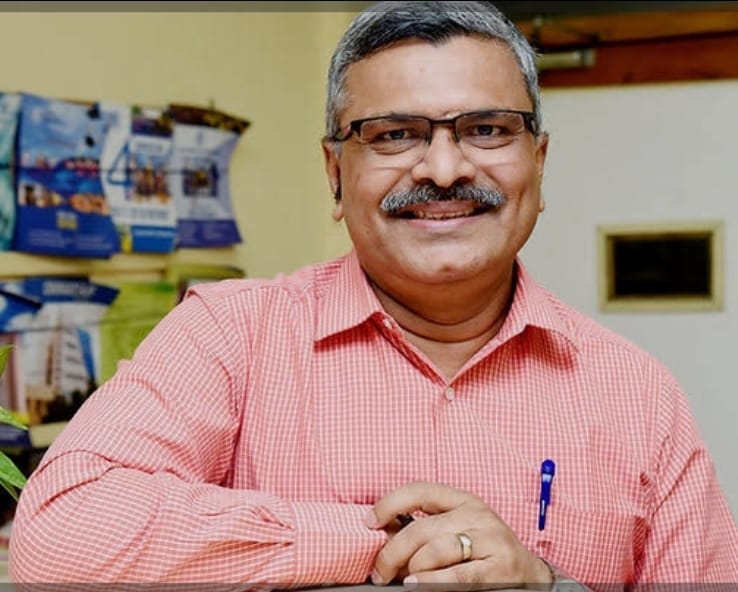
As India’s CSR landscape matures and the country prepares for the upcoming State CSR Conclave, to be Organized by the Interview Times, one truth is becoming increasingly evident: money alone does not create impact—understanding does. In an in-depth conversation with The Interview Times, Dr. Niraj Kumar, Dean – School of Rural Management, XIM University, Bhubaneswar, unpacked the shifting philosophy of CSR, the human capital behind sustainable development, and the deeper crisis quietly unfolding in higher education.
This was not a conversation about theory. It was a conversation about ground reality.

“CSR in India is no longer philanthropy—it has become a business strategy,” Dr. Kumar stated upfront.
What was once cheque-writing has now turned into a compulsory, regulated, boardroom-driven exercise. Compliance opened the doors; strategy entered the room. Yet, something critical is still missing.
“Rural Management sits exactly between philanthropy and strategic investment,” he explained. “It tells corporates what they are doing, where they are spending, and what outcomes they are actually creating.”
In one line, he summarized the shift perfectly:
CSR has moved from emotion to evaluation—but conviction must catch up.
The Real Gaps in Rural CSR Projects
When asked about the biggest implementation gaps in rural CSR projects, Dr. Kumar didn’t hesitate.
The first gap is over-obsession with compliance.
The second is poor problem diagnosis—treating symptoms instead of root causes.
The third is ignoring local institutions—NGOs, SHGs, Panchayati Raj bodies—operating parallelly instead of collaboratively.
And the fourth, often forgotten, is sustainability.
“Most projects don’t ask what happens after we exit,” he said. “They ask whether the report is complete.”
In one sharp line:
CSR fails not because of lack of intent, but because of lack of listening.
Sustainability Is Not About Spending More
One of the most powerful insights from Dr. Kumar was his critique of fund-centric thinking.
“The moment you focus only on funding, you limit your thinking—timeline, scope, ambition.”
Instead, he advocates an outcome-first mindset. True sustainability, he argued, does not come from extending deadlines or overspending budgets. It comes from deep local engagement, institutional partnerships, and respecting local power structures.
His one-liner cuts deep:
Don’t extend projects to justify budgets; design budgets to serve outcomes.
Compliance vs Conviction: The Thin Line Between CSR and PR
Are corporates driven more by compliance than conviction?
“Hundred percent,” Dr. Kumar answered bluntly.
Every CSR initiative begins with compliance. Transformation begins only when conviction follows. Compliance opens the gate; conviction decides how far you walk.
“Compliance plus conviction—that’s where real change happens.”
In business terms:
Compliance keeps you legal. Conviction makes you relevant.
Spend Value, Build Value
If there is one philosophy Dr. Kumar wants CSR leaders to adopt, it is this:
“Move from spending value to building value.”
Targets should not drive CSR—purpose should. When objectives are meaningful, outcomes sustain themselves.
Or as he put it succinctly:
Spend wisely. Build wisely. Value follows clarity.
Speed, Scale, Sensitivity: Sequence Matters
In a world chasing scale and speed, rural ecosystems demand sensitivity. Dr. Kumar sees no conflict—only a sequencing issue.
“Start with sensitivity. If it works, speed it up. Scale will follow.”
Reverse the order, and projects collapse. Get it right, and objectives may be achieved faster than expected.
One-liner for every CSR playbook:
Sensitivity first. Speed second. Scale last—but lasting.
Why XIM University Is a Natural CSR Knowledge Partner
CSR in India, Dr. Kumar believes, has largely been outside-driven. It now needs to become inside-driven—and that is where academic institutions matter.
From diagnostic studies and consumer behaviour analysis to impact assessment, data validation, and social marketing—universities bring intellectual rigour that CSR often lacks.
“Everything corporates need for informed CSR already exists inside academic institutions.”
In short:
Funds create projects. Knowledge creates impact.
Rural Management Students: The Missing Human Link
Perhaps the most compelling part of the conversation was about Rural Management students.
“These students understand what rural India needs,” Dr. Kumar said. “That clarity comes naturally.”
They bring sensitivity, empathy, analytical vigour, field credibility, and exuberance. More importantly, they are the translators between corporate language and rural reality.
They are not interns. They are catalysts.
CSR succeeds when strategy meets sensitivity—and students sit exactly at that intersection.
Rural Immersion, Fellowships, and Scholarships with Purpose
Structured CSR fellowships and rural immersion programs, according to Dr. Kumar, are not just desirable—they are necessary.
XIM University already practices this through its Learning, Living, and Experience (LLE) model. Formalizing such exposure with corporates and government can create powerful ecosystems of learning and impact.
He also advocated corporate-sponsored scholarships for deep rural research—not as charity, but as strategic knowledge investment.
His framing is clear:
Scholarships shouldn’t fund degrees; they should fund discovery.
A Life Chosen by Conviction, Not Convenience
Dr. Kumar’s own journey reflects the values he preaches. An academic by choice, he moved seamlessly from graduation to PhD, driven by one motivation—human interaction.
“I belong in the classroom or training hall,” he said. “That’s my zone.”
For him, education is not a profession—it is a purpose.
Millennials to Gen Z: Information-Rich, Depth-Poor
On the evolution of students, Dr. Kumar offered an unfiltered assessment.
Cognitive ability, he believes, has reduced—and is bound to reduce—due to instant gratification.
AI tools now provide multiple answers instantly. The danger lies not in access, but in absence of inquiry.
“If students ask why behind the AI answers, technology becomes their friend,” he said. “Otherwise, it becomes a crutch.”
Surface-level smoothness hides cognitive hollowness. Retention drops. Thinking weakens.
A line that defines the era:
Technology answers faster than humans think—but thinking still matters.
NEP: A Strong Policy, A Long Transition
On the National Education Policy, Dr. Kumar was optimistic.
“NEP is student-friendly and multidisciplinary,” he said.
Its flexibility—credit transfers, breaks, re-entry—aligns education with real life. But transformation will take time.
“It may take a generation to realize its full intent.”
Policy can enable change. Culture must absorb it.
The Larger Truth
Dr. Niraj Kumar’s insights converge on one undeniable reality:
CSR without empathy becomes accounting.
Education without depth becomes training.
Technology without thinking becomes noise.
As India stands at the crossroads of development and disruption, his message is both timely and timeless:
Real impact is not built by money, machines, or mandates—but by minds that think, hearts that feel, and systems that listen.
— The Interview Times
