
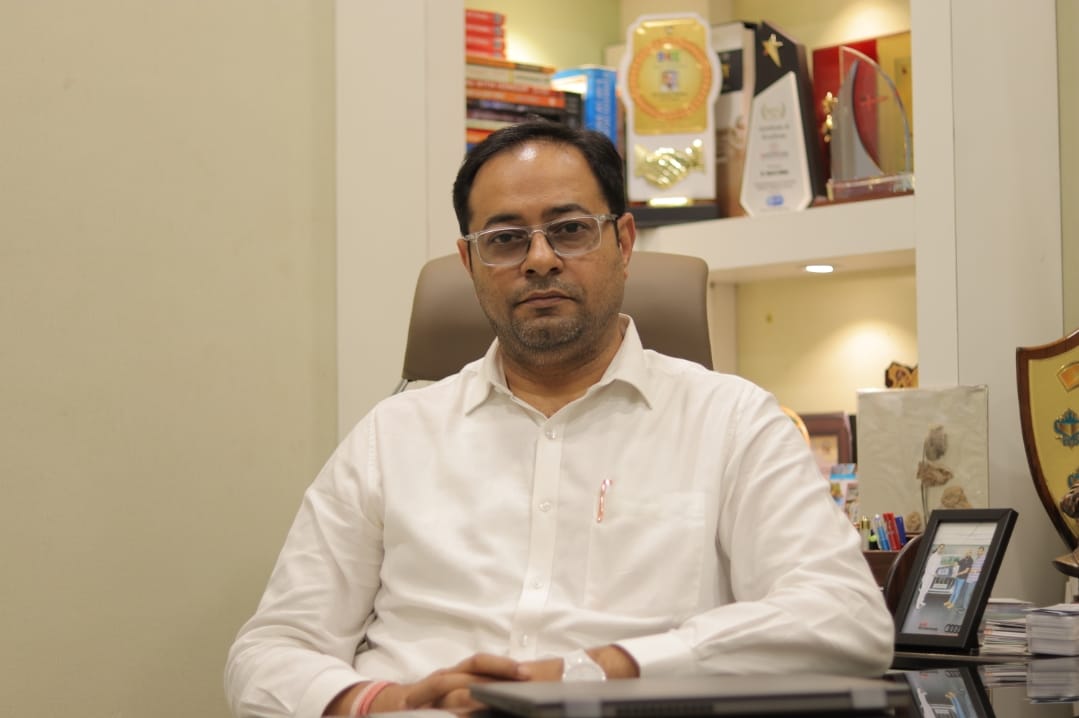

There are people who inherit businesses, and then there are people who inherit responsibility. Dr. Gaurav Ralhan (Adv.) belongs to the latter category — an entrepreneur whose journey has been shaped not merely by commerce, but by grief, observation, instinct, reinvention, and an unusually deep understanding of human behaviour. His rise in Odisha’s business landscape did not emerge from startup incubators, management schools, or investor ecosystems. It emerged from emotional upheaval, relentless curiosity, and the ability to identify opportunity where most people only saw uncertainty.
Born into the family behind Premier Surgicals, Gaurav grew up around enterprise, discipline, and customer trust. His father, Mr. Sudesh Kumar Ralhan, and Bade Papa, Mr. Vijay Kumar Ralhan, had already spent decades building credibility in the medical and surgical trade. Even today, despite being in their seventies, both continue to work with remarkable energy and discipline. The values of consistency, ethics, and customer relationships were deeply embedded into Gaurav’s upbringing long before he entered business himself.
Yet despite belonging to an established business family, his transition into entrepreneurship was far from comfortable. In 2002, Gaurav lost his mother, Neelam — a loss that profoundly altered the course of his life. The emotional impact was devastating. He has often spoken about how the tragedy interrupted his academic rhythm and created a phase where he genuinely believed his education and direction in life had come to an end. The grief was not temporary; it reshaped his emotional foundation. Even today, while speaking about her, there is a visible shift in his voice and thought process.

After eventually completing his graduation in 2003, Gaurav assumed he would naturally enter the family business. Instead, his father took a completely different approach. One morning at the breakfast table, he handed Gaurav a cheque worth ₹15 lakh and told him to build something independently. At a time when ₹15 lakh represented an enormous amount for a young graduate, the gesture carried both trust and pressure. There was no business model attached to the cheque, no detailed roadmap, and no safety net. The message was simple — discover your own path.
Initially, Gaurav purchased a commercial space in a newly developing retail property but found himself paralysed by uncertainty. The mall developers expected a premium brand to anchor the location. Friends questioned his choices. Self-doubt began taking over. At one point, overwhelmed by pressure, he emotionally admitted to his father that he did not think he could continue.
The advice he received changed the direction of his life.
“Travel.”
His father asked him to travel across India before taking any decision. He was told to observe people, understand markets, study consumer behaviour, and discover what excited urban India. That journey became his real entrepreneurial education. Gaurav travelled through Chennai, Bengaluru, Mysore, Mumbai, Delhi, and Kolkata, closely observing retail environments, colours, branding, pricing psychology, and lifestyle aspirations.
Among all the experiences he encountered, one brand remained fixed in his memory — Baskin-Robbins. It was not merely the product that fascinated him, but the psychology behind the brand. At a time when a double scoop ice cream in Bhubaneswar cost approximately ₹20, Baskin-Robbins was comfortably selling a single scoop for ₹55. That difference revealed something important to him: customers were willing to spend significantly more for aspiration, experience, perception, and emotional value.
In 2004, Gaurav brought Baskin-Robbins to Forum Mart in Bhubaneswar. Expectations were modest. Even company representatives reportedly believed that the outlet would struggle unless it achieved daily sales of ₹2,000 to break even. What followed surprised everyone. On the very first evening, the outlet generated nearly ₹18,000 in sales within six hours. The following day crossed ₹32,000. The success was so unexpected that the family reportedly reopened the cash counters late at night just to verify the figures.
Within a short period, the store transformed into far more than a retail franchise. It became a cultural symbol in Bhubaneswar’s changing urban identity. For an entire generation in Odisha, Baskin-Robbins represented aspiration, celebration, dating culture, premium lifestyle, and modern city experience. People from influential families, corporate circles, and elite social groups frequented the outlet regularly. For nearly a decade, the Forum Mart outlet remained the highest-selling Baskin-Robbins outlet in India, competing directly with major metropolitan markets and large-format malls across the country.
The success fundamentally changed Gaurav’s public identity. He was no longer simply the son of an established business family; he became recognised as a businessman capable of understanding consumer aspiration before the market itself fully evolved. Yet what distinguished him most was his refusal to remain confined to a single successful venture. Instead of repeatedly replicating the same model, he began exploring sectors that appeared completely unrelated — healthcare systems, garments, wellness infrastructure, sustainability, environmental engineering, public utility projects, and eventually law.
His exposure to medical systems through family business networks and healthcare collaborations gradually deepened his understanding of public health beyond conventional commerce. Over time, he worked closely with doctors, innovators, researchers, and institutional systems. One of the most significant influences during this period was his interaction with Dr. Jayanti Pradarshi, a leading expert in sleep disorders and sleep medicine in Odisha. Gaurav often acknowledges that many doctors and innovators trusted him not merely as a businessman, but as someone genuinely interested in creating meaningful systems.
This phase eventually led to the creation of Health on Top in 2021. The philosophy behind the organisation extended beyond healthcare alone. Gaurav envisioned a platform that addressed both human wellbeing and environmental sustainability simultaneously. The name itself reflected that vision — health not merely for individuals, but also for the environment and society at large.
The timing of the launch was extraordinary. India was entering one of the most difficult phases of the COVID-19 pandemic. Markets across the country were witnessing panic-driven pricing and widespread profiteering in healthcare supplies. At a time when N95 masks were being sold at ₹300 to ₹500, Health on Top sold them at near-cost pricing. Basic masks that had become symbols of scarcity elsewhere were sold affordably. For Gaurav, healthcare during a crisis could not become an instrument of exploitation. That principle became foundational to the organisation’s identity.
Over the years, Health on Top expanded into multiple verticals including sustainable infrastructure, solar-wind hybrid systems, rainwater harvesting, automated sanitation systems, green terraces, public utility technologies, and environmental waste management solutions. The company became actively associated with projects related to legacy waste management and environmental sustainability. It also expanded beyond Odisha and entered procurement ecosystems in countries such as South Africa, Malaysia, Tanzania, Zimbabwe, and Kenya. What began as a regional initiative gradually evolved into a globally connected sustainability and healthcare platform originating from Bhubaneswar.
One of Gaurav’s strongest beliefs is that business must remain socially responsible even while being commercially ambitious. He openly describes entrepreneurs as opportunists — but quickly adds that opportunity must always be balanced with responsibility. His approach towards crisis management during COVID became an example of that philosophy in practice.
Yet perhaps the most unexpected chapter of Gaurav Ralhan’s journey came much later in life. After already establishing himself as a successful entrepreneur, he decided to enter the legal profession. Under the mentorship of Mr. Bibhu Prasad Tripathy, Gaurav pursued legal studies and formally stepped away from several directorships and partnerships to train seriously in law. Today, he works in areas such as corporate law, partnership disputes, property law, and emerging frameworks related to GDPR, Digital Personal Data Protection, and compliance systems.
This transition reveals an important aspect of his personality — success never appears to have reduced his curiosity. Instead, every achievement seems to push him toward newer areas of learning and responsibility. Throughout his life, one recurring influence remains impossible to ignore: his extraordinary respect for teachers, mentors, and parental figures. He frequently speaks about educators with the same emotional intensity with which he discusses business.
At one stage during his school years, Gaurav scored very poorly in his pre-board examinations. One of his teachers, Mr. Nirmal Rath, reportedly began waking up at 4 a.m. every day to personally tutor him before school hours. Weeks later, Gaurav scored 78% in the final examinations. Gaurav also emotionally remembers his teacher Mrs. Ferat Ahmed, who read course books aloud to help him regain confidence and succeed in his board examinations. Those experiences left a permanent impression on him and shaped the way he values mentorship even today.
Even now, the emotional centre of his entrepreneurial universe remains his mother, Neelam. The umbrella identity behind several of his ventures continues through “Neelam’s Lifestyle,” a name that reflects not merely remembrance, but emotional continuity. For Gaurav, business has never been only about financial growth. It has also been about gratitude, memory, purpose, and responsibility.
In an era dominated by polished startup language, valuation-driven narratives, and carefully manufactured founder personalities, Dr. Gaurav Ralhan’s story feels strikingly human. It is emotional, instinctive, commercially sharp, spiritually grounded, and deeply shaped by lived experiences. His journey demonstrates that entrepreneurship is not always born inside boardrooms or business schools. Sometimes, it is born from grief, from observation, from travel, from mentorship, and from the quiet determination to create something meaningful in the face of uncertainty.
