
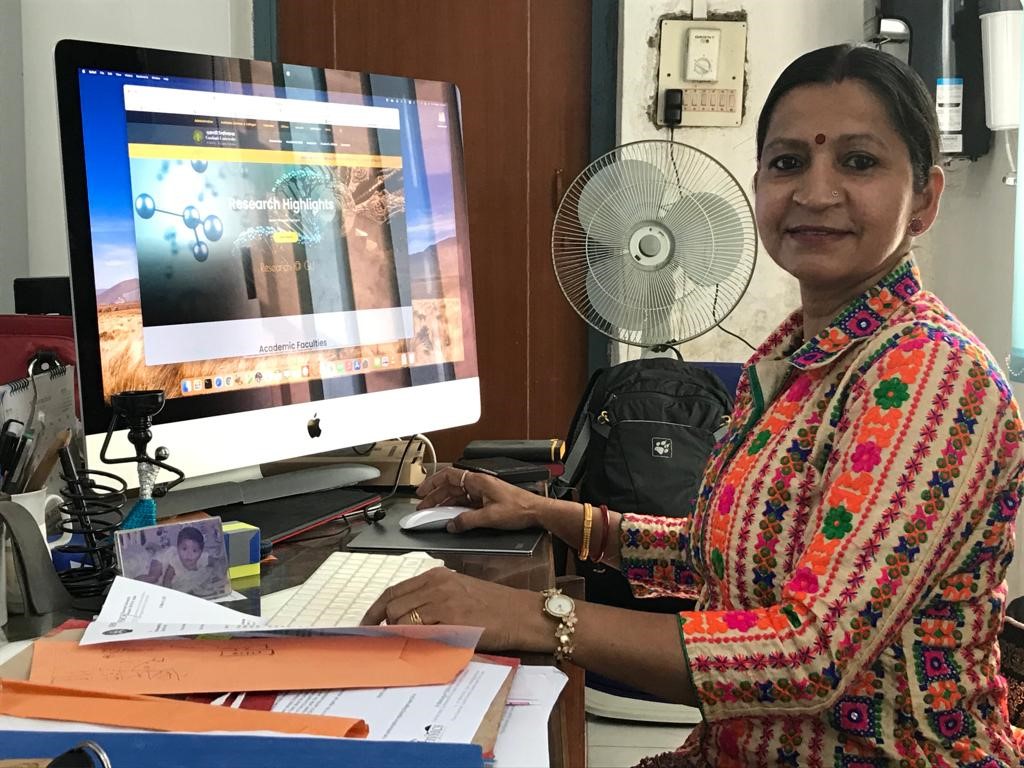
Allow me to introduce Dr. Kalpana Bora, a distinguished female presence in the world of academia, hailing from the vibrant city of Delhi, and now settled in Guwahati, Assam. As a revered Professor in the Physics Department at Gauhati University, Guwahati, her intellectual contributions are as profound as her passion for nurturing young minds. With a remarkable solo book titled “My India, My Story,” she seamlessly intertwines her expertise in physics with her deep reverence for India’s heritage, traditions, and cultural values. Beyond the lecture halls, she finds solace in music, dance, and exploring new horizons through travel. Dr. Bora’s commitment to both her field and her country is evident in her role as an educator, a firm believer in India’s potential as a global leader, and a torchbearer of its timeless wisdom.
Q1. Can you share the inspiration behind your solo book “My India, My Story”? How did your background as a Physics professor intersect with your desire to delve into India’s traditions and cultural heritage?
Ans 1- The inspiration behind writing my debut book “My India, My Story” is my country, its cultural heritage and traditions, and my upbringing by my parents in Delhi. It is a tribute to the people of my country. I came to Assam after my marriage and settled here. As I am a teacher, I felt there is so much I could share with students and youth, and even parents. My experiences in Delhi during my education, and with some of the best educational Institutions across India and abroad that I got opportunity to visit, and the way my parents brought us up – constitute different pages of story of my life. And hence, the idea of writing this book was born in my mind, during COVID19 lockdown. Whatever I have achieved in my life today is only due to inspiration and support of my parents, my hard work, dedication, sincerity and perseverance, and I have built my career from scratches. And today, I am a happy and sensitive citizen of my India, successful in my career, so thought of sharing my story with students and parents, which could serve as life-lessons for them.
I feel, since my parents raised us following the Indian traditions and cultural heritage, I fell in love with their values, depth and wisdom, and even as I studied Physics, I gradually became even more passionate follower of them, as I could perceive the connections between science and traditions and culture in a transparent way. Being a student of Physics, I could see the logic behind how our parents brought us up and what they used to tell us in our daily lives.
Q2 – Your book seems to bridge the worlds of science and culture. How do you believe your scientific knowledge enhances your exploration of India’s ancient wisdom, and how do these aspects come together in your book?
Ans 2- Culture of a region/country is nothing but the food habits, way of living daily life, celebration of festivals, set of rules of society etc. The wisdom, values, scientific knowledge of ancient India, and their depths and areas imbibed into our ancient Indian scriptures, epics, four Vedas, Puranas, Vedanta etc, was a culmination of research of thousands of years done by our Sages, Rishi-Munis and other people. All this has a strong scientific base, as our Sages, Rishi-Muni were great scientists of their times. This knowledge has been a treasure house for the whole world since ages. Our life style, traditions, culture, everything is based mostly on Vedas, Puranas, Gita, Ramayana, Arthshastra etc. And being a scientist, I have always tried to see the science behind our traditions, festivals and culture. Since it would not have been possible for common man to understand these scientific explanations, hence they took the form of customs, such that it is easier for everyone to follow them. I feel proud that I was raised following these by my parents, and hence I penned them down in my book, and their elements can be found at many places traversed across many chapters.
Q3 – As a Professor in the Physics Department at Gauhati University, you’ve had a profound impact on students’ lives. How does your teaching philosophy align with your vision of a prosperous and culturally enriched India?
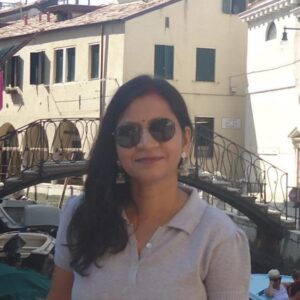
Ans 3- I have always lived my life, following Indian culture and traditions and understanding the science behind them, and it is also reflected in my lifestyle, personality and attitude. Though I do occasionally do wear western outfits like jeans, skirt etc also (during travel or family outings, always with Sindoor and Bindi), I am very proud of ancient India’s scientific and cultural heritage, her prosperity, as we were known as “Sone ki chidiya (golden sparrow)”. And, we know it very well that students are inspired by the personality of their teachers. In classrooms, I not only impart knowledge related to syllabus of Physics, but also talk sometimes about value education, potential of youth of our country and their role in making India a prosperous and culturally rich India. With my students, I engage in conversation related to what they want to do in their life and career, and also that however technologically advanced we may become, we should never forget about our roots, and pride of our Bharat should always be held high. I have mentioned in my book (though I am not an expert in this field), the scientific heritage of ancient India, and I do speak sometimes about them in my classroom as well.
Q4 – “My India, My Story” suggests a deeply personal connection to the country. Could you elaborate on the stories or experiences from your own journey that have contributed to your perspective on India’s potential as a global leader?
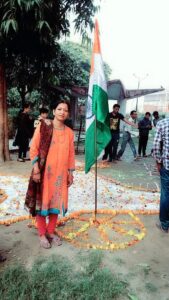
Ans 4 – I hail from a very humble family in Delhi, my father has been a school teacher (and then Principal) of Govt. school, and mother was a house wife. We were a big family, and didn’t have lot of money then, but we lived a healthy and happy life. Quality of life that my parents gave us was good I must say. With that background, I could get a CSIR JRF/NET fellowship, I could get admission into IISc Bangalore for regular PhD programme in Physics, I visited Italy, USA and Singapore for academic purpose, I have written many research papers in International and Scopus indexed Journals. My brother is IITB graduate, and keeps visiting Japan as a part of team of Maruti company. All this is from the story of my life. Two of my sisters are also Assistant professors in colleges in Delhi. Moreover, I find so many Indians are doing excellent in various fields all across the world. So many top positions today, in various tech companies as well as political positions are being held by Indians or persons of Indian origin. Though our country faces several problems like poverty, corruption etc, still we did fairly well during tackling of COVID19 pandemic as well during global economic slowdowns. All these big happenings are sufficient to make me perceive that my India has huge potential to become a global leader. And I feel we are yet to tap our potential, the potential of our youth in rural and far away places, and if we could narrow down the bridge among the poor and rich, we can do wonders. It is irony that a huge chunk of our wealth is owned by a handful of very rich people.
Q5 – You mentioned being a follower of ancient Indian knowledge and value systems. How do you think these traditions can be harmonized with modern advancements to create a stronger future for India?
Ans – A very interesting question, the answer to which is so close to my heart! As I mentioned earlier, our ancient Indian knowledge system, traditions, customs and culture, has a strong scientific base, the scientific explanations of which may be different from modern science. For example, our “devtas” used to live in heaven, and they used to age slower than people living on earth. This is nothing but time dilation due to relativity in modern Physics. We had “Brahmastra” which could be compared to today’s nuclear weapons. So many demonstrations of science can be found in our ancient scriptures, which have their parallels in modern science. I have explained in my book, many of our traditions that we follow in our daily lives, have scientific explanations. I feel deeply pained when our youth make a mockery of these old-age traditions and customs, without understanding the logic and science behind them. Anything western is good for them, while now the West is following our principles like Yoga, vegetarianism, etc. True, we have to move ahead with modern scientific and technological advancements, but why forget our roots and traditions and culture? We can follow a perfect fusion of both, making an aesthetic balance between the two, and that will make us unique, that will give us our identity, of being proud “Bharatiya”. Our food habits, our attire, our languages, our festivals, everything is so beautiful, why should we forget them, as these make us special and make us stand apart in the crowd. I believe our youth is so talented, they can bring a perfect harmony between the two, and it is parents’ duty to keep them in touch with our culture and traditions. This will definitely give us an extra edge over other citizens, since now is the era of global citizen, as truly said in our scriptures – “Vasidhaivam Kutumbakam”.
Q6 – Balancing a demanding academic career with writing can be challenging. How did you find the time and mindset to write a book while continuing to excel as a professor and researcher?
Ans 6 – Well, I have mentioned in the prologue of my book that I had the urge of writing a book in which I would share the experiences of my life with students and youth, however, I could get this opportunity only during COVID19 pandemic. During lockdown, I started writing down the experiences of the pandemic, and then slowly, I thought, it could take shape of a book if I could add some more content to it. And then, I kept on adding more and more content to it, and yes, I have worked hard to compete the book. It took almost three years to finish writing the book, and I used to work extra hours for the purpose, stealing some time in between my busy schedule of academic career as well taking care of my children. It is rightly said – “where there is a will, there is way”. And I must thank my wonderful publishing team – Lalitha Ravindran, Puja Gupta and Deepthy P. Nair, who have contributed immensely in making this possible. With their creative inputs and suggestions, my text was shaped into the beautiful book that has been published. Specially Puja has worked really hard and gone out of ways to listen to my last minute changes and feedback. Hats off to the entire Team. And of course, unconditional, continued support from my Husband and children has been the driving force and my strength during the whole course of writing the book.
Q7- Your hobbies include music, dance, and travel. How have these pursuits influenced your writing and your understanding of both physics and culture?
Ans 7 – Listening to music gives solace to the mind, body and soul, it helps release your stress. Our India has so rich heritage of music, I feel truly fascinated by the richness, depth, diversity and beauty of Indian classical music. My daughter has learnt Bharatnatyam and Sattriya dances (two of the eight Indian classical dances), and twin sons are learning Indian classical vocal music. I always sit with them while they practiced, and hence got a flavour of all of them. Moreover, we grew up listening to songs on radio channel Vividh Bharati during my childhood in Delhi. In the journey of my life so far, I happened to travel a lot as well. When you visit different places, you get to learn about the people, food, life style of that place. During childhood, my father took us to all India tours on LTC, and I got an opportunity to learn about the diversity present in my India, about its people, and more I got fascinated by my country. This has helped develop my personality, my perspective about life, our country, and its amazing how people in my India keep on living life so lively, with zeal, and with so much of hard work, inspite of so many problems. This has inspired me a lot, and has ignited desire in me to do something for my country. And I guess this book is a small step towards that, I wanted to give tips to students for how to become successful in career, how to study well, be happy and keep healthy naturally. In the dances and songs of India, we can find elements of our culture and life style as well, which are reflected in my writings as well.
I got an opportunity to visit some of the best educational Institutions in India as well as abroad, and meeting world class International physicists has definitely enlightened my knowledge of physics. It has helped me to give a platform to interact with them, and be updated with latest research in the field, as well broaden my knowledge base of physics. When we interact with leading scientists, it helps cultivate new ideas. And that’s how travel has helped me in physics.
Q8 – Can you share an anecdote or a memorable interaction with a student that reflects the impact of your teaching and your broader message of embracing India’s rich heritage?
Ans 8- When my research computer laboratory was inaugurated, my PhD students arranged a small function on other own, with small Puja ceremony and prasad arrangements. That has been a memorable experience. Again, students gifted me a small idol of Lord Ganesha, flower pots, and earthen lamps on my birthday, it really touched me. Recently, a student of our department, who has become an official at a bank in Assam, complimented that “ma’am you have been a very caring teacher”, I felt so happy knowing this.
Q9 – Your belief in India’s potential to become a world leader is inspiring. What specific steps do you envision, both within and beyond academia, that could contribute to this goal?
Ans 9 – A very important question indeed. We have the potential, but we are yet to tap it fully. Within academia, first thing is we need is to revamp our whole educational system. NEP2020, the new National Educational Policy has been launched recently in the country, and if it can be implemented successfully across the country, it would be great step towards making India a world leader. However, it is a mammoth task, and its loopholes, if any, will come to light slowly as it is implemented. After independence, we have been carrying the burden of an educational policy that was in line with British Raj, which was designed to produce clerks for the British. Main focus has been on marks, rote learning so far. Less emphasis was given on practical applications, free and critical thinking and acquiring skills. Seven and a half decade with that education policy, has made us crippled. We have so many educated unemployed youth. Hence, to me, if we can revamp our educational system, it would be a giant leap towards our goal. Intensive teacher training is required. Unless we train our teachers properly and unless we change the evaluation/assessment methods of our examinations, we won’t get desirable results. A lot more funding from the Government is needed in our education sector. We need to pay attention on holistic development of our children in schools and colleges.
Corruption need to be reduced. People should understand the importance of, and should adopt, work culture. Acadedmia-polity collaboration needs to be increased as well.
Beyond academia, I feel community service is the need of the hour. We need to connect our students with communities. We need to bridge the gap between classrooms and communities. Parents need to spend more quality time with their children. A matter of grave concern is growing drug abuse and drinking habits among our youth, and I believe if we can reach out to communities, this problem could be tackled up to some extent. At least some amount of research need to be community-need driven. What is the advantage of research if it can’t be utilised for the benefit of people around?
All of us should keep our Nation and Institution above self-interest.
When all the above mentioned traits will be acquired by our citizens, no power on earth can stop us from becoming a world leader. And our culture, wisdom and ancient Indian knowledge system is our unique asset, we should not forget it. That will add to our strength.
Q10 – In a rapidly changing world, how can education, scientific inquiry, and cultural appreciation collectively shape a brighter future for India and its global influence, as you envision?
Ans 10 – Education makes a Nation. It enlightens people’s minds, personality, helps us keep updated with latest developments going on across the world. Education should be such that it takes care of all-round, holistic development of the child, as children are the future of a Nation. Moreover, I think, one can’t separate culture from science. My identity as an Indian affects my scientific temperament too. Of course, fundamental science is universal and absolute, but then as I mentioned earlier, our ancient India was highly advanced in the field of science and technology. A culture determines the traits, personality, intellectual capability and personality of citizens of a Nation. We Indians are hard working by nature, and we now how to pull on somehow, under adverse situations. We are expert in Jugaad (it has positive aspects too), but we had to strive when we were being ruled by so many invaders, be it Mughals or the British. Since ages, our Rishi-Munis and their pupils in Ashrams used to memorise and recite Sanskrit Shlokas and Mantra by heart, and hence, our memory is very sharp and Indians are generally good in mathematics. This is a part of our culture only. At the same time, we are also inflicted by genuine problems like corruption. So, I believe, if we can revamp our educational system, and if we are able to ignite innovative, free, critical thinking among our children and youth, it can definitely help make India a global leader. And today, we have reached at such a stage that the whole world looks up to us, as we are a growing economy, we are a young Nation. We have given solutions to so many problems to the world, be it vaccination, software technology, agriculture, space technology. So, what India does, influences the world as well. And if above mentioned corrective measures can be taken, India has a bright future.
Q11 – Your dedication to both academia and cultural heritage is admirable. What advice would you give to young professionals aspiring to balance their careers with their passions and societal contributions?
Ans 11- Well, it is a very difficult question to answer, but still, I would try to answer it from my perspective. I am proud of my upbringing by my parents, the ambience in my house was very down to earth, we have been always very close to our roots. My parents, grandparents, and other elders, all have immense contribution towards the development of my personality. And of course, my own convictions, judgement, attitude, temperament also have their chunk of contribution towards how could I manage all this. More details are there in my book. However, I can say, always keep faith in your values, roots, culture, and God. I am not a workaholic person who is just concerned about my career, but, I am a hard working soul. I left IISc Bangalore (I was doing PhD there), for the sake of my family in Assam. To me, money has never been that important. Of course duty is top priority, but then, my children have been equally important to me. I would work during extra hours for my career, but never compromised with the quality time for my children. And I am a very optimistic person. I guess, faith in God and myself, following our traditions, Indian values, and giving top priority to my children have helped me achieve what I have so far in life. Even when I wear Jeans or western dress, I always wear sindoor and Bindi, as I want to show it explicitly, as I love my culture and my India. And I aspire to do community work as well, in the years to come.
